
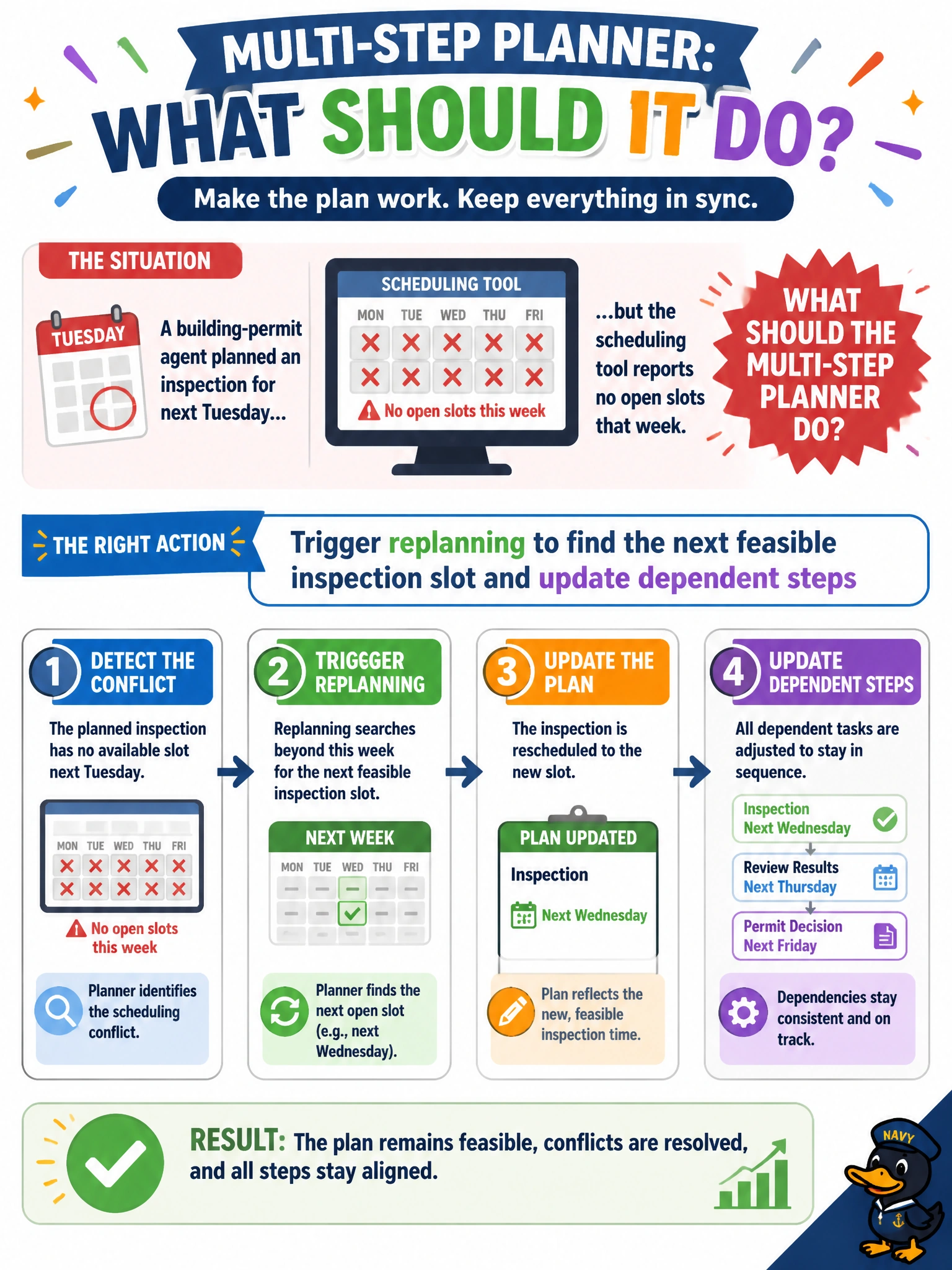
A building-permit agent planned an inspection for next Tuesday, but the scheduling tool reports no open slots that week. What should the multi-step planner do?
Select an answer to reveal the explanation.
Short Explanation
Think of it like a road closed on your commute—you don’t pretend the street still works; you reroute. When the inspection slot vanishes, the planner should replan: pick the next real opening and reshuffle anything that depended on Tuesday.
Full Explanation
Adaptive multi-step planning for municipal workflows must treat scheduling capacity as a live constraint, not a static assumption. When a building-permit agent’s planned Tuesday inspection collapses because the scheduling tool reports no open slots that week, the correct response is to trigger replanning: search for the next feasible inspection slot and revise every dependent step (notices, fee holds, follow-up inspections) so the plan remains internally consistent with available city capacity. Replanning preserves the resident’s permit goal while replacing an infeasible Tuesday commitment with an executable sequence grounded in real tool output.
Inventing a fake confirmation number while keeping the original Tuesday goal is operationally and ethically wrong: it fabricates municipal evidence, misleads the resident, and creates audit and liability exposure when the inspection never occurs. Abandoning structured planning for unstructured free-text chat discards dependency tracking, precondition checks, and auditability that permit workflows require under high concurrency. Deleting the permit application from long-term memory does not resolve the slot conflict; it erases civic case continuity and forces rework or loss of applicant context.
Exam caveat: replanning is not the same as blindly retrying the identical Tuesday goal—feasibility must change. Operational check: after replanning, confirm the new slot is written back to case state, dependent tasks are rescheduled or cancelled, and the resident receives an accurate confirmation that matches the scheduling system—not a fabricated token.