
A business-license agent must not skip tax clearance. What planning strategy enforces that gate?
Select an answer to reveal the explanation.
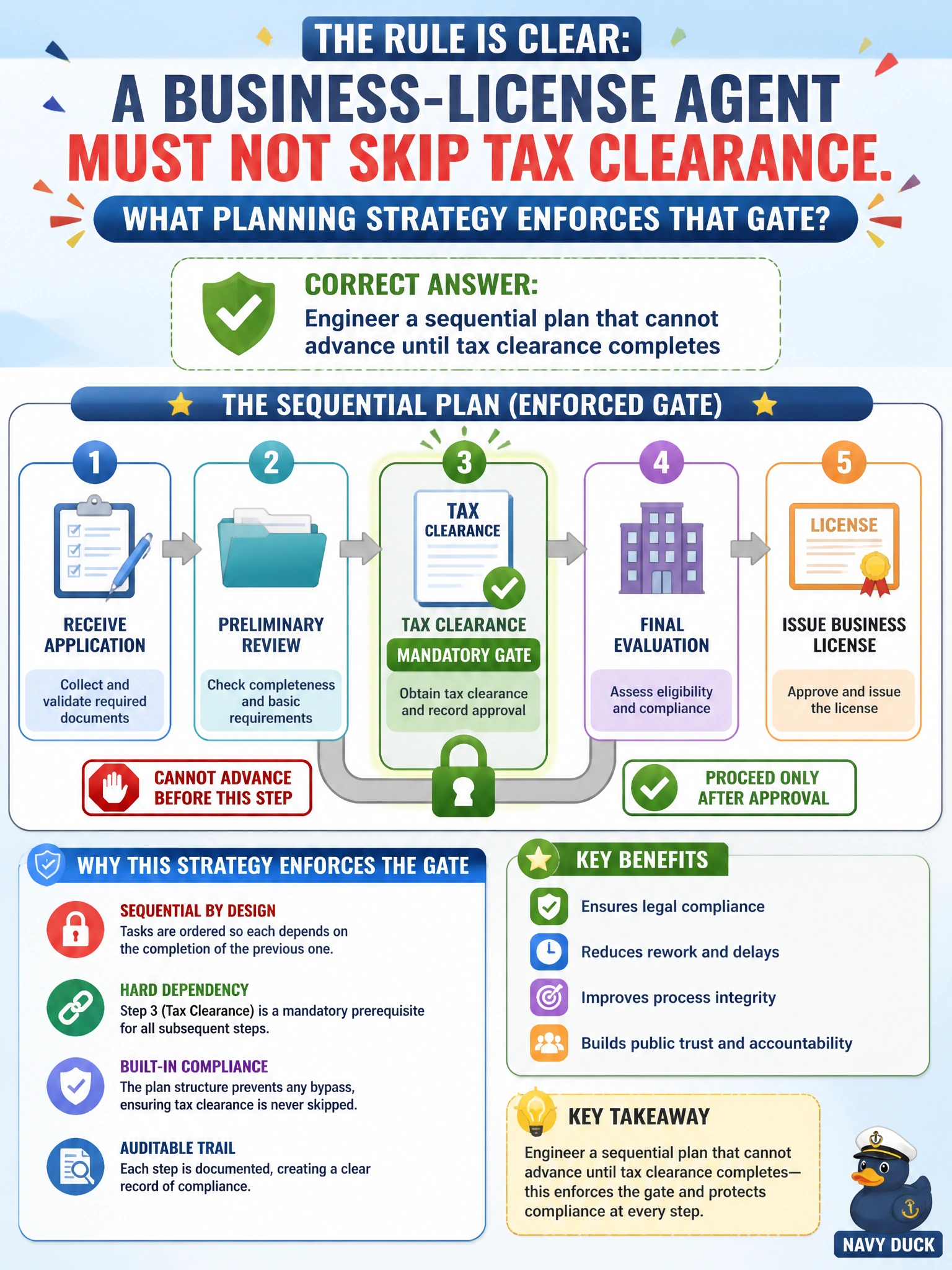
Short Explanation
Tax clearance is a locked gate on the license path—not optional flavor text. Build a sequential plan that refuses to move forward until clearance finishes. Random step order and queue-based skips break municipal rules.
Full Explanation
A business-license agent must not skip tax clearance, so the planning strategy is to engineer a sequential plan that cannot advance until tax clearance completes. Sequential (gated) planning encodes hard prerequisites: identity verification, tax clearance, fee payment, then license issuance. Soft suggestions are insufficient for statutory gates; the planner must treat clearance as a blocking stage with verified tool results before subsequent steps unlock. This prevents premature approvals that create compliance and revenue failures for the city.
Allowing the agent to invent a random order of steps each time fails conceptually because nondeterministic ordering can bypass mandatory gates. Skipping tax clearance whenever the queue looks long fails because operational backlog does not waive legal prerequisites. Treating tax clearance as optional flavor text in the welcome message fails because informational copy is not an enforcement control in the plan graph.
Exam caveat: the gate must verify clearance via authoritative finance/tax systems, not via the model’s belief that clearance occurred. Provide resident-visible status when blocked, and define exception paths only through authorized human override with audit logs.
Operational check: implement a sequential state machine with a hard tax-clearance precondition, attempt to force skip in tests and confirm the agent refuses, and audit production paths for any licenses issued without clearance evidence.