
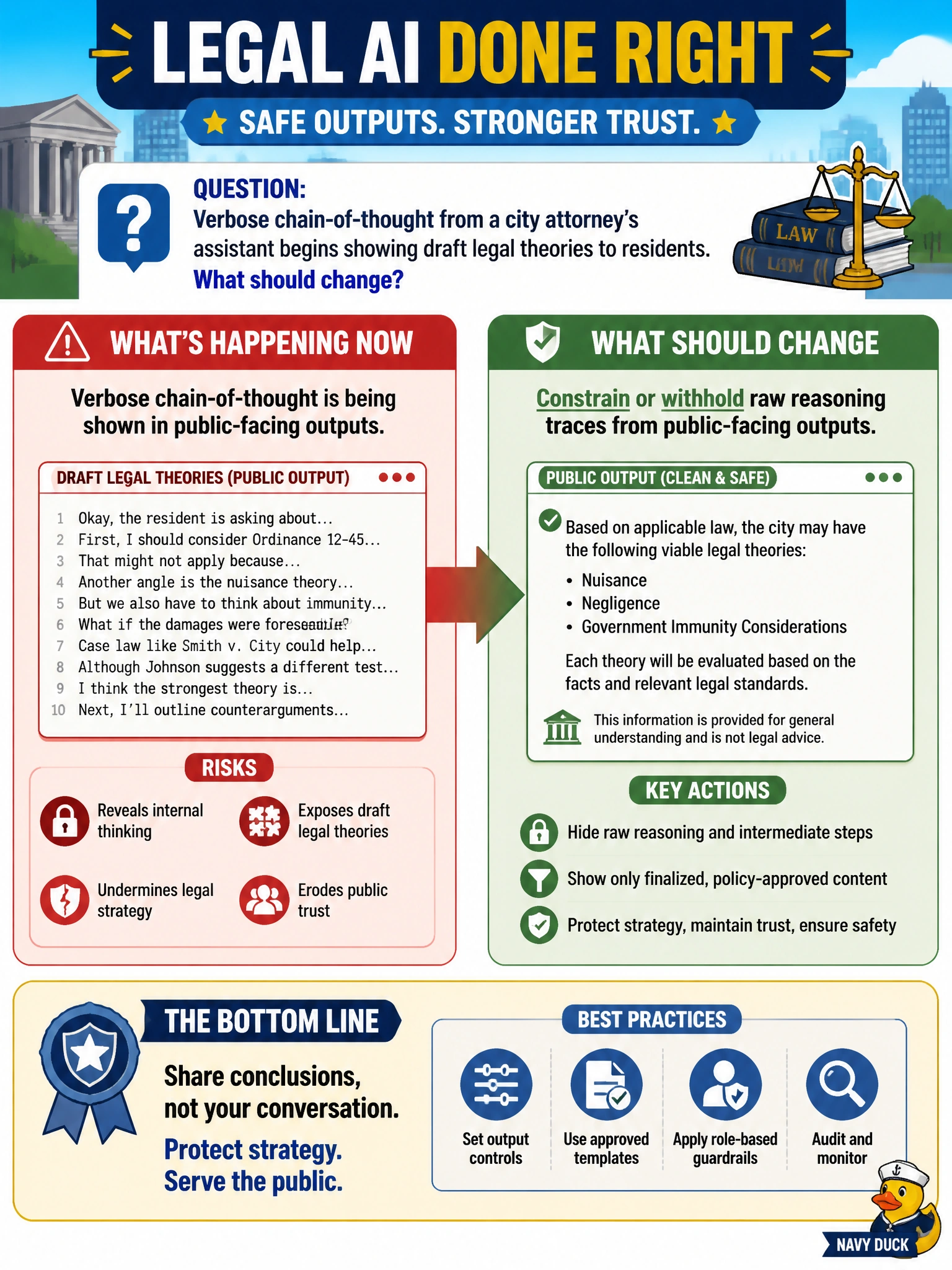
Verbose chain-of-thought from a city attorney’s assistant begins showing draft legal theories to residents. What should change?
Select an answer to reveal the explanation.
Short Explanation
Draft legal theories aren’t hallway chatter. Clamp down so raw CoT doesn’t spill to residents—more verbosity and public packets make the leak worse. Constrain the trace; keep the public answer clean.
Full Explanation
When verbose chain-of-thought from a city attorney’s assistant begins showing draft legal theories to residents, the change required is to constrain or withhold raw reasoning traces from public-facing outputs. Draft legal theories are privileged, incomplete, and potentially harmful if published mid-reasoning. Public channels should receive carefully reviewed guidance, not the model’s internal deliberation. Constraining traces protects privilege, reduces confusion, and aligns with professional responsibility norms for municipal legal assistance tools.
Increasing verbosity so every internal doubt is published fails conceptually because it enlarges the leak and amplifies uncertainty as if it were advice. Requiring residents to approve each intermediate legal hypothesis fails as an unusable process that still exposes draft theories. Storing unfiltered CoT in the public meeting packet by default fails because public records packaging would institutionalize disclosure of non-final legal analysis.
Exam caveat: withholding raw CoT does not eliminate the need for accurate, citable public answers and proper attorney review workflows. Logging of traces for internal counsel may still be appropriate under access control.
Operational check: set output filters/policies that strip or summarize reasoning for resident channels, add regression tests that fail if draft-theory markers appear publicly, and route full traces only to authorized attorney review systems.