
A storm-response agent must restore service. Which reasoning pattern structures the work?
Select an answer to reveal the explanation.
Short Explanation
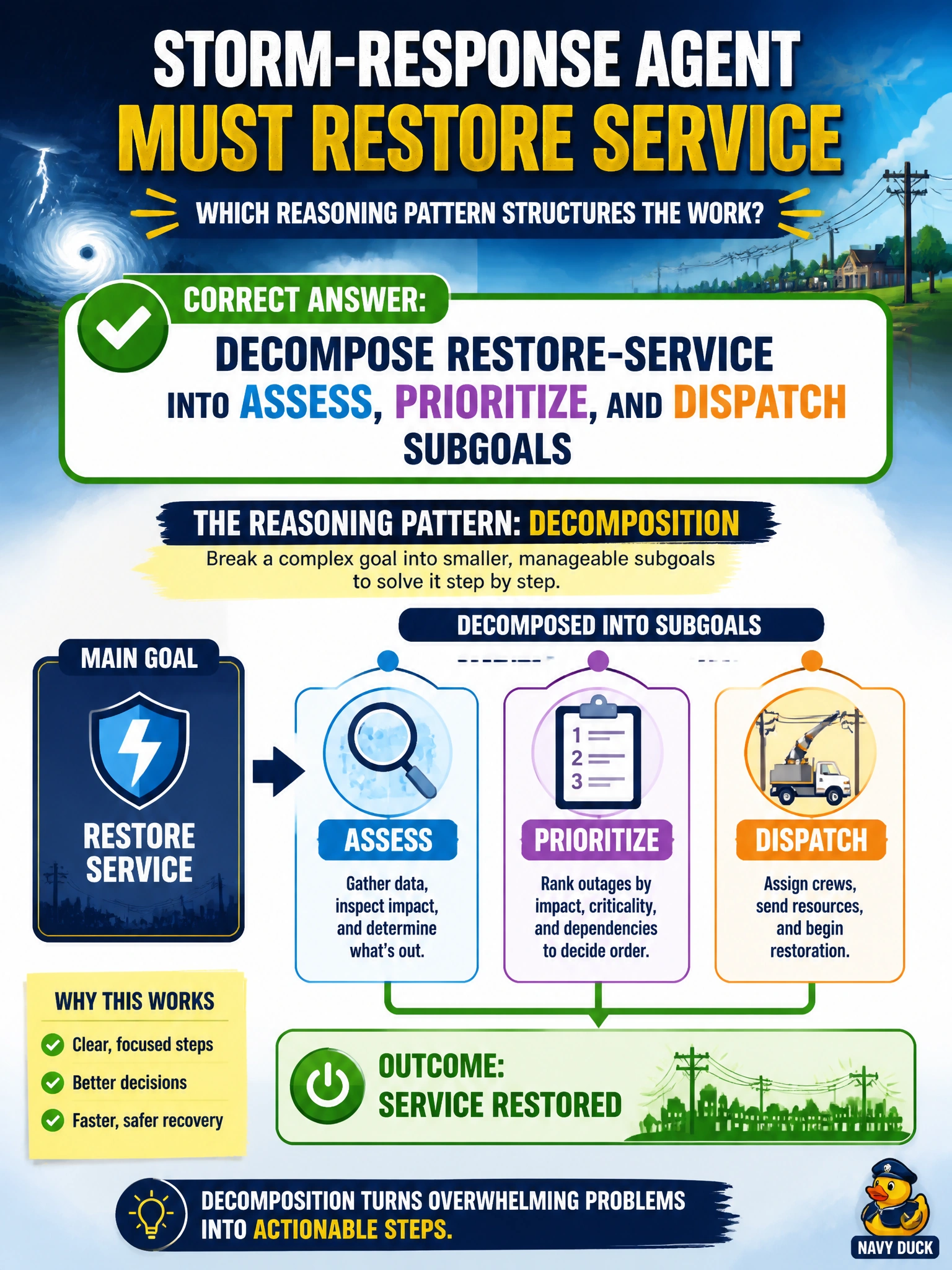
Storm work isn’t one magic leap—assess, prioritize, then dispatch. Hierarchical subgoals keep emergency agents from guessing. Random crews and posters don’t restore service.
Full Explanation
A storm-response agent tasked to restore service should structure work by decomposing restore-service into assess, prioritize, and dispatch subgoals. Hierarchical goal decomposition matches emergency operations: assess damage/outages, prioritize by life-safety and critical infrastructure, then dispatch crews. Opaque single-leap “restore everything” reasoning skips triage and misallocates scarce municipal resources during storms.
Treating restore-service as one opaque leap with no subgoals fails conceptually because complex emergency goals require intermediate control points and evidence. Ignoring assessment and dispatching randomly to any crew fails because random dispatch wastes capacity and can delay critical sites. Only writing motivational posters until power returns fails because messaging is not operational restoration—though communications may be a parallel track, it is not a substitute for assess/prioritize/dispatch.
Exam caveat: decomposition must integrate live OT/IT telemetry and EOC priorities; agents assist operators and must not unilaterally override emergency command protocols. Subgoals should be interruptible as conditions change.
Operational check: encode assess→prioritize→dispatch as explicit plan stages with required inputs, simulate a storm scenario, and verify crews are assigned by priority rather than random or slogan-driven behavior.