
Fee-logic agents need chain-of-thought internally. How should that reasoning appear to residents?
Select an answer to reveal the explanation.
Short Explanation
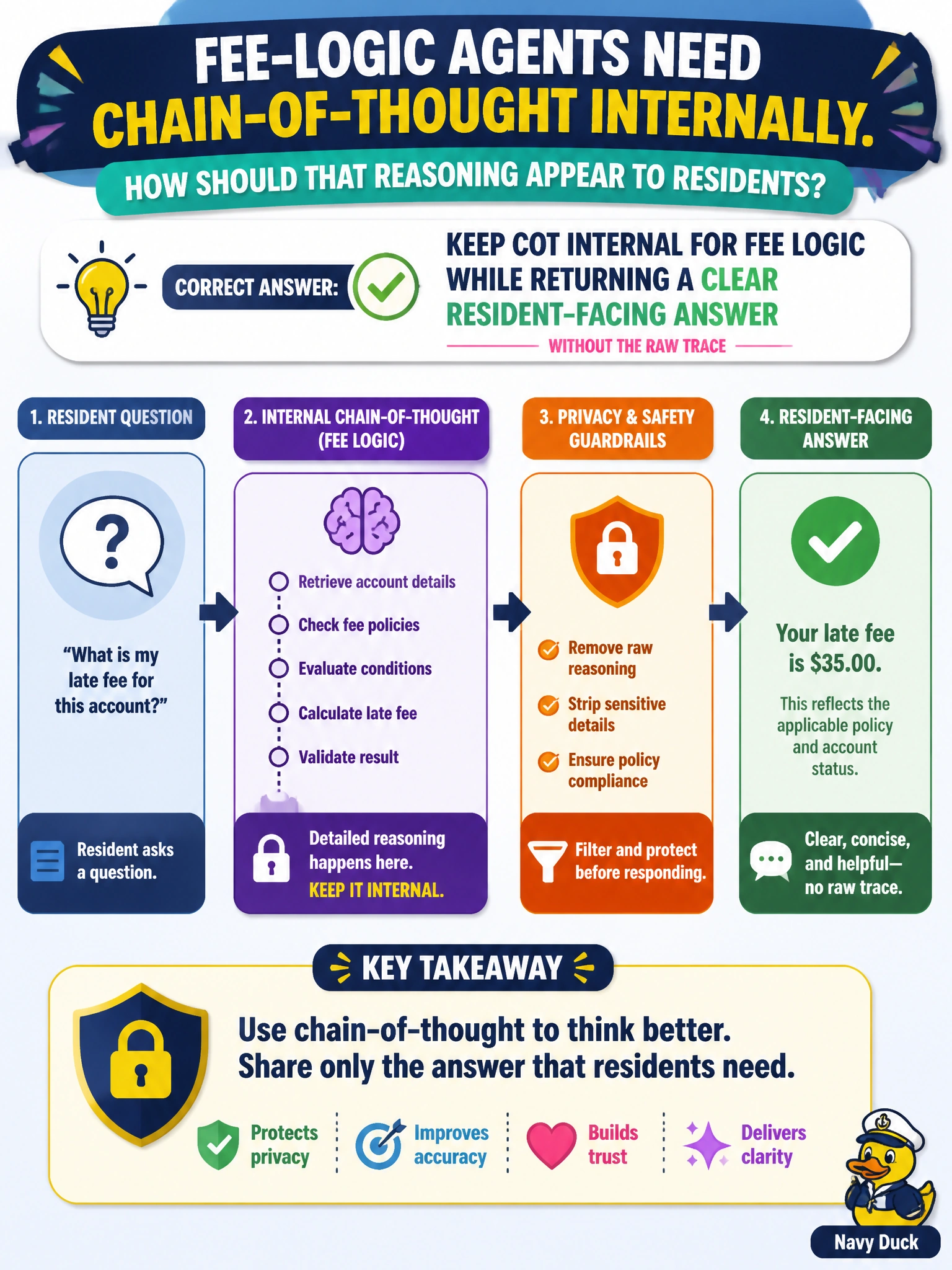
Do the fee math in the back room; tell the resident the clear total up front. Raw CoT dumps and mailing scratchpads aren’t transparency—they’re clutter and risk. Hide the trace, keep the answer clean.
Full Explanation
Fee-logic agents may use chain-of-thought internally to check calculations and rule branches, but that reasoning should remain internal while residents receive a clear answer without the raw trace. Internal CoT helps verify fee schedules, exemptions, and edge cases; exposing the scratchpad confuses residents, may reveal non-final legal theories, and can leak sensitive intermediate assumptions. The professional pattern is private reasoning, public clarity—especially for municipal fee determinations.
Dumping the full internal scratchpad into every public reply fails conceptually because raw traces are not resident-ready communication and can include unstable hypotheses. Disabling all reasoning frameworks so fee math is never checked fails because fees need verification; removing reasoning increases error risk. Emailing intermediate legal theories to unrelated neighborhood lists fails as both a privacy and a process failure—disseminating incomplete legal analysis broadly.
Exam caveat: “hide raw CoT” is not “hide the fee basis.” Residents still deserve a clear explanation of the assessed fee and citations to published schedules; withhold the model’s private scratchpad, not accountability.
Operational check: configure the agent to keep CoT/tool traces in secured logs for auditors, return concise resident-facing fee explanations with schedule references, and red-team prompts that try to extract the raw trace.