
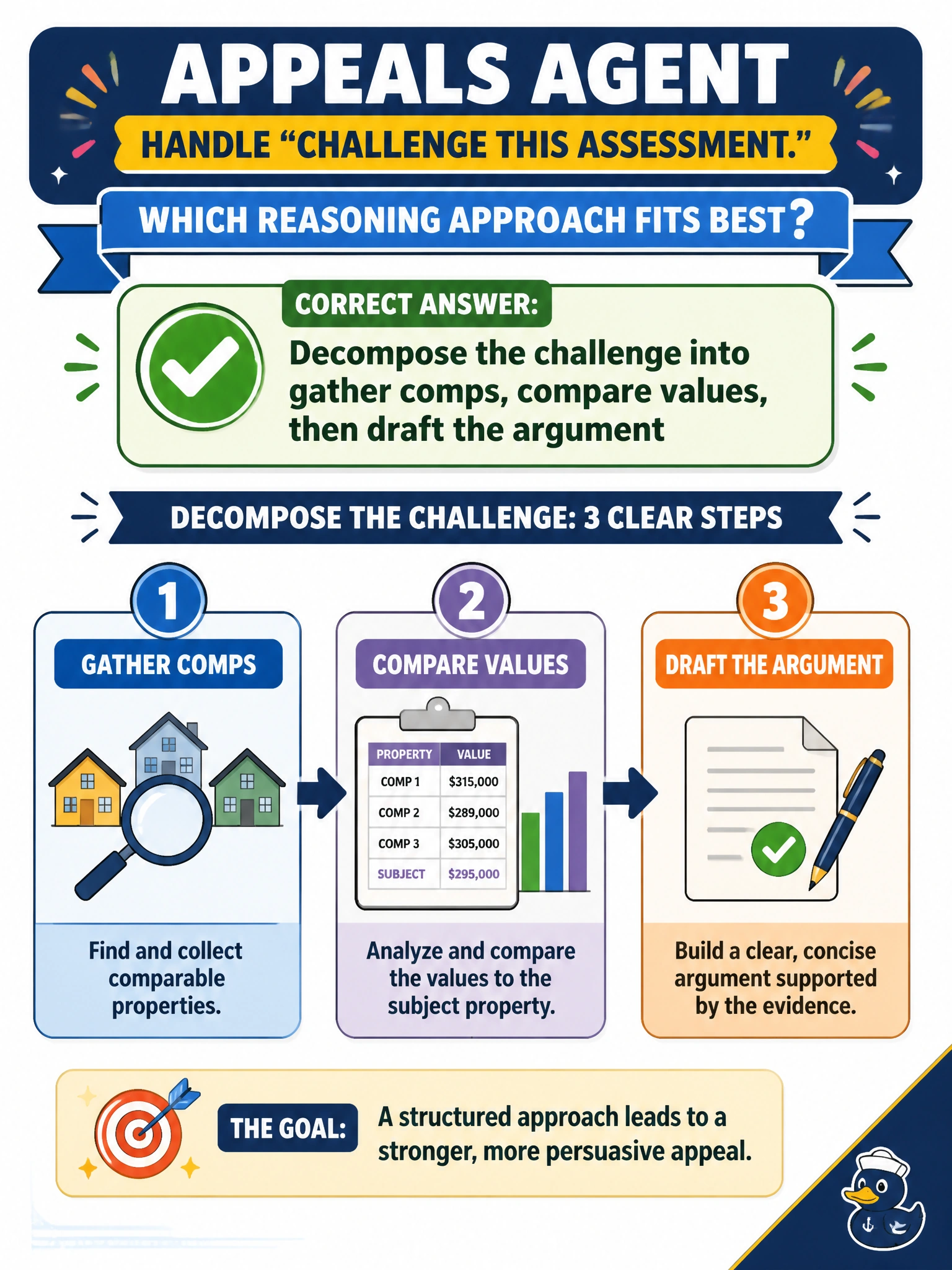
An appeals agent must handle “challenge this assessment.” Which reasoning approach fits best?
Select an answer to reveal the explanation.
Short Explanation
Big civic problems chop into steps: gather comps, compare, then draft the argument. One slogan or invented numbers won’t survive an appeals desk. Decomposition is how the agent stays honest and useful.
Full Explanation
An appeals agent handling “challenge this assessment” should decompose the challenge into gather comps, compare values, then draft the argument. Property assessment appeals are multi-step civic procedures: evidence collection (comparable sales), structured comparison against the assessed value, then a coherent written argument. Decomposition (structured planning / stepwise reasoning) reduces skipped legal/factual gates and produces auditable intermediate artifacts for assessors and residents.
Answering with a single unexamined slogan and no intermediate steps fails conceptually because slogans are not evidentiary processes and will not withstand appeals review. Skipping comparable sales and inventing numbers that feel fair fails as fabrication—unacceptable in assessment contexts and harmful to equity. Refusing all structured decomposition because it slows the model fails because correctness and procedural completeness dominate raw speed for adjudicative civic tasks.
Exam caveat: decomposition must still ground comps in authorized data sources; structured steps do not license hallucinated sales. Human review gates may remain mandatory before filing.
Operational check: implement an explicit plan with gather→compare→draft stages, block drafting until comps are retrieved, log each stage for audit, and sample outputs for invented figures.