
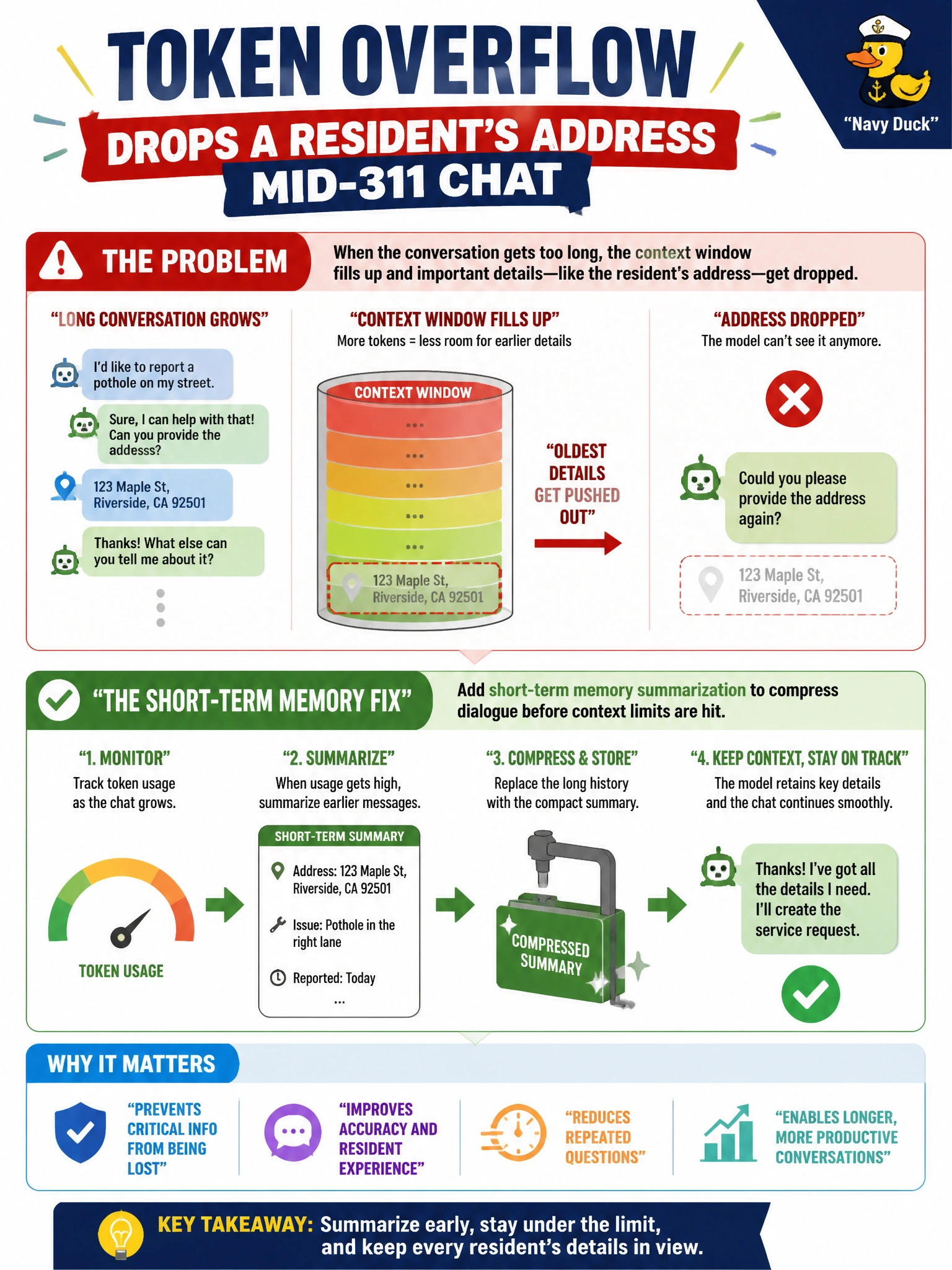
Token overflow drops a resident’s address mid-311 chat. What short-term memory fix should the team add?
Select an answer to reveal the explanation.
Short Explanation
When the chat approaches its token limit, add summarization to compress earlier turns and keep the resident’s address available. Raising the response timeout, removing the address field, or hoping it survives overflow won’t preserve the ticket data you need.
Full Explanation
When token overflow drops a resident’s address mid-311 chat, add short-term memory summarization to compress earlier dialogue before context limits are hit. Addresses and other critical ticket fields should be preserved in structured working state or a rolling summary so they are not evicted when the raw transcript exceeds the context window. Summarization, paired with structured field extraction, is a standard pattern for long civic conversations under token constraints. Raising the chat timeout gives the resident more time to respond, but it does not expand the token context or prevent earlier dialogue from being dropped; it therefore does not solve the memory problem. Deleting the address field from the ticket schema fails because the address remains operationally necessary for dispatch. Ignoring overflow and hoping critical fields survive by chance fails because chance is not an engineering control under context truncation. Exam caveat: naive summarization can itself omit the address, so summaries should be field-aware or paired with explicit structured state outside the free-text window; re-prompting the resident to confirm critical fields after compression can also help. Practical check: enable short-term summarization with protected fields, force a long conversation past the context limit in staging, and verify that the address and other key ticket fields remain present and correct.