
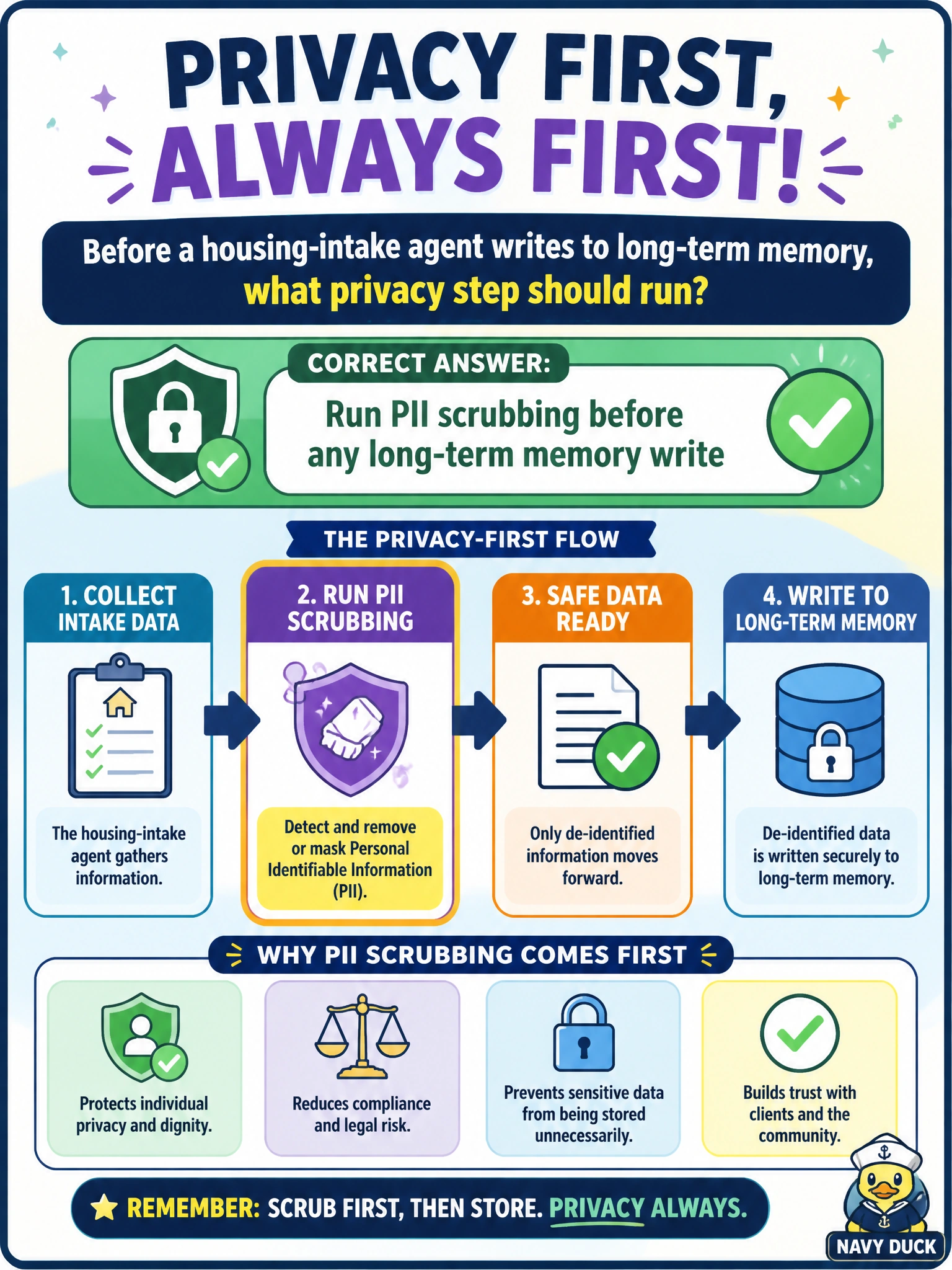
Before a housing-intake agent writes to long-term memory, what privacy step should run?
Select an answer to reveal the explanation.
Short Explanation
Don’t file the resident’s raw identifiers in the permanent drawer. Scrub PII before long-term memory writes on housing intakes. Assuming “it’s private enough” or publishing transcripts is how trust evaporates.
Full Explanation
Before a housing-intake agent writes to long-term memory, PII scrubbing must run. Housing intake routinely includes SSNs, DOB, income, medical notes, and addresses. Writing raw identifiers into durable agent memory expands breach impact, complicates retention, and may violate privacy policy or law. Scrubbing or tokenizing sensitive fields before long-term write—while keeping necessary references in governed systems of record—is the required privacy step for civic memory architectures.
Writing raw Social Security numbers into permanent memory by default fails conceptually because it maximizes sensitive data persistence without need. Skipping scrubbing because long-term stores are assumed private forever fails because “assumed private” is not a control; stores get breached, misconfigured, or over-shared. Publishing full intake transcripts to a public open-data portal fails as an extreme confidentiality violation incompatible with housing casework.
Exam caveat: scrubbing is necessary but must not destroy auditability of decisions; use redaction with reversible tokens only where lawful and tightly controlled. Align with records schedules—some data belongs in case management systems with stronger controls, not in free-form agent memory.
Operational check: insert a PII scrubbing/redaction stage before memory write, test that SSNs never appear in long-term memory stores, verify agents can still operate on case IDs, and audit samples regularly.