
A 311 agent must track the live ticket fields and also recall similar past tickets. How should those memory roles differ?
Select an answer to reveal the explanation.
Short Explanation
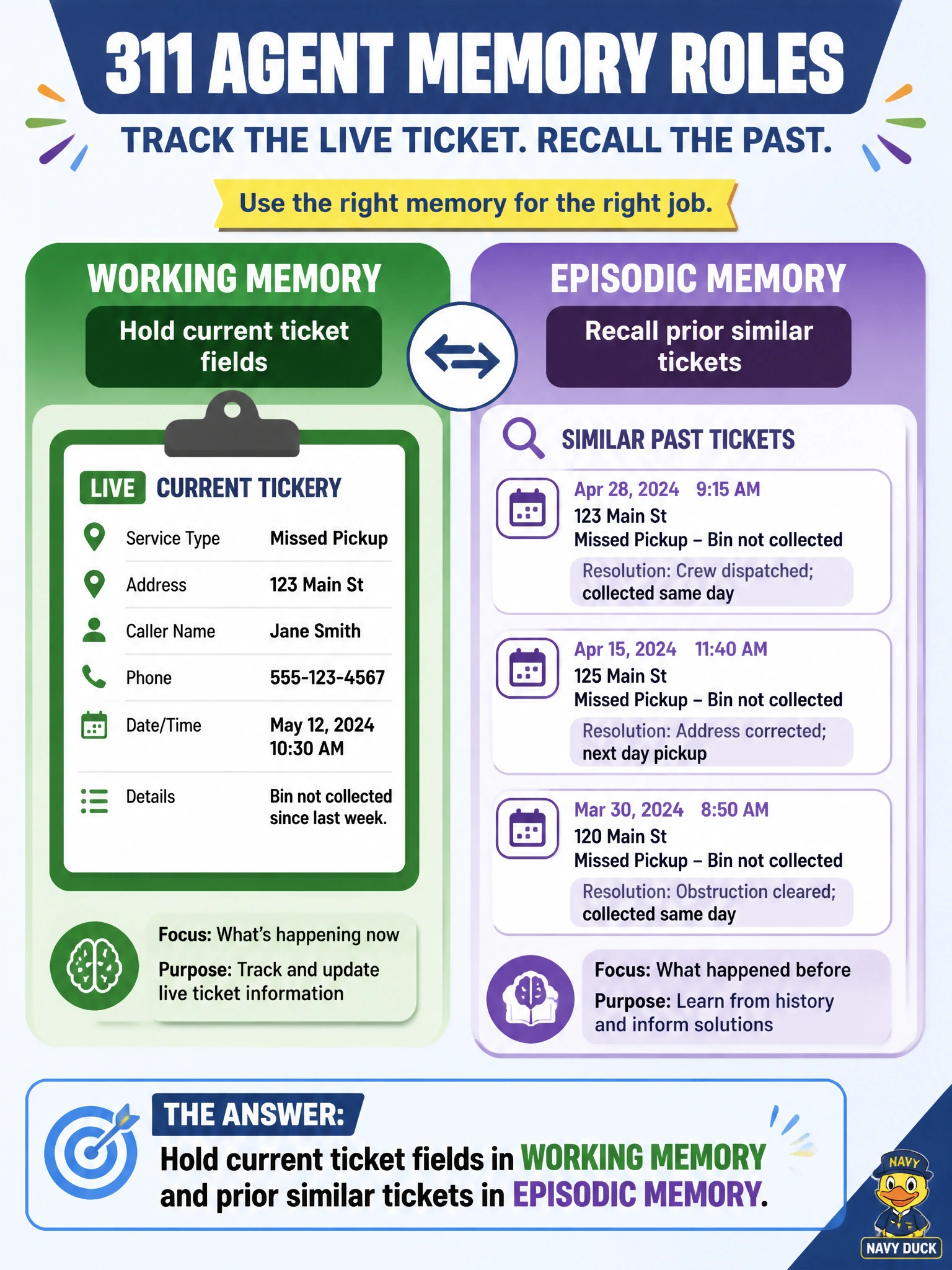
Working memory is the sticky note on the desk; episodic memory is the filing cabinet of similar past tickets. Keep live 311 fields up front and pull look-alikes from episodic store—don’t invent fields or mash them into the weights.
Full Explanation
A 311 agent that must track live ticket fields and also recall similar past tickets should separate those roles: hold current ticket fields in working memory and prior similar tickets in episodic memory. Working memory is the volatile, task-scoped state for the active conversation (address, issue type, open fields). Episodic memory retrieves analogous historical tickets to guide troubleshooting without overwriting the live case. Mixing the two roles either loses the current ticket or pollutes it with unrelated history.
Storing nothing until the chat ends, then inventing ticket fields from scratch fails conceptually because deferred invention is hallucination risk and loses mid-chat accuracy. Putting both live fields and historical tickets only in the model weights fails because weights are not a per-ticket state store and cannot safely update per conversation. Overwriting working memory with random prior tickets on every keystroke fails because it destroys live field integrity and makes the current ticket incoherent.
Exam caveat: episodic retrieval must be similarity-filtered and privacy-scoped so one resident’s case details do not leak into another’s chat. Working memory should sync to the official 311 ticket system of record, not exist only inside the LLM context.
Operational check: implement distinct stores/APIs for live ticket state vs historical similar-ticket retrieval, simulate a multi-turn 311 chat, and verify live fields remain stable while relevant past tickets are suggested as references only.