
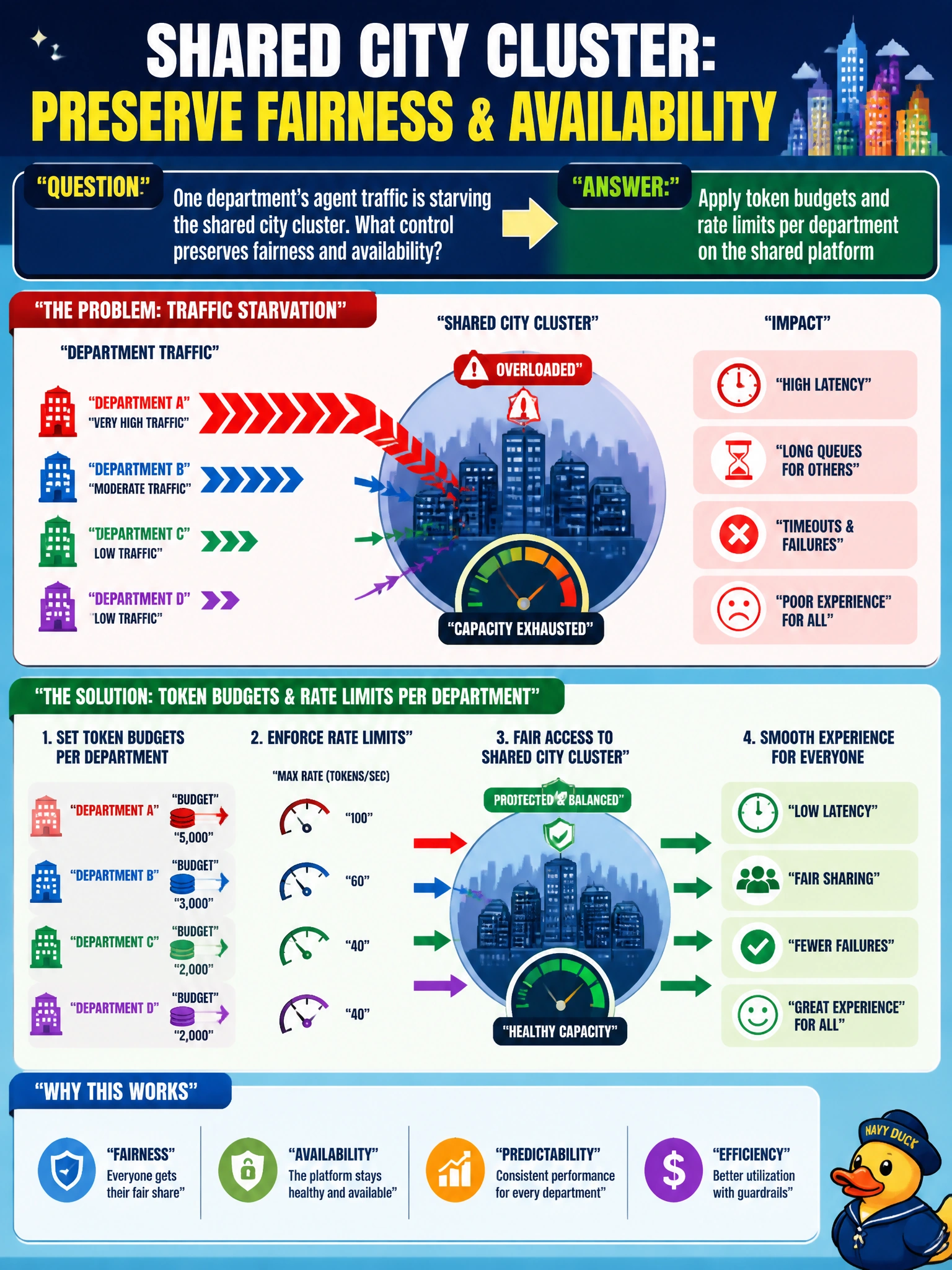
One department’s agent traffic is starving the shared city cluster. What control preserves fairness and availability?
Select an answer to reveal the explanation.
Short Explanation
Shared kitchens need portion control. Token budgets and per-department rate limits stop one agency from eating the whole cluster. Unlimited noisy neighbors—or deleting everyone else—aren’t fair ops.
Full Explanation
When one department’s agent traffic starves a shared city cluster, fairness and availability are preserved by applying token budgets and rate limits per department on the shared platform. Quotas convert a noisy-neighbor problem into governed multi-tenancy: each agency gets bounded throughput/tokens so permitting bursts cannot silence 311 or emergency FAQ agents. This control is both a capacity and a governance mechanism for municipal shared AI platforms.
Letting the noisiest department consume unlimited capacity without caps fails conceptually because unlimited consumption is the starvation mechanism itself. Deleting every other department’s agents permanently fails as a destructive “fix” that removes legitimate civic services instead of enforcing fair share. Removing rate limits so budgeting tools are never needed fails because it abandons the control plane required for shared platforms.
Exam caveat: limits must be tuned to real demand and emergency overrides may be needed during citywide incidents; overly tight caps can create artificial outages. Budgets should cover tokens, RPS, and possibly GPU seconds, with clear owner escalation paths.
Operational check: enforce per-department quotas at the gateway, alert on sustained throttle, review weekly usage vs budget, and confirm that a synthetic noisy tenant cannot breach other departments’ SLOs.