
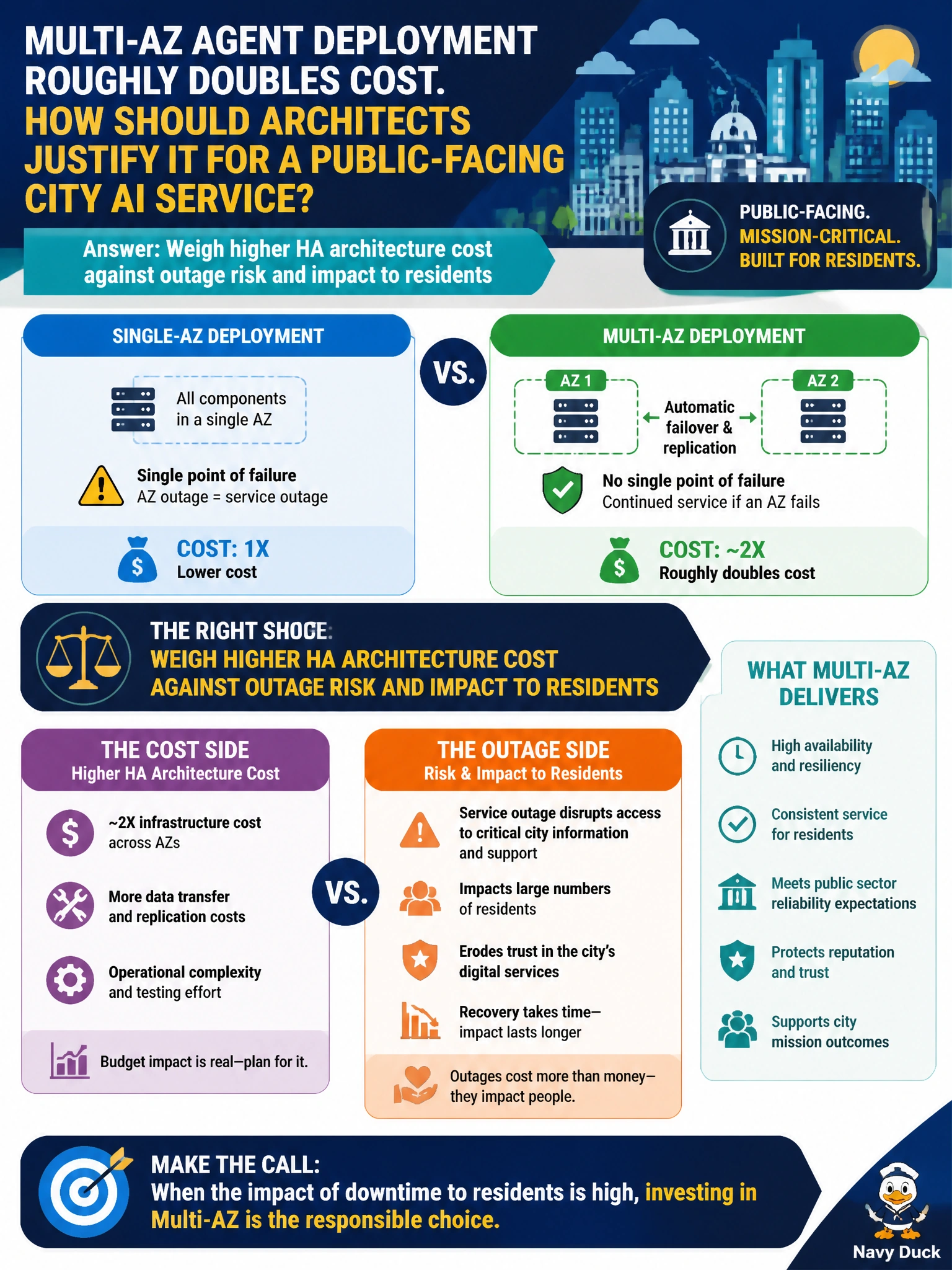
Multi-AZ agent deployment roughly doubles cost. How should architects justify it for a public-facing city AI service?
Select an answer to reveal the explanation.
Short Explanation
Paying for a second zone isn’t vanity—it’s insurance against leaving residents in the dark. Weigh the extra HA cost against real outage impact. Cheapest-always or “cost never matters” both miss the civic trade-off.
Full Explanation
Multi-AZ agent deployment that roughly doubles cost is justified for a public-facing city AI service by weighing higher HA architecture cost against outage risk and impact to residents. Architects should quantify blast radius of a single-AZ failure (311 down, permitting frozen, emergency FAQ dark), estimate probability and duration, and compare that civic impact—and political/operational cost—to the incremental spend of multi-AZ. For resident-facing services, availability is part of the service itself, not an optional luxury feature.
Claiming cost never matters for any public technology fails conceptually because public budgets are constrained and require accountable tradeoffs. Ignoring resident outage risk and always picking the cheapest single zone fails because it externalizes harm onto residents and undermines continuity of government digital services. Justifying spending only by how colorful the status page looks fails because aesthetics are not a risk or value metric.
Exam caveat: multi-AZ is not automatic multi-region, and data gravity/replication lag still matter. Some internal batch tools may remain single-AZ; the exam focus is public-facing impact-driven justification.
Operational check: document RTO/RPO and resident impact for AZ loss, cost the multi-AZ design, present the risk/cost tradeoff to stakeholders, and verify failover drills actually keep the city AI service available across zones.