
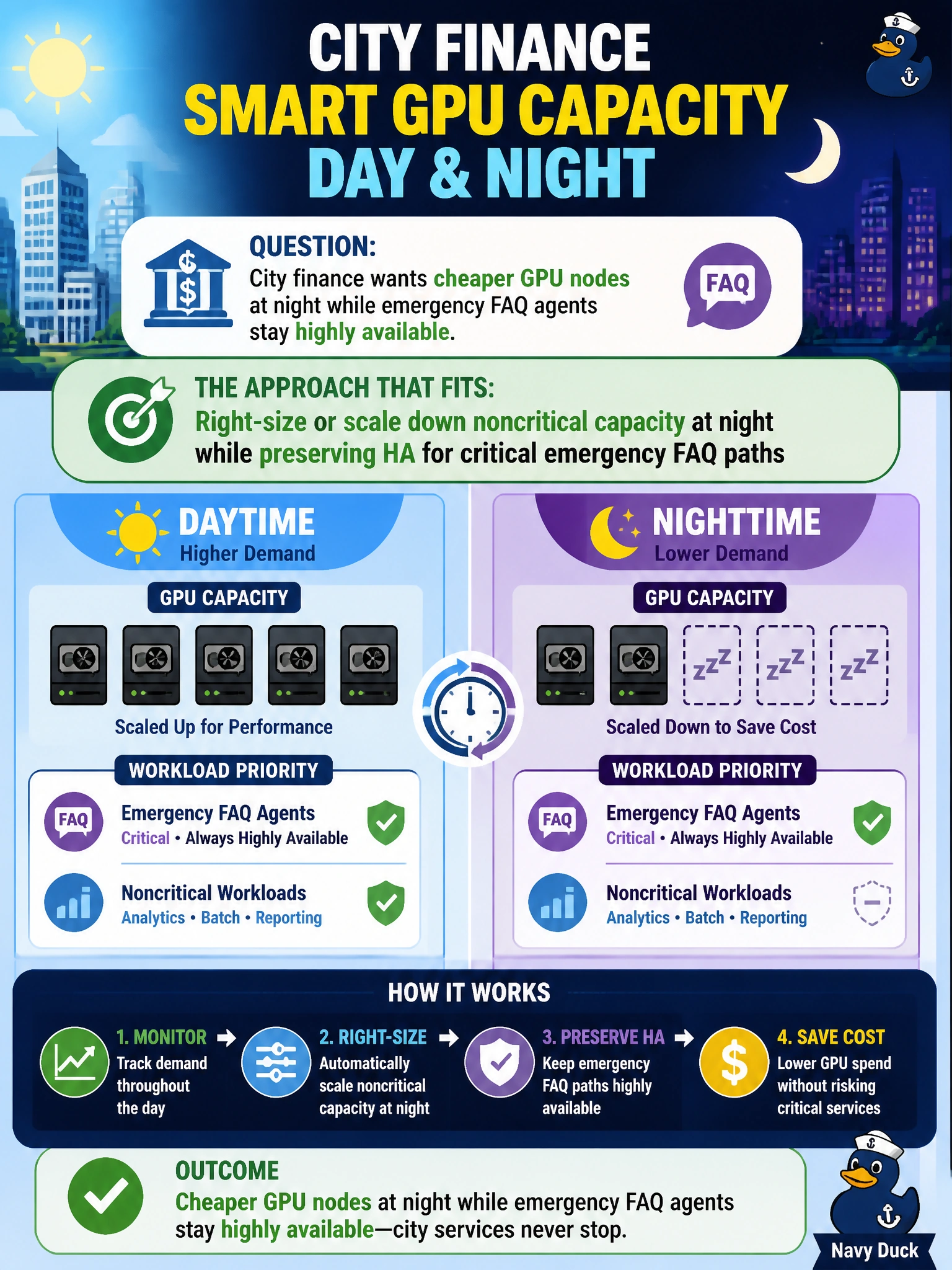
City finance wants cheaper GPU nodes at night while emergency FAQ agents stay highly available. What approach fits?
Select an answer to reveal the explanation.
Short Explanation
Dim the lights on the empty floors at night, but keep the emergency exits lit. Right-size noncritical GPU capacity while HA stays on for emergency FAQs. Killing everything—or one spare laptop—isn’t thrift, it’s risk.
Full Explanation
City finance goals for cheaper GPU nodes at night must be balanced with high availability for emergency FAQ agents. The fitting approach is to right-size or scale down noncritical capacity overnight while preserving HA for critical emergency FAQ paths. Batch embedding jobs, low-priority research agents, and non-urgent analytics can shed GPU spend after hours; emergency guidance for outages, shelters, or safety FAQs must retain redundant capacity and healthy replicas. This is cost optimization by criticality, not blanket shutdown.
Turning off all agent capacity overnight including emergency guidance fails conceptually because it removes life-safety and urgent civic assistance precisely when overnight incidents occur. Keeping maximum GPU spend 24/7 with no differentiation by criticality fails fiscally—it ignores that not all workloads share the same availability class. Hosting emergency FAQs only on a single unprotected spare laptop fails because a laptop is not an HA platform and creates an unacceptable SPOF for emergency content.
Exam caveat: “night” schedules must respect local incident patterns and on-call procedures; some cities see evening peaks. Ensure scale-down automation cannot touch labeled critical Deployments, and test that emergency paths survive noncritical drain.
Operational check: label workloads by criticality, configure scheduled scale-down only for noncritical GPU pools, verify emergency FAQ replicas and multi-AZ placement remain intact, and review nightly cost and availability dashboards.