
In the city’s zero-trust Kubernetes cluster, how should multi-agent pod traffic be secured at scale?
Select an answer to reveal the explanation.
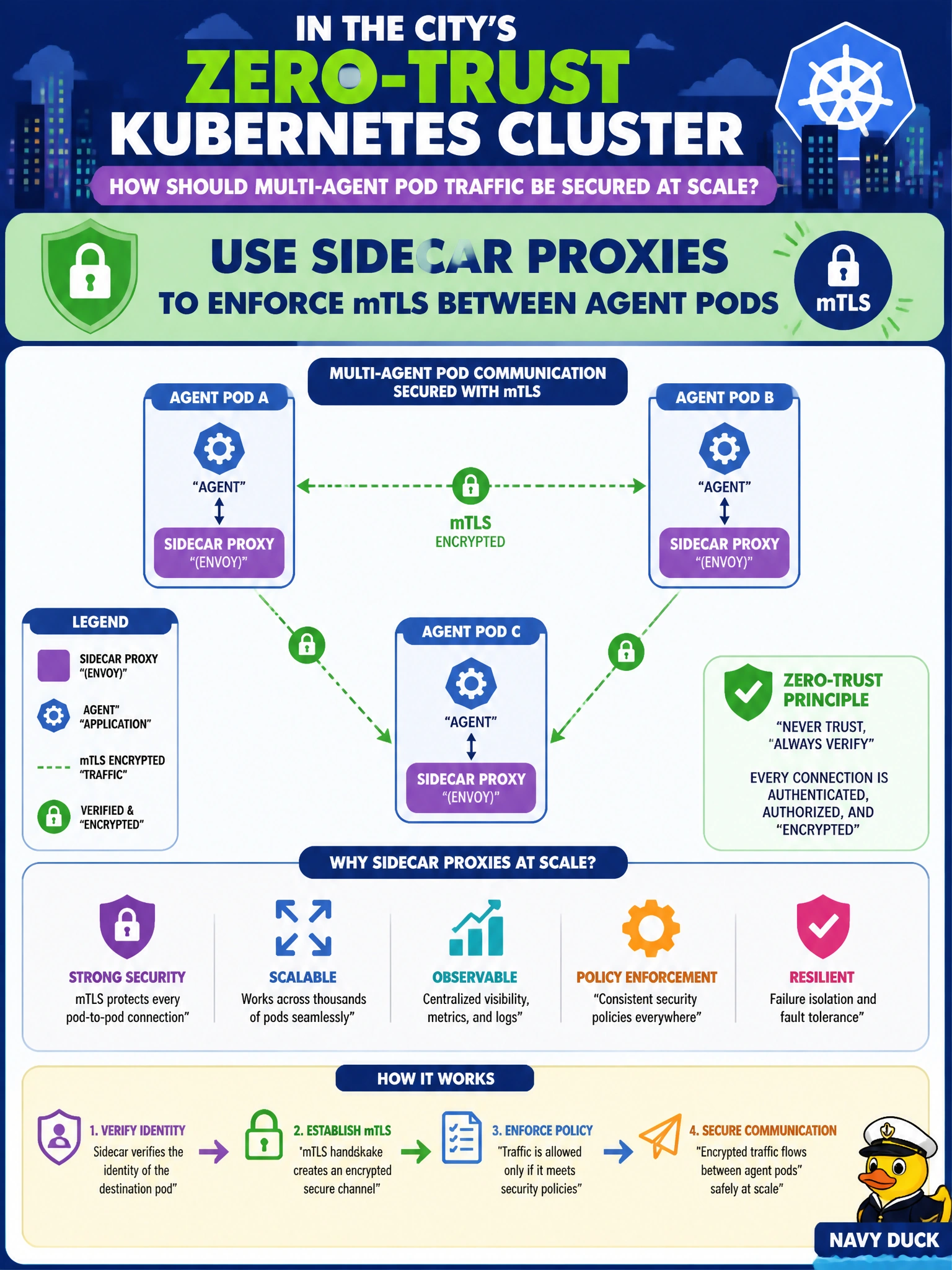
Short Explanation
Zero-trust means agents don’t gossip in the clear. Sidecar proxies with mTLS keep pod-to-pod talk private at scale. Public cleartext, wiki’d admin keys, and no network policies invite trouble.
Full Explanation
In a city’s zero-trust Kubernetes cluster, multi-agent pod traffic should be secured at scale with sidecar proxies that enforce mutual TLS between agent pods. Sidecars (service mesh pattern) authenticate peer identity via workload certificates, encrypt east-west traffic, and enable consistent policy without rewriting every specialist agent. For municipal multi-agent systems exchanging case context and tool results, mTLS prevents eavesdropping and spoofed peer calls on the cluster network.
Sending all inter-agent payloads as cleartext on the public internet fails conceptually because it abandons confidentiality and authenticity for sensitive civic data. Sharing one cluster-admin kubeconfig in a public wiki fails as catastrophic credential exposure and privilege overreach, unrelated to pod-to-pod encryption. Disabling network policies to simplify debugging forever fails because it removes least-privilege segmentation; debugging convenience does not justify permanent open lateral movement.
Exam caveat: mTLS sidecars complement, not replace, network policies and RBAC. Certificate rotation, identity binding (SPIFFE-style), and excluding plaintext fallbacks matter. Also ensure mesh telemetry itself respects PII rules for civic payloads.
Operational check: enable mesh mTLS STRICT mode between agent namespaces, verify plaintext probes fail, confirm authorization policies allow only required service pairs, and include mTLS health in release readiness.