
How should specialist agents be packaged for scalable deployment on the city’s Kubernetes platform?
Select an answer to reveal the explanation.
Short Explanation
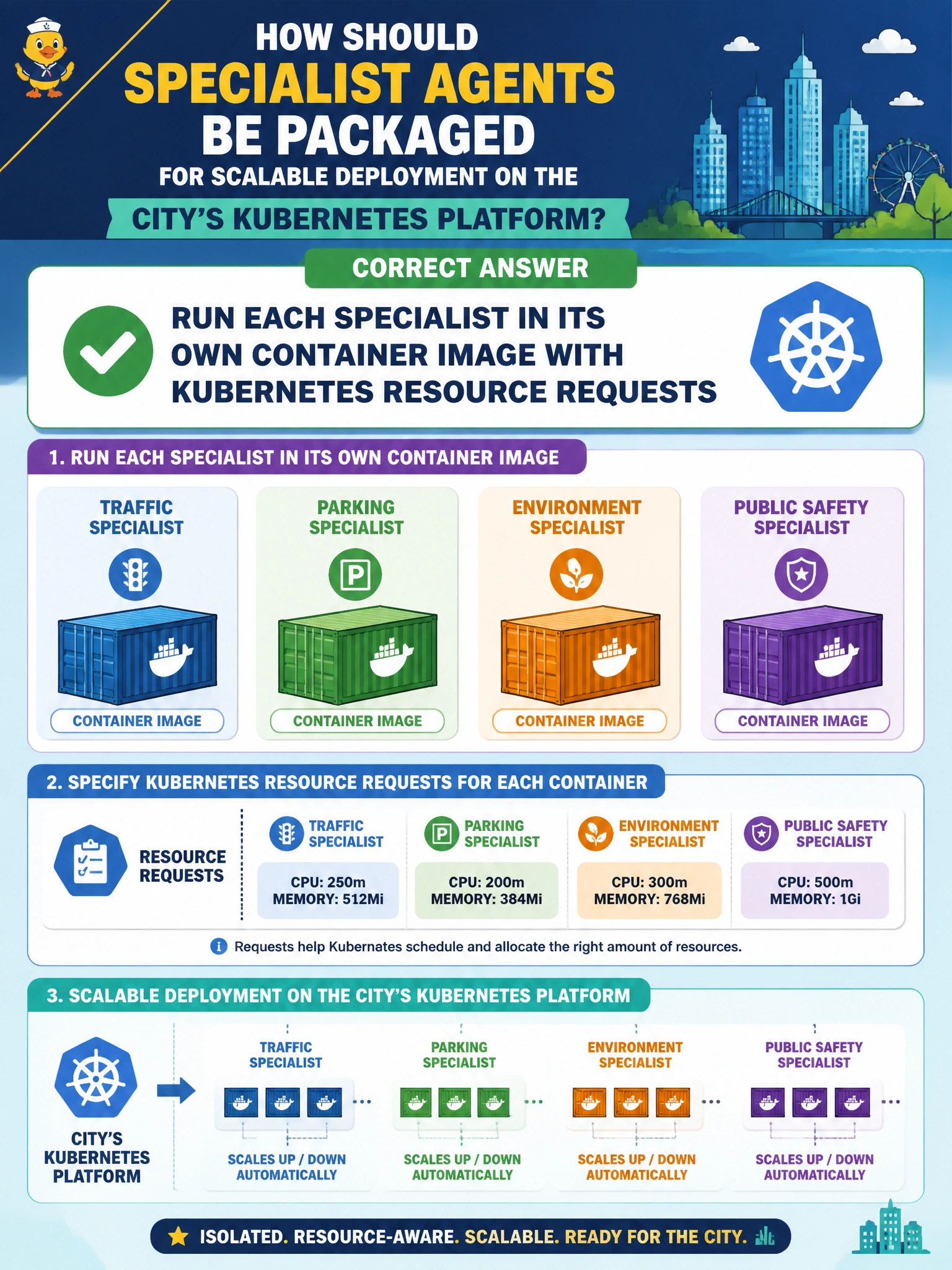
Give each specialist its own container with clear resource asks—like labeled workstations, not one shared login free-for-all. Kubernetes can then schedule and scale them. Laptops and unmanaged scripts won’t survive permit season.
Full Explanation
Specialist agents on a city’s Kubernetes platform should be packaged as individual container images with declared resource requests (and typically limits). Containerization gives reproducible builds, isolation between permitting, benefits, and GIS specialists, and lets the scheduler place workloads according to CPU/GPU/memory needs. Declared requests prevent noisy-neighbor starvation on shared civic clusters and make Horizontal Pod Autoscaler and capacity planning meaningful. This packaging pattern is the scalable baseline for municipal multi-agent platforms.
Running all specialists as unmanaged scripts on a single shared login fails conceptually because shared logins destroy auditability, isolation, and resource control—classic anti-patterns for production civic systems. Installing agents only on council members’ personal laptops fails because personal devices are not HA platforms, cannot meet patching/compliance standards, and cannot serve citywide load. Avoiding containers so resource requests cannot be declared fails because it deliberately removes the knobs Kubernetes needs to schedule fairly and safely.
Exam caveat: containers alone are not enough—images must be signed/scanned, secrets injected properly, and network policies applied. Resource requests that are wildly wrong still cause scheduling or OOM issues; right-sizing remains an ops duty.
Operational check: build one image per specialist, set requests/limits from load tests, deploy via Deployment/StatefulSet as appropriate, verify the scheduler can place pods across nodes, and confirm metrics show per-specialist resource use rather than an opaque shared process.