
Resident 311 sessions carry workflow state. What load-balancing approach fits containerized agent replicas?
Select an answer to reveal the explanation.
Short Explanation
Spread the load, but don’t orphan the conversation state—ingress that respects sticky workflow stores keeps chats coherent. Random drops, one forever-pod, or a hard-coded IP are how resident sessions fall apart.
Full Explanation
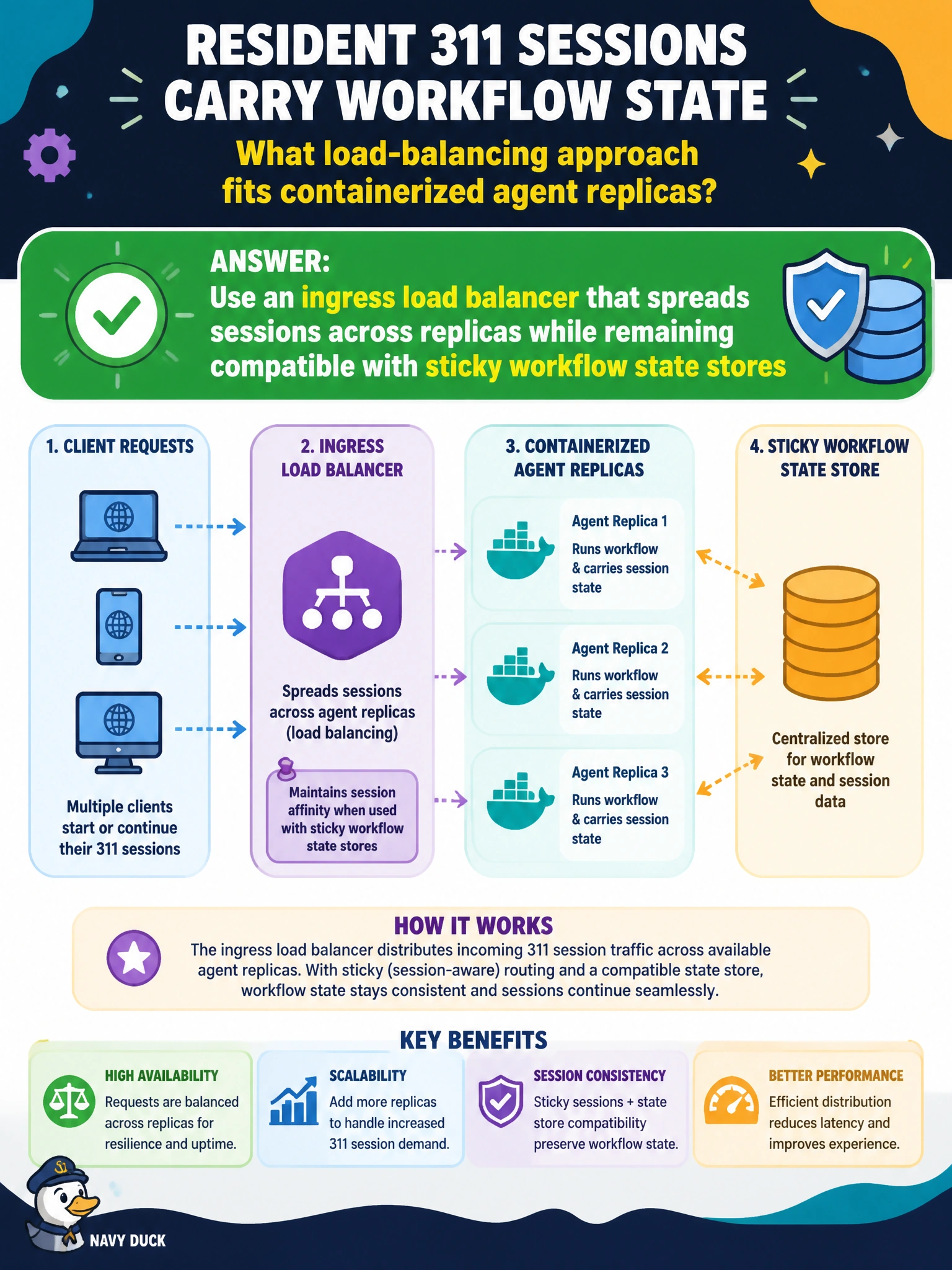
Resident 311 sessions carry workflow state—ticket fields, clarification turns, tool results—so load balancing across containerized agent replicas must spread traffic while remaining compatible with sticky workflow state stores. An ingress load balancer that distributes sessions across replicas, paired with an externalized session/state store (or carefully scoped affinity to that store), keeps conversations coherent as replicas scale. The key concept is horizontal scale without orphaning mid-workflow civic cases.
Randomly dropping half of sessions to keep replica counts artificially low fails conceptually because dropping resident sessions is not load balancing; it is availability sabotage. Pinning every resident worldwide to a single pod forever with no failover fails because it creates a hard SPOF and defeats replica scaling. Disabling the load balancer and hard-coding one IP in the mobile app fails for the same SPOF reason and makes blue/green or rolling upgrades nearly impossible.
Exam caveat: “sticky sessions” at the ingress are not a substitute for durable workflow state; if state lives only in pod memory, sticky routing still loses work on pod death. Prefer externalizing state and using affinity only where needed. Also protect session cookies/tokens as sensitive civic data.
Operational check: place workflow state in a shared store, configure ingress for even distribution (with affinity only if required), kill a replica mid-session in staging, and verify the resident can continue without losing ticket context.