
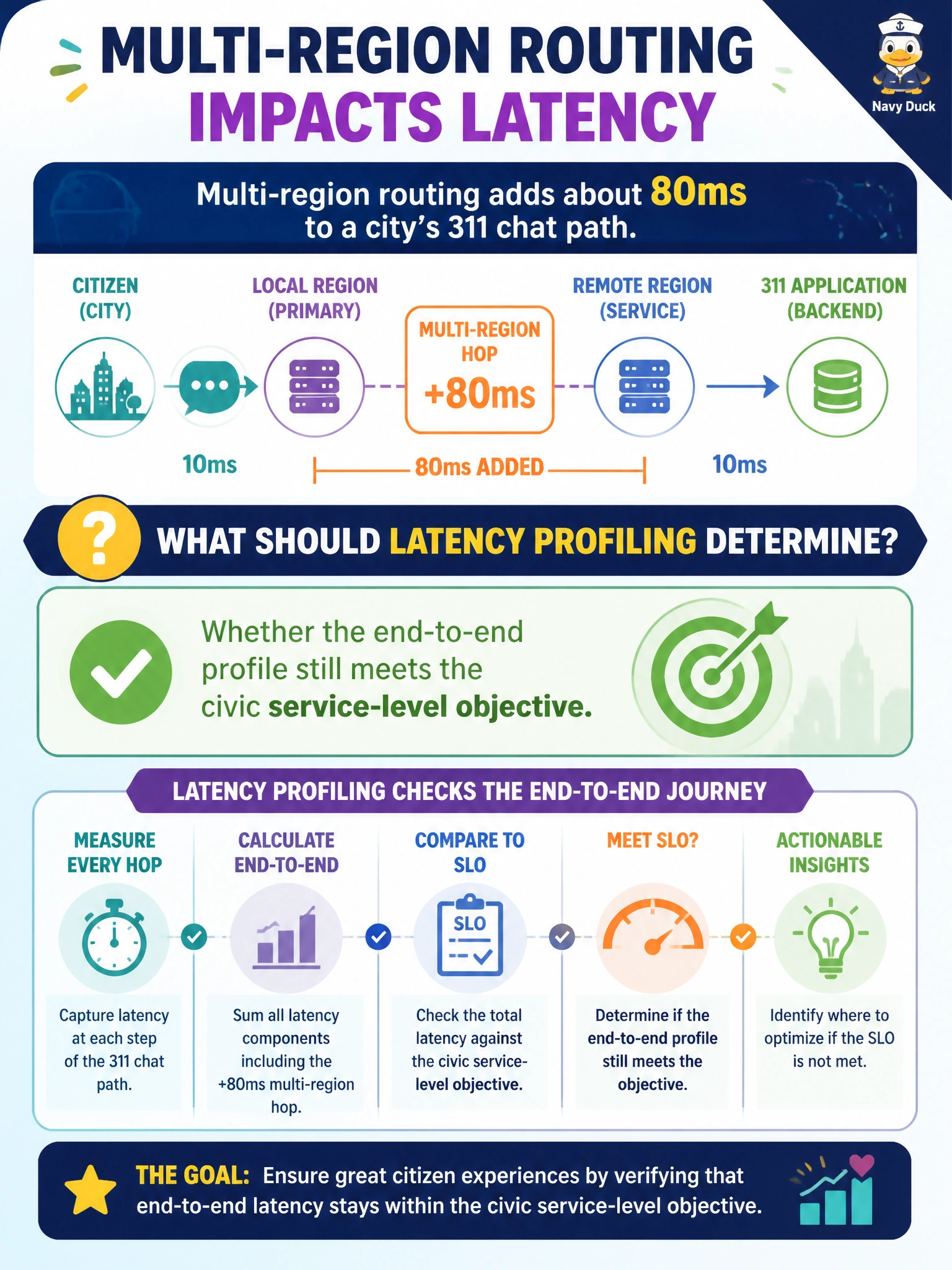
Multi-region routing adds about 80ms to a city’s 311 chat path. What should latency profiling determine?
Select an answer to reveal the explanation.
Short Explanation
Eighty milliseconds isn’t a vibe—it’s a number you check against the SLA. Profile the full path and see if 311 still meets the city’s objective. Press-release spin and hiding metrics don’t help residents.
Full Explanation
Multi-region routing that adds about 80ms to a city’s 311 chat path is only acceptable if the end-to-end latency profile still meets the civic service-level objective. Latency profiling must measure the full resident path—edge, auth, agent orchestration, retrieval, tools, and model—under representative load, then compare the multi-region tax against the published SLO (for example p95 reply time). Continuity benefits of multi-region failover matter for municipal availability, but they do not automatically justify missing the objective residents and council metrics care about.
Whether 80ms sounds impressive in a press release fails conceptually because communications framing is not an SLO test. Hiding latency metrics from operations staff fails because operators cannot manage what they cannot see, and concealment violates operational transparency. Banning multi-region designs regardless of continuity needs fails because it ignores legitimate HA requirements for citywide outages; the decision must be evidence-based against the SLO and risk, not ideological.
Exam caveat: 80ms average or median is not the same as 80ms at p99; civic chat often fails on tails. Also account for cross-region tool calls and data residency constraints that may force regional pin of certain backends even when chat routing is multi-region.
Operational check: profile baseline single-region vs multi-region p50/p95/p99 for 311 agent turns, document the SLO margin, and only enable multi-region routing if objectives remain met—or adjust architecture (regional affinity, caching) until they do.