
For the clerk agent, how should prompt and tool-schema changes move to production?
Select an answer to reveal the explanation.
Short Explanation
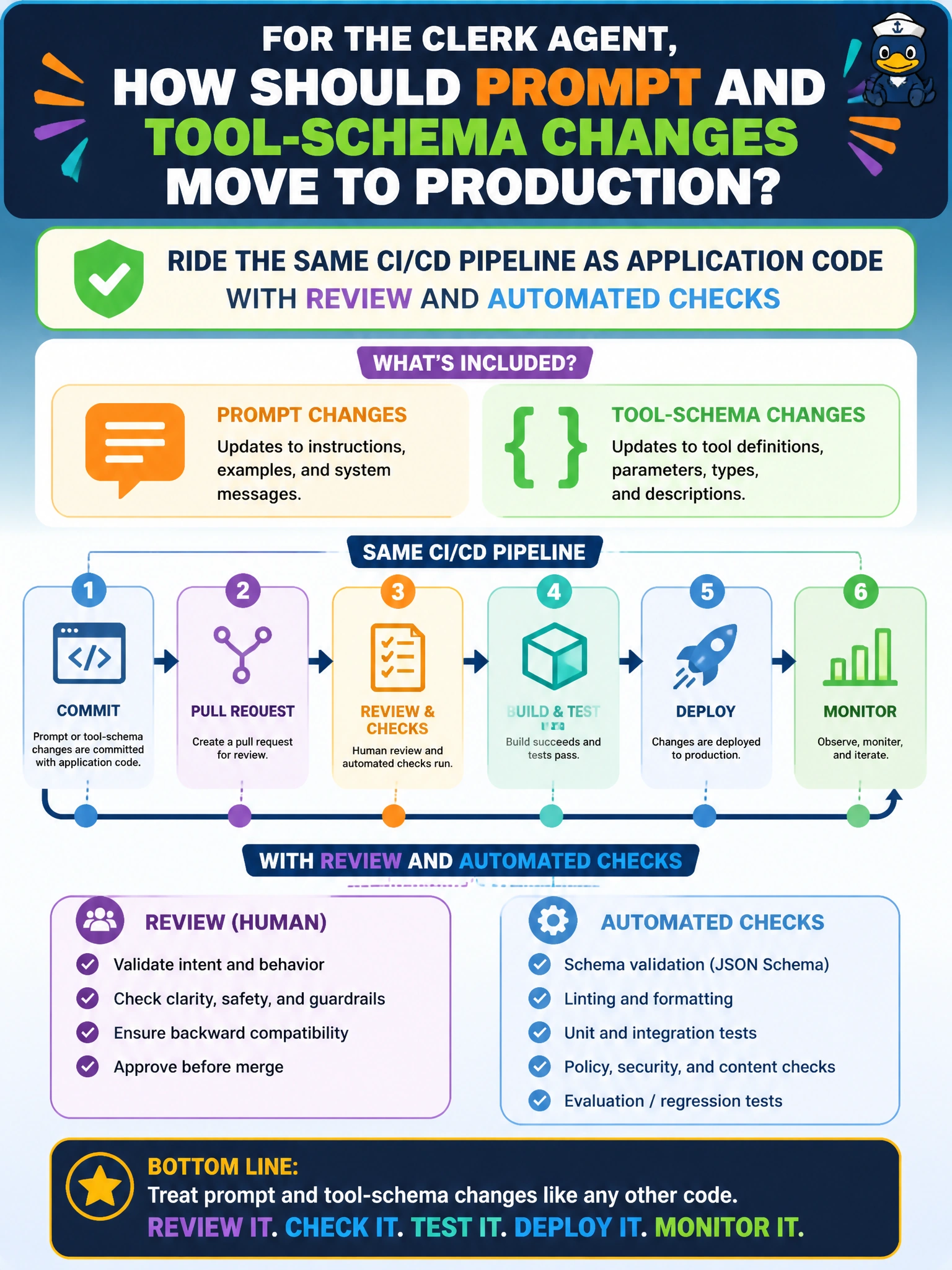
Prompts and tool schemas are code wearing a costume—run them through the same CI/CD line as the app. Live prod edits and Word-doc pastes are how mystery breakage shows up on Monday. Versioned pipelines keep the clerk agent honest.
Full Explanation
MLOps CI/CD for municipal agents treats prompts and tool schemas as versioned artifacts that flow through the same pipelines as application code, with review and automated checks. For the clerk agent, prompt and tool-schema changes should move to production on that shared path so diffs are reviewed, evaluated, releasable, and roll-backable with the same discipline as application code. Behavior changes belong in the delivery system, not in ad-hoc edits.
Editing prompts live in production with no version history destroys reproducibility and auditability when residents get a bad answer. Emailing a Word doc of the new prompt and hoping someone pastes it is an informal handoff that skips gates, tests, and accountability. Skipping CI for prompts because they are “not software artifacts” misclassifies the highest-leverage behavior source in the agent stack.
Exam caveat: prompts and tool schemas are delivery artifacts—same CI/CD discipline as app code for civic production. Operational check: submit a prompt or schema change via pull request, confirm lint and eval jobs run, require human review, deploy via the pipeline to staging then production, and verify release history shows the version pin rather than a manual paste with no trail.