
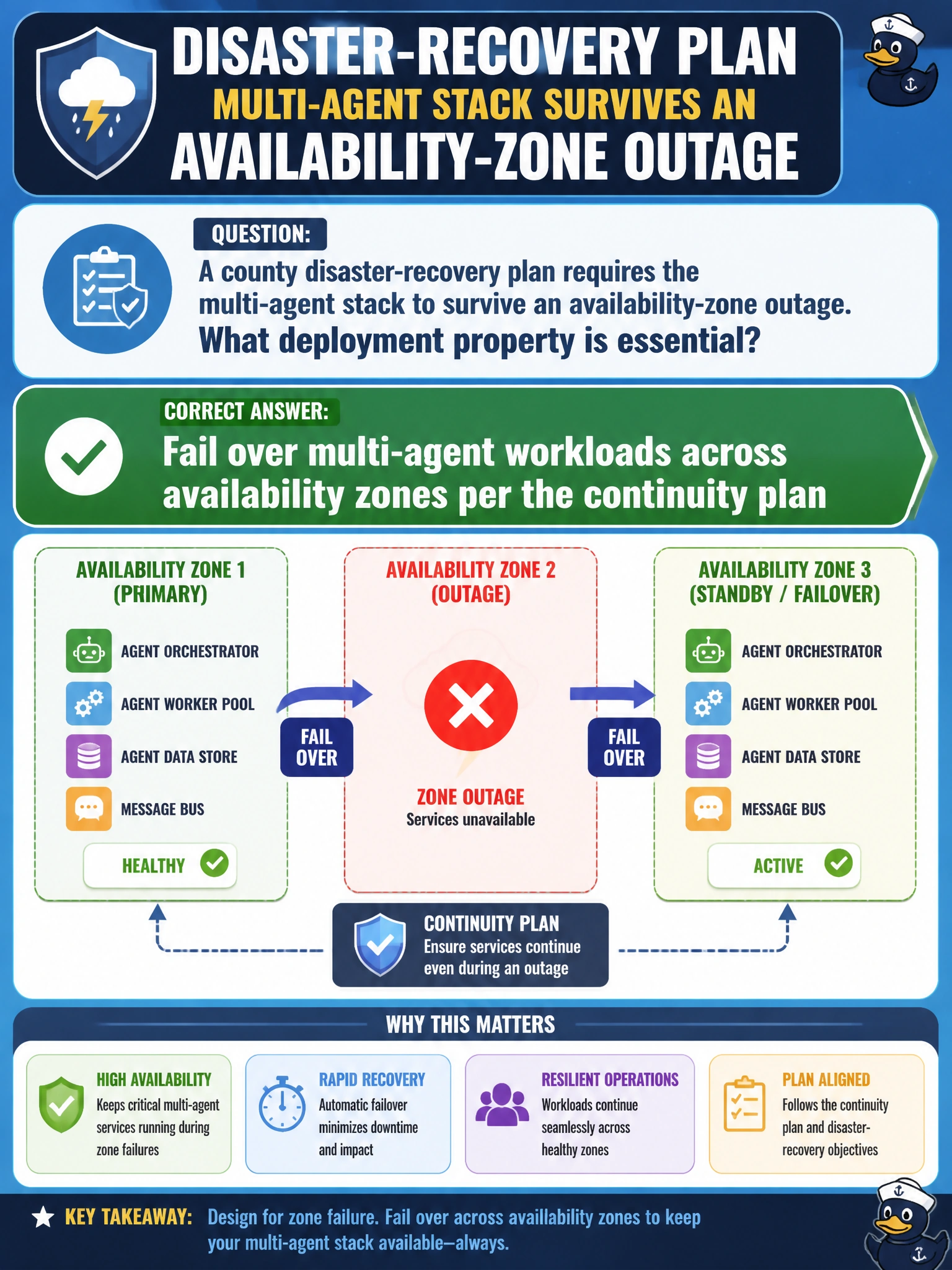
A county disaster-recovery plan requires the multi-agent stack to survive an availability-zone outage. What deployment property is essential?
Select an answer to reveal the explanation.
Short Explanation
If one data center goes dark, the county still needs the agents answering. Build failover across zones—don’t pin everything to one basement. Notebook state and fake-green health checks won’t survive a real outage.
Full Explanation
Resilient multi-agent municipal deployments must fail over across availability zones to meet disaster-recovery and continuity requirements. When a county DR plan requires survival of an availability-zone outage, the essential deployment property is failing over multi-agent workloads across zones per that continuity plan—with replicated or externally durable state, health-based routing, and tested runbooks. Continuity is a deployment property, not a slide-deck aspiration.
Pinning every agent to a single zone with no failover path guarantees outage when that zone fails and contradicts the DR plan. Storing all runtime state only in one engineer’s notebook is not durable, shared, or recoverable infrastructure. Disabling health checks so failed zones look healthy on paper falsifies readiness and blocks automated failover decisions.
Exam caveat: multi-AZ failover aligned to the continuity plan is a core production property for county multi-agent stacks—single-zone demos are not disaster recovery. Operational check: simulate a zone outage in staging, confirm orchestrator, tools, and specialists resume in a surviving zone, validate state recovery for in-flight civic workflows, measure RTO/RPO against the DR plan, and keep health checks enabled as the failover signal.