
Peak snow-day load requires autoscaling the planner agent. What must production orchestration preserve?
Select an answer to reveal the explanation.
Short Explanation
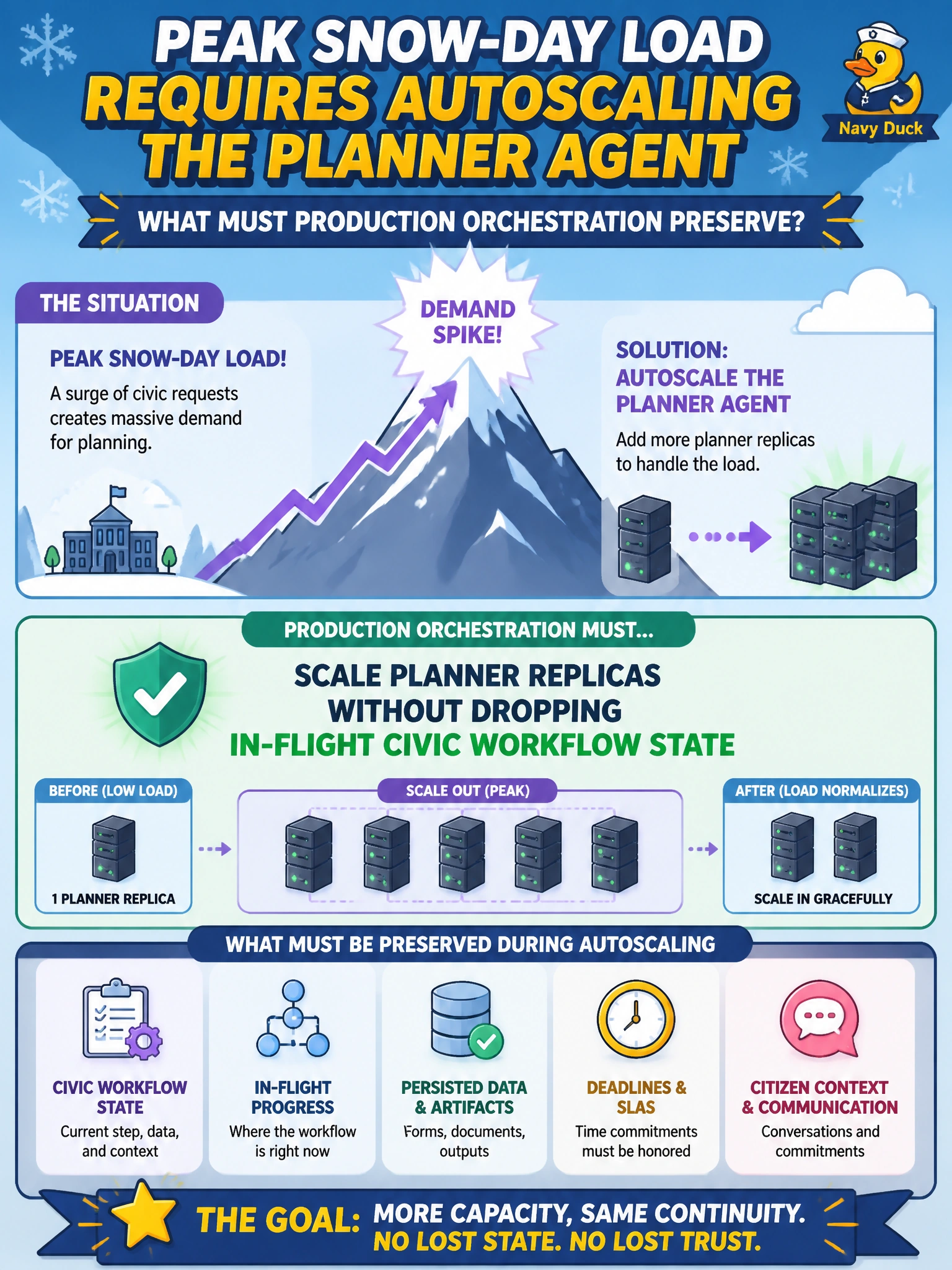
Snow day is rush hour for the planner—add lanes without dumping the trucks already en route. Autoscale replicas while keeping in-flight workflow state. Freezing scale or bouncing every process mid-task loses the work mid-storm.
Full Explanation
Production-scale orchestration under municipal load spikes must autoscale planner capacity while preserving in-flight workflow state for tasks already underway. Peak snow-day load on plow and salt coordination cannot simply shed active work; scaling planner replicas without dropping in-flight civic workflow state keeps continuity for residents and field crews during the surge. Durable workflow state and session affinity or shared stores are part of that design.
Dropping all in-flight plow and salt tasks so new requests always win sacrifices work already accepted and confuses field operations mid-route. Freezing autoscaling entirely during emergencies denies capacity exactly when demand peaks and SLOs are most at risk. Restarting every agent process on each new ticket to clear memory destroys session and workflow continuity and amplifies load instead of absorbing it.
Exam caveat: autoscaling for civic planners must be state-safe—scale out without abandoning in-flight workflows during emergency peaks. Operational check: inject a snow-day load test with in-flight tasks, trigger scale-out of planner replicas, confirm existing workflow IDs continue to completion via durable state, verify no silent task drops in the audit log, and validate field-facing status APIs still resolve those IDs.