
How should orchestrator, tools, and specialist agents be deployed for a production civic multi-agent system?
Select an answer to reveal the explanation.
Short Explanation
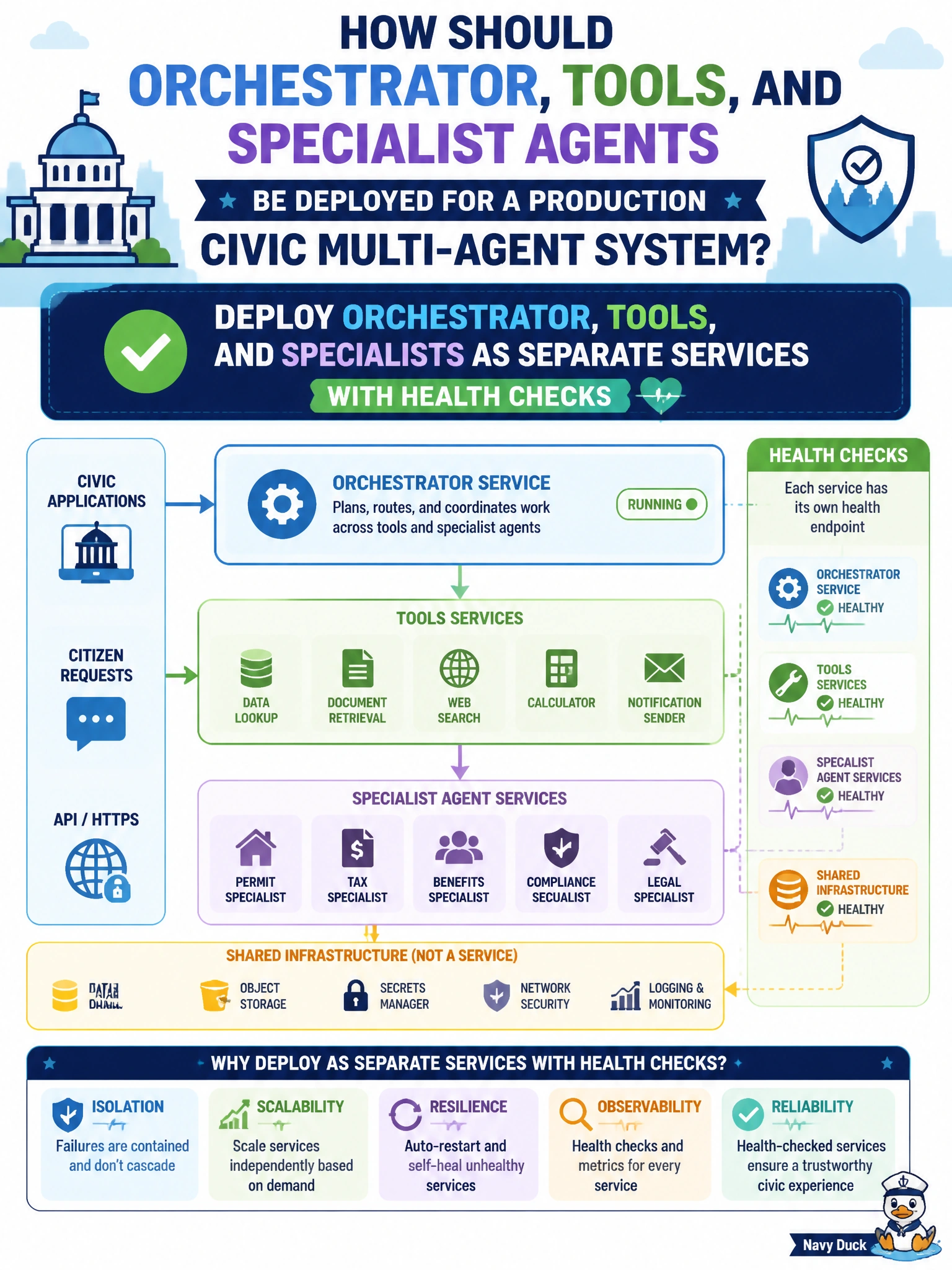
Think separate kitchen stations with a pass window, not one giant blender. Split orchestrator, tools, and specialists into services you can health-check. One mega-process or a home PC is how lunch—and permits—stop for everyone.
Full Explanation
Service decomposition for production multi-agent civic systems separates orchestrator, tools, and specialist runtimes so each can be health-checked, scaled, and restarted independently. Deploying those pieces as separate services with health checks is the operational pattern that matches how municipal platforms monitor, alert, and recover production workloads without taking the entire stack down for one failing tool.
Bundling every agent and tool into one unsplittable process with no health checks creates opaque failure domains and a coarse blast radius when anything breaks. Hosting tools only on a volunteer’s home PC outside city control violates custody, security, network, and continuity requirements. Deploying each piece as a spreadsheet macro that cannot be monitored is not a production runtime and cannot meet civic SLOs.
Exam caveat: production civic multi-agent architecture expects separable, health-checked services—not monoliths, home hosting, or unmonitorable office artifacts. Operational check: deploy orchestrator, a tool service, and a specialist as distinct units; kill each in turn and confirm health checks fail and remaining components degrade gracefully; verify metrics and logs are per-service; document restart runbooks for on-call staff.