
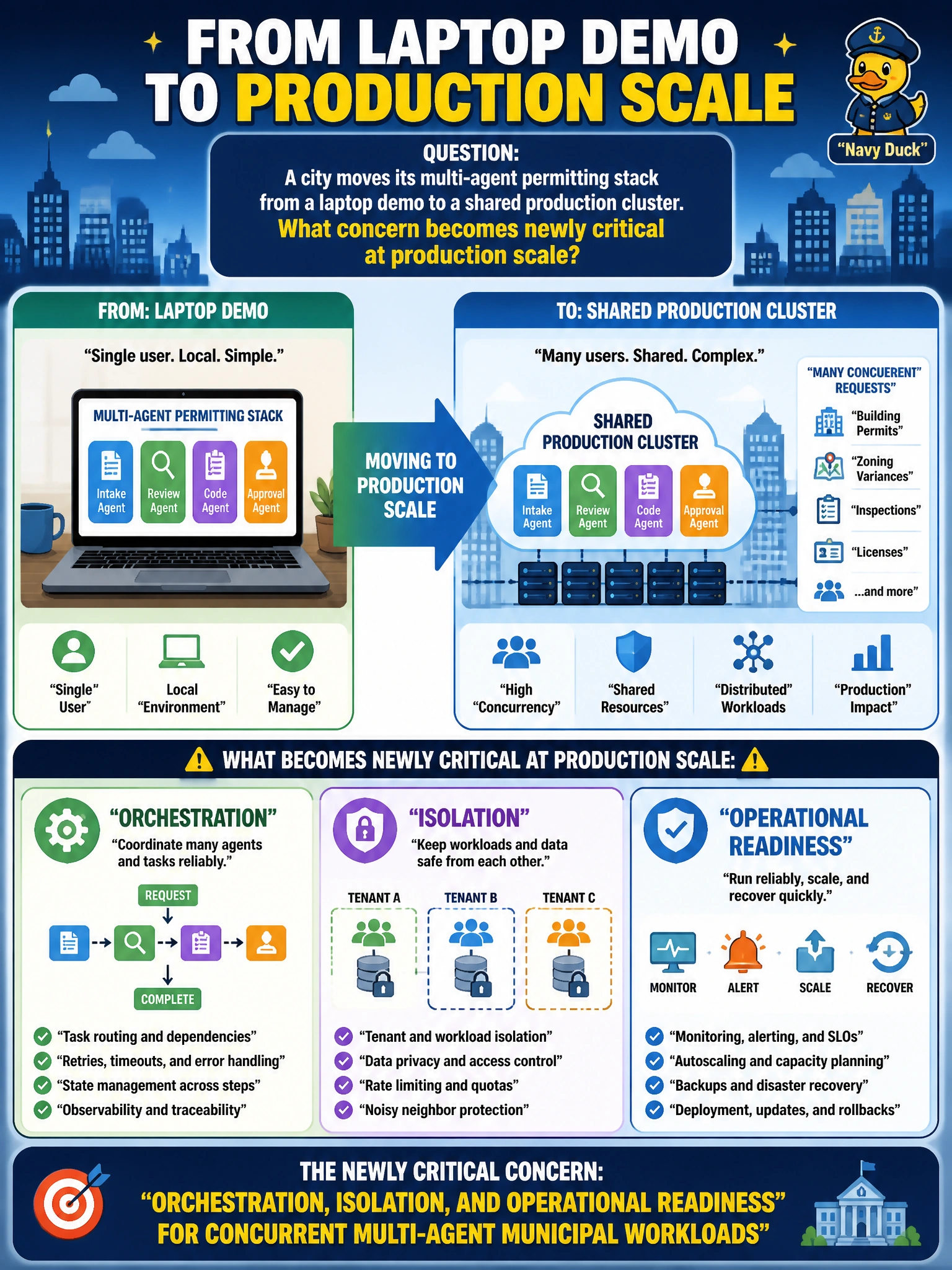
A city moves its multi-agent permitting stack from a laptop demo to a shared production cluster. What concern becomes newly critical at production scale?
Select an answer to reveal the explanation.
Short Explanation
A laptop demo is a garage band; production is the civic center on opening night. You need real orchestration, isolation, and ops readiness for many agents at once—not SSH into someone’s laptop. Screensaver polish won’t keep permits flowing.
Full Explanation
Production deployment of multi-agent municipal systems introduces concurrency, isolation, health, and operational concerns absent from single-laptop demos. Moving a permitting stack from a laptop demo to a shared production cluster makes orchestration, isolation, and operational readiness for concurrent multi-agent workloads newly critical—service boundaries, resource limits, secrets management, structured logging, and on-call paths that a personal demo never stressed. Shared clusters must survive concurrent clerks and residents without colliding state.
Whether the demo laptop screensaver looks civic enough is irrelevant to production risk. Keeping agents startable only by SSH onto one engineer’s machine recreates a single point of failure and blocks shared operations handoff. Requiring every specialist to remain a single local Python script forever refuses the service model production scale and multi-tenant municipal load need.
Exam caveat: demo success is not production readiness—shared civic multi-agent systems need orchestration and isolation for concurrent load. Operational check: deploy to a shared cluster staging environment, run concurrent permit scenarios with multiple specialist agents, verify health checks and isolation between agents and tools, confirm ops can restart and observe services without SSH to a developer laptop, and document runbooks before cutover.