
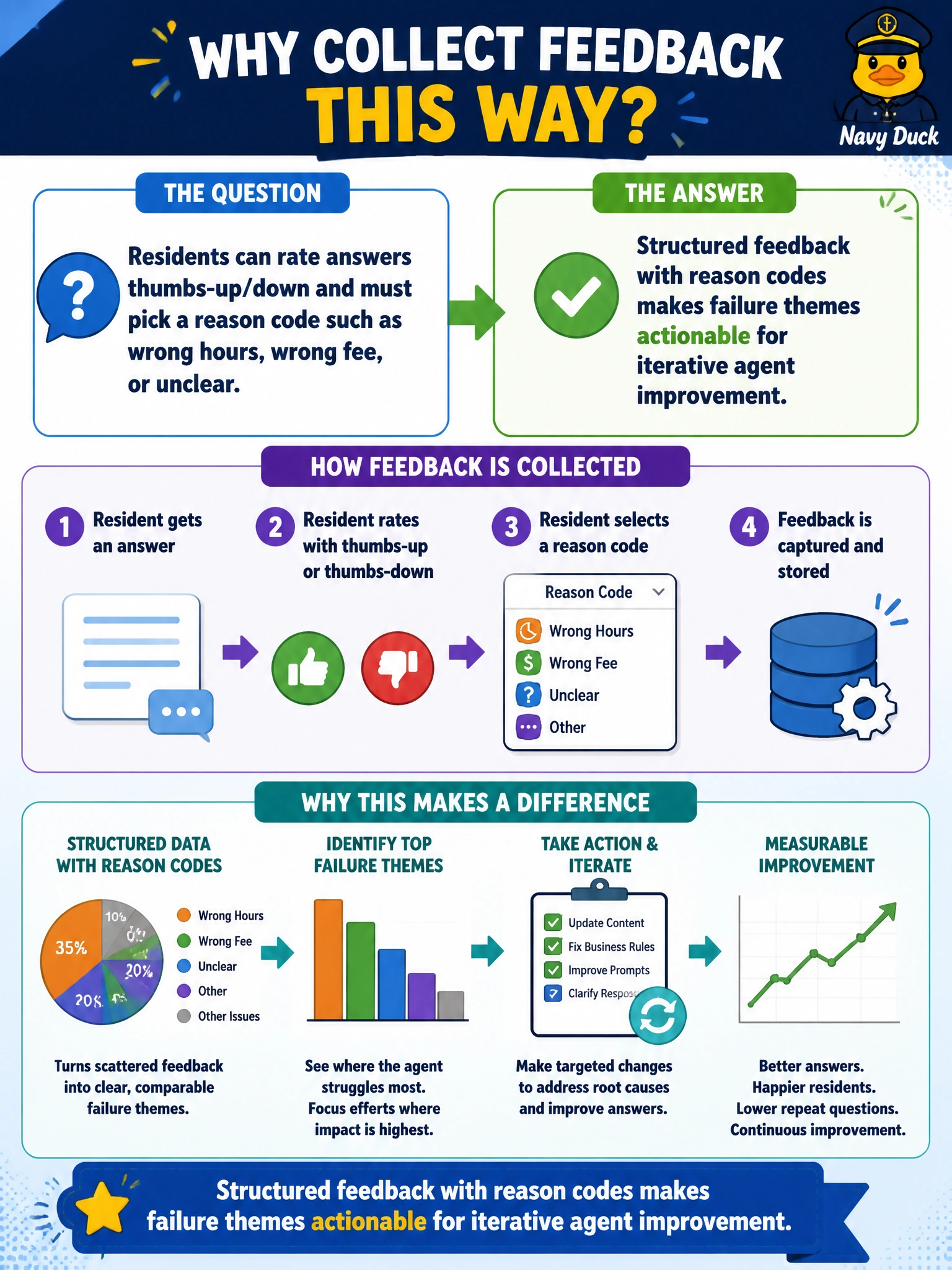
Residents can rate answers thumbs-up/down and must pick a reason code such as wrong hours, wrong fee, or unclear. Why collect feedback that way?
Select an answer to reveal the explanation.
Short Explanation
A thumbs-down without “wrong fee” or “unclear” is a shrug—you can’t fix a shrug. Reason codes turn resident feedback into a punch list. Free-form rants alone are harder to tally into prompt work.
Full Explanation
Residents rating answers thumbs-up/down and selecting reason codes such as wrong hours, wrong fee, or unclear provides structured feedback that makes failure themes actionable for iterative agent improvement. Reason codes turn binary sentiment into categorized defect classes that product and prompt teams can prioritize—fee errors versus hours errors need different fixes. Structured civic feedback loops are an evaluation-and-tuning input, not a vanity widget.
Unstructured silence from residents is not enough to prioritize prompt fixes; absence of signal is not a ranked backlog. Claiming reason codes slow learning so teams should accept only free-form rants undervalues aggregation; free text helps nuance but is harder to tally at city scale without codes. Treating thumbs-down without codes as an automatic production deletion is an unstable control loop that lacks diagnosis.
Exam caveat: combine reason codes with sampled free text and online metrics; codes prioritize themes, while traces explain root cause. Operational check: require a reason code on thumbs-down, weekly-aggregate top codes (wrong fee, wrong hours, unclear), map each theme to owners (retrieval, prompt, tool data), and verify the backlog shrinks those categories after targeted fixes.