
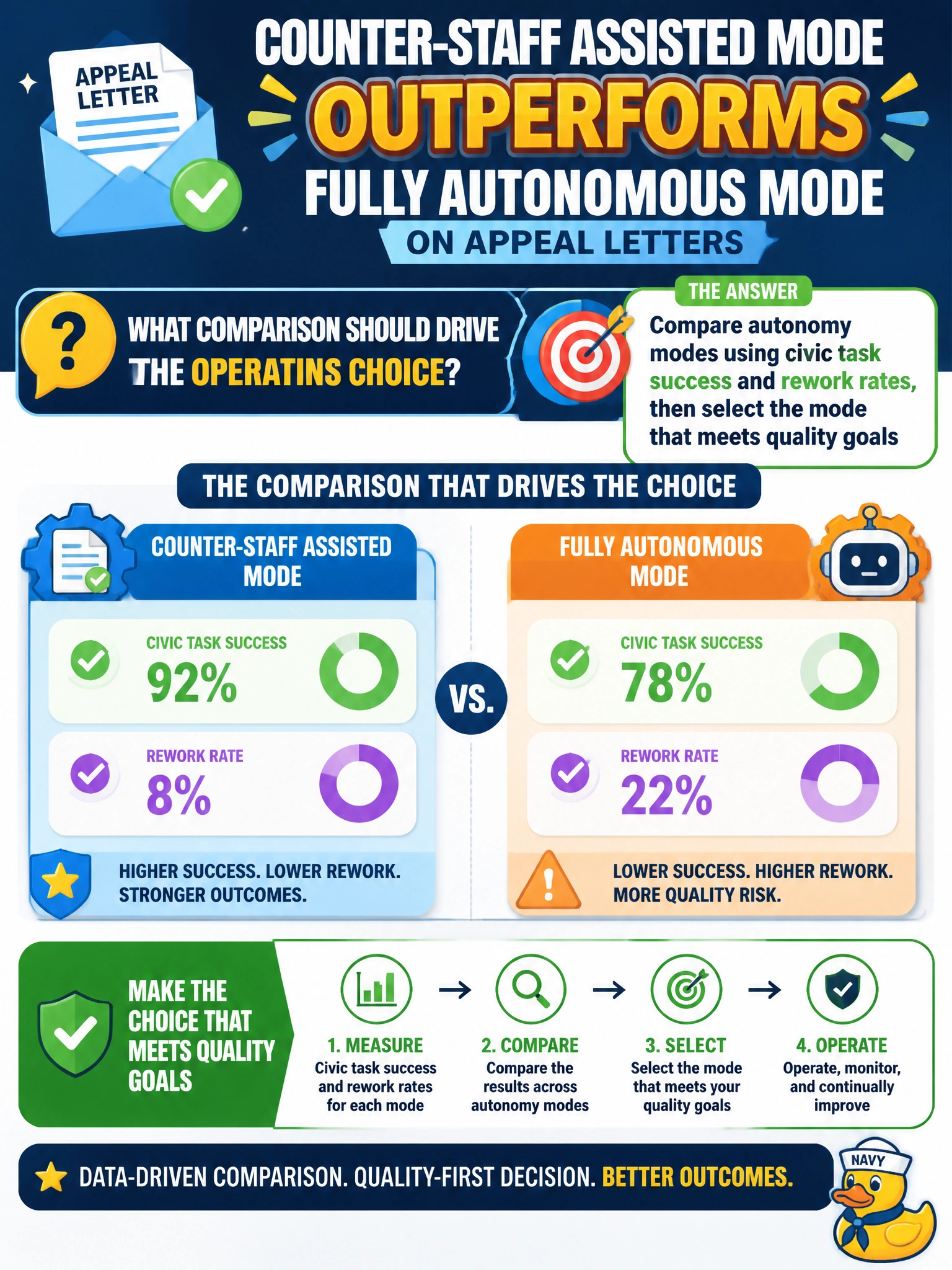
Counter-staff assisted mode outperforms fully autonomous mode on appeal letters. What comparison should drive the operating choice?
Select an answer to reveal the explanation.
Short Explanation
If staff-assisted drafts win on appeal letters, believe the scoreboard: success and rework rates. Blind autonomy or “fast email” without quality checks just ships more do-overs. Pick the mode that hits the city’s quality bar.
Full Explanation
When counter-staff assisted mode outperforms fully autonomous mode on appeal letters, the operating choice should follow a comparison of autonomy modes using civic task success and rework rates, then select the mode that meets quality goals. Assisted mode that wins on correctness and reduces rework is the rational municipal choice even if it spends some human time. Autonomy level is a tunable operating parameter guided by evaluation evidence, not an ideology.
Always choosing full autonomy to minimize measured human time regardless of rework ignores quality and can increase total municipal labor through corrections. Ignoring assisted-mode wins because autonomy is always the strategic mandate discards evaluation evidence. Measuring only how quickly letters are emailed without checking correctness optimizes speed of defective correspondence.
Exam caveat: autonomy can still expand later if assisted-mode metrics show the agent closing the quality gap; the comparison should be revisited on a schedule. Operational check: compare assisted versus autonomous appeal-letter suites on success and rework, adopt assisted mode while it wins, track human minutes and rework cost, and reconsider full autonomy only when autonomous quality meets the city’s bar without unacceptable rework.