
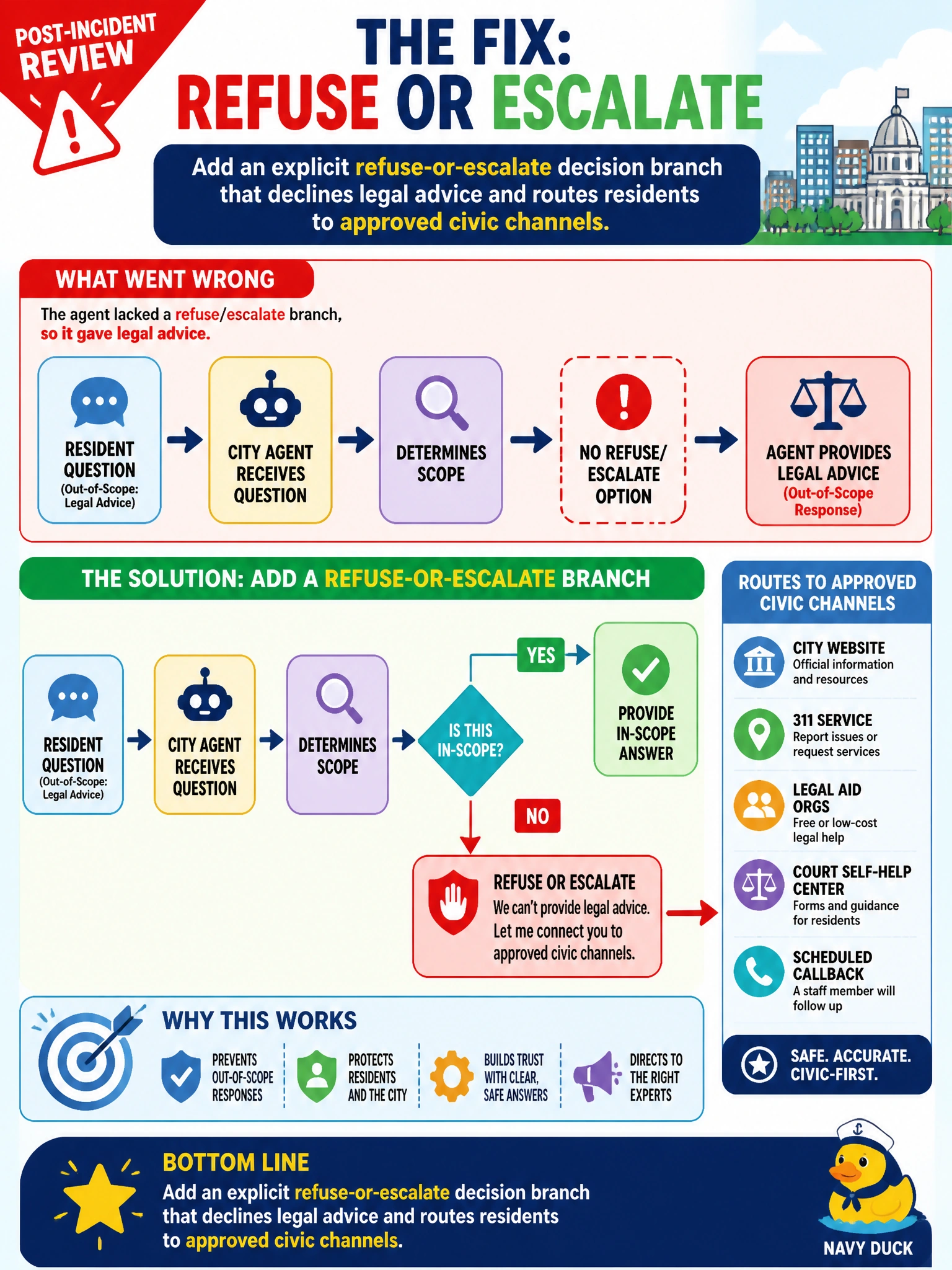
A post-incident review finds the city agent gave legal advice because it lacked a refuse/escalate branch for out-of-scope questions. What decision strategy should be added?
Select an answer to reveal the explanation.
Short Explanation
City bots aren’t the resident’s lawyer. When the review shows it gave legal advice, you add a clear “nope—escalate” branch and point people to the right channel. Silence or confident internet lawyering both fail the resident.
Full Explanation
A post-incident review that finds the city agent gave legal advice because it lacked a refuse/escalate branch shows a missing decision strategy for out-of-scope questions. Developers should add an explicit refuse-or-escalate branch that declines legal advice and routes residents to approved civic channels (city attorney referral paths, published legal aid resources, or human intake—per local policy). Scope control is decision logic: without a governed “no / handoff” path, models improvise, and improvised legal advice creates liability and resident harm.
Answering all legal questions confidently using general internet summaries doubles down on unauthorized practice-of-law risk. Silently ignoring legal questions without telling the resident anything withholds help and referral, leaving people stranded. Replacing the entire agent with a static PDF of state statutes abandons conversational triage and does not implement a refuse/escalate decision branch for live questions.
Exam caveat: refuse/escalate for legal advice is a scope boundary, not a ban on linking to official published ordinances when policy allows informational citation without personalized legal counsel. Operational check: ask clearly legal-advice prompts in staging, confirm the agent declines and offers approved referral channels, verify no improvised counsel is emitted, and ensure the new branch is covered in the evaluation suite before closing the incident.