
School-district agents escalate routine questions to humans too early, flooding counselors. What decision-strategy change is appropriate?
Select an answer to reveal the explanation.
Short Explanation
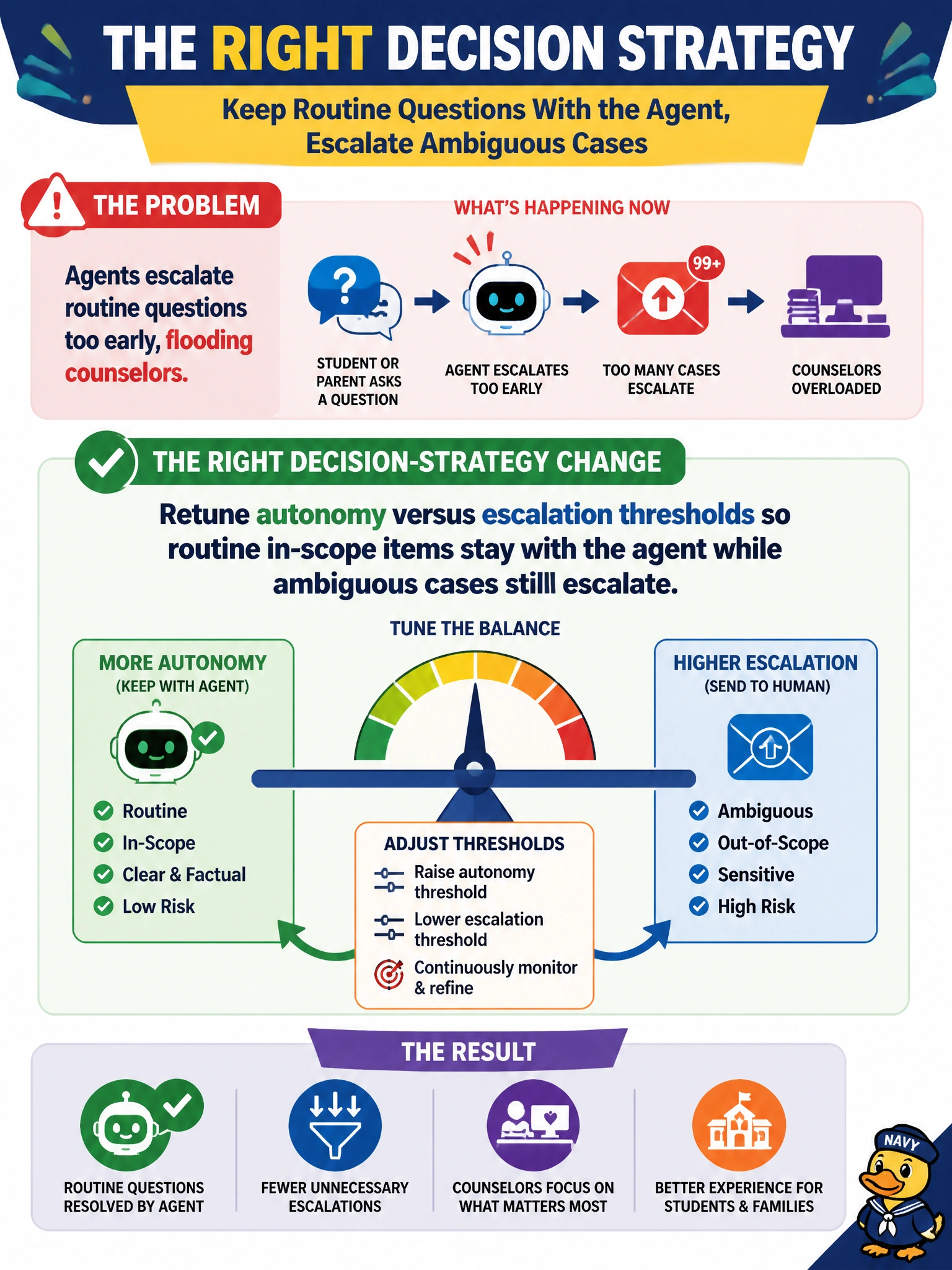
If the agent taps counselors for “what’s the lunch menu,” the threshold is too twitchy. Raise autonomy for routine in-scope asks, keep escalation for the fuzzy or risky stuff. Never-escalate and always-escalate are both broken dials.
Full Explanation
School-district agents that escalate routine questions to humans too early flood counselors and waste scarce staff time. The appropriate decision-strategy change is to retune autonomy versus escalation thresholds so routine in-scope items stay with the agent while ambiguous, crisis, or out-of-policy cases still escalate. Threshold calibration is a core agent decision control: too low and counselors drown in lunch-menu questions; too high and genuine risk is missed.
Escalating every question immediately so counselors handle the entire queue abandons the agent’s purpose and recreates a full human queue. Never escalating again, even for crisis or out-of-policy requests, removes the safety valve municipal education agents need. Randomizing escalation so staff workload feels fairer week to week is not a principled policy and can delay urgent cases while still escalating trivial ones.
Exam caveat: retune with measured overload and error rates by question class; autonomy gains must not disable crisis or policy-bound escalation paths. Operational check: classify a week of escalations into routine-in-scope versus ambiguous/crisis, raise autonomy for the routine class, keep escalation for crisis/out-of-policy, re-measure counselor volume and miss rate, and lock thresholds that balance both.