
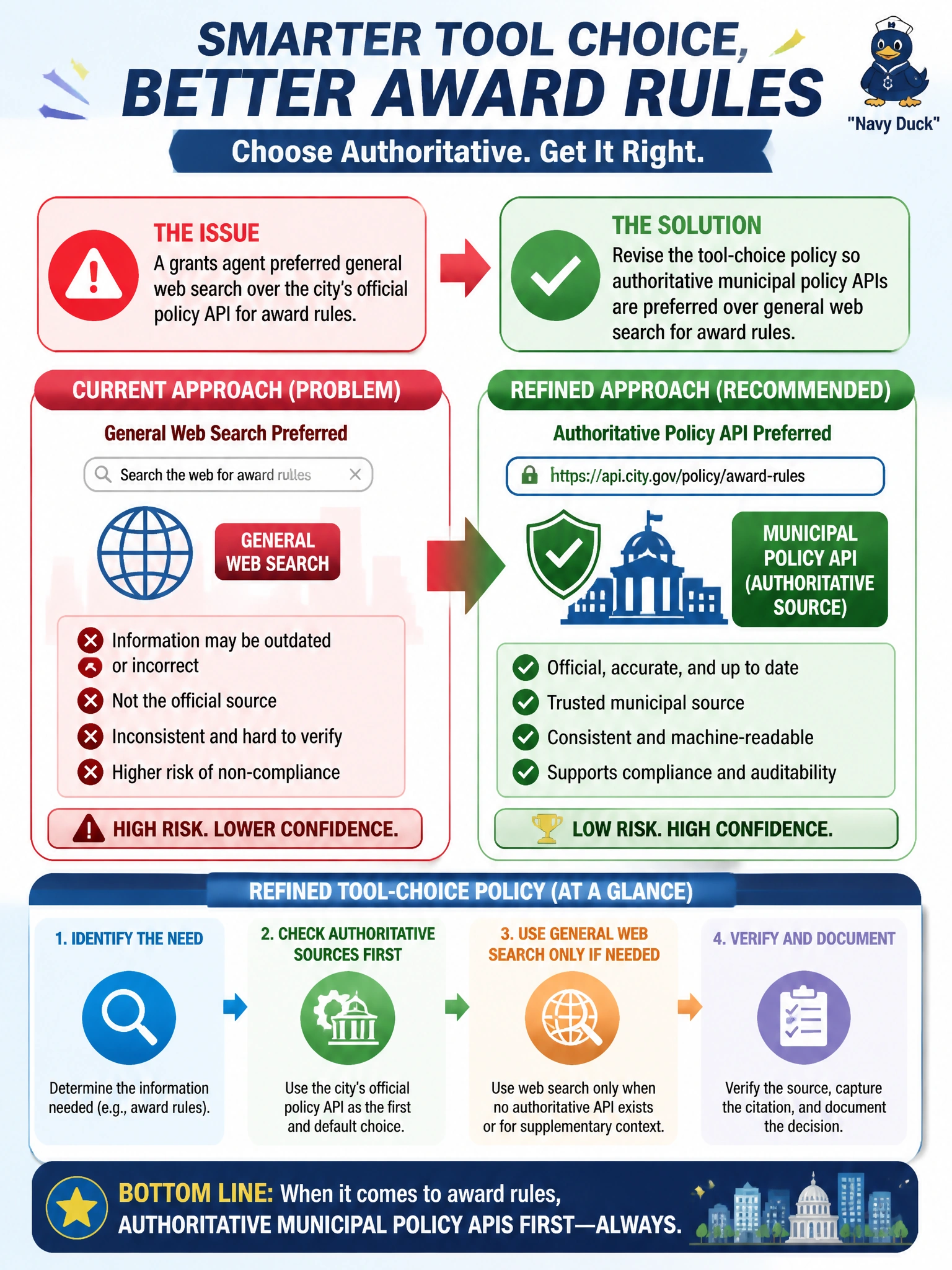
A grants agent preferred general web search over the city’s official policy API for award rules. How should its tool-selection strategy be refined?
Select an answer to reveal the explanation.
Short Explanation
You’ll get more reliable award-rule answers by having the agent prefer the city’s official policy API over general web search. Make that authority clear in its tool-choice policy. Avoiding the API, inventing grant caps, or relying on memory alone can lead you away from the city’s actual rules.
Full Explanation
The tool-selection strategy should be revised so the city’s official policy API is preferred over general web search for award rules. The API is the authoritative source for municipal policy, so making it the preferred tool helps the agent return rules grounded in the city’s current information rather than general search results. Configuring the agent to avoid the city’s policy API and rely on public search engines removes access to that authoritative source; reputable search results do not replace the city’s own rules. Allowing the model to invent grant caps when tools disagree fabricates financial limits instead of resolving uncertainty and could produce incorrect award guidance. Removing all tools and answering from parametric memory alone leaves the agent without a way to check policy against the city’s current source, so its answers may be outdated or unsupported. Exam caveat: tool preference should also specify how to handle conflicts or API unavailability; the agent should not invent a cap when it cannot verify one. Practical check: test an award-rule question where general web search and the policy API disagree, then confirm the agent consults the API and reflects its rule, and does not make up a cap if the API is unavailable.