
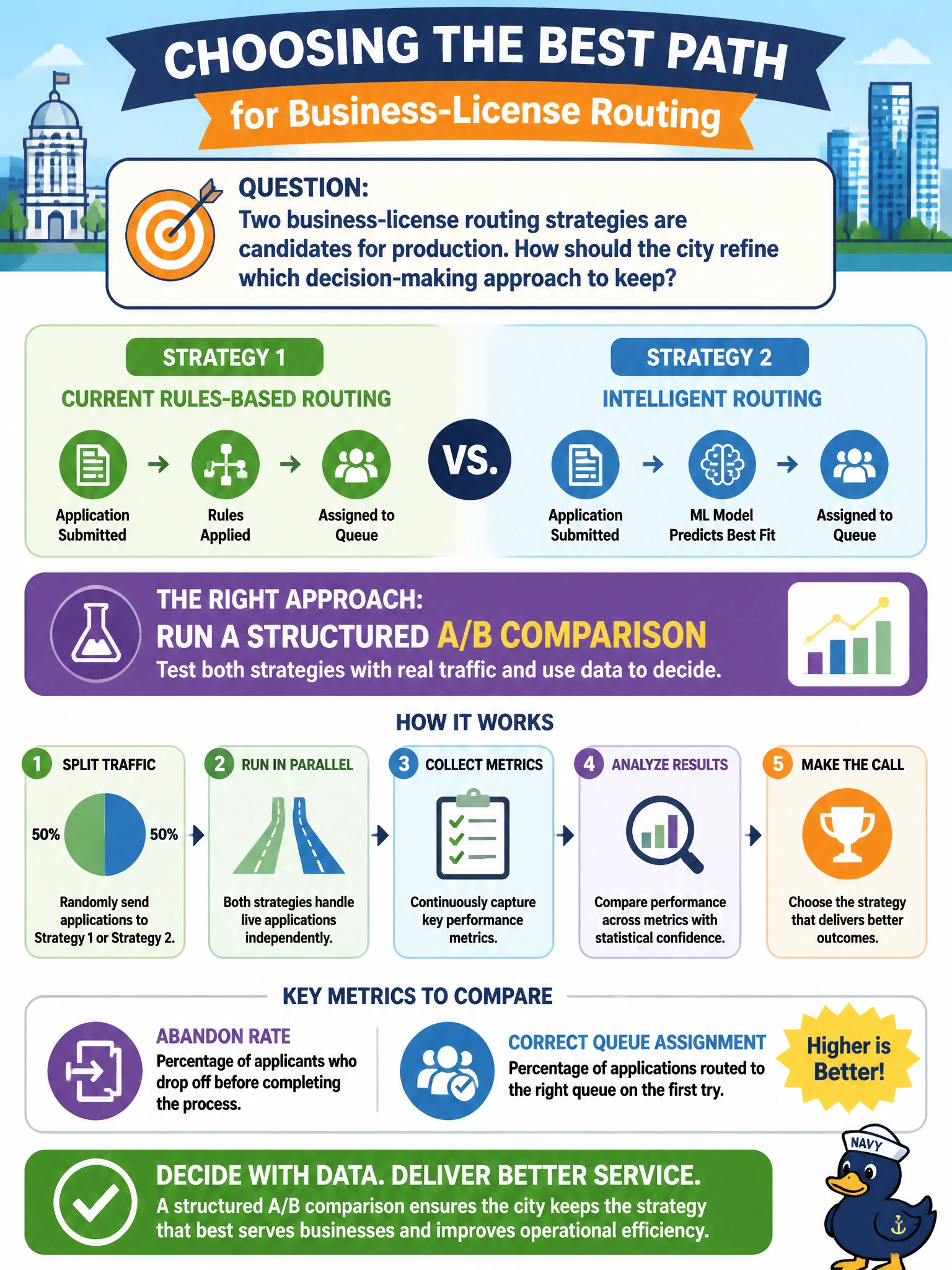
Two business-license routing strategies are candidates for production. How should the city refine which decision-making approach to keep?
Select an answer to reveal the explanation.
Short Explanation
Don’t crown a routing idea because it sounded clever in a meeting—race it. A/B on abandon rate and correct queue tells you which decision strategy actually helps license applicants. Biggest tool pile isn’t a metric.
Full Explanation
When two business-license routing strategies are production candidates, the city should refine the decision-making approach with a structured A/B comparison on outcome metrics such as abandon rate and correct queue assignment. Measured experiments show which strategy actually helps license applicants complete filings and land in the right staff queue. Decision-strategy selection for municipal agents belongs on civic outcome evidence, not on authorship prestige or architectural theatrics.
Picking the strategy written by the most senior developer without measuring outcomes substitutes hierarchy for evidence and can lock in a worse routing policy. Shipping both strategies to every resident simultaneously in the same reply creates contradictory guidance and confounds measurement. Always preferring the strategy that uses the largest number of tools regardless of accuracy optimizes for tool sprawl, not correct license routing or applicant completion.
Exam caveat: A/B refinement needs predefined success metrics, adequate sample size, and guardrails so a clearly harmful variant can be stopped early. Operational check: assign applicants to strategy A or B under an experiment harness, track abandon rate and correct queue assignment, select the winner on those civic metrics, retire the loser, and document the decision so future routing changes follow the same evidence standard.