
After wrong triage of mold complaints, the city reviews which decision heuristic the agent used. What should developers do next?
Select an answer to reveal the explanation.
Short Explanation
When triage goes sideways, you look at the playbook the agent followed and fix that playbook. One bad mold routing is a lesson, not a reason to throw the whole queue into voicemail. Cranking temperature isn’t a strategy review.
Full Explanation
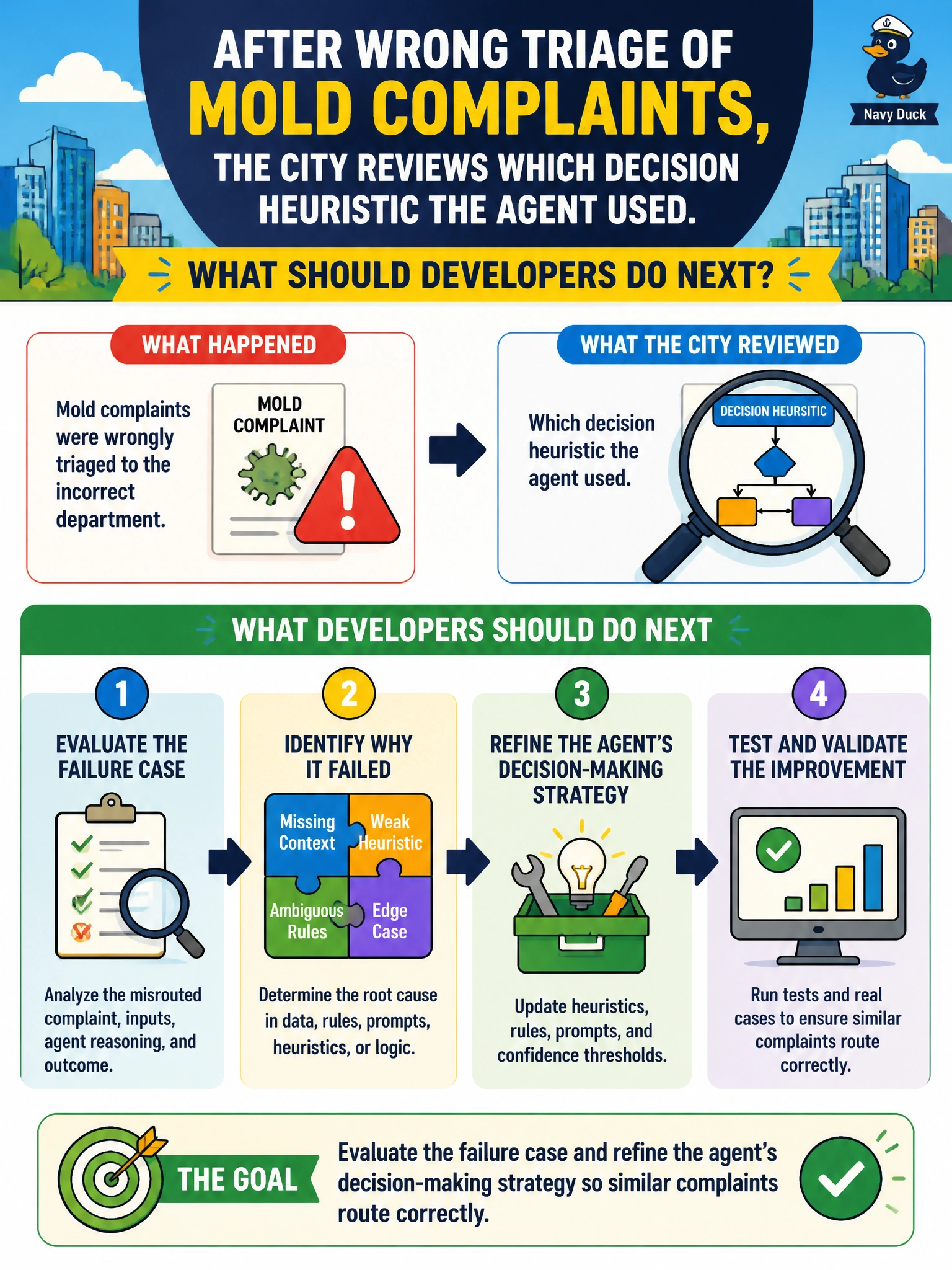
After wrong triage of mold complaints, developers should evaluate the failure case and refine the agent’s decision-making strategy so similar complaints route correctly. Post-incident review of the heuristic, tool-choice policy, or routing rules converts a civic miss into an improved strategy—exactly the agent-development loop of observe, diagnose, and retune decision logic. Mold triage errors can create health and housing risk, so the refinement should be explicit, tested, and monitored rather than shrugged off.
Ignoring the incident because one failure cannot inform strategy changes discards production evidence and leaves the same heuristic in place for the next resident. Disabling all triage and forcing every mold call to voicemail permanently abandons useful automation and floods scarce staff without fixing the decision rule. Raising temperature on every future safety topic is not a strategy review; it increases randomness where civic safety needs clearer, more conservative decision policies.
Exam caveat: strategy refinement after failure is not the same as blanket feature disablement; target the decision heuristic that caused misrouting. Operational check: reconstruct the mold-complaint transcript and tool traces, identify the decision branch that mis-triaged, update routing/heuristics, re-run a labeled mold suite, and confirm similar complaints now reach the correct municipal queue before closing the incident.