
A benefits agent must query eligibility with validated case IDs. What custom-tool design best supports safe municipal system interaction?
Select an answer to reveal the explanation.
Short Explanation
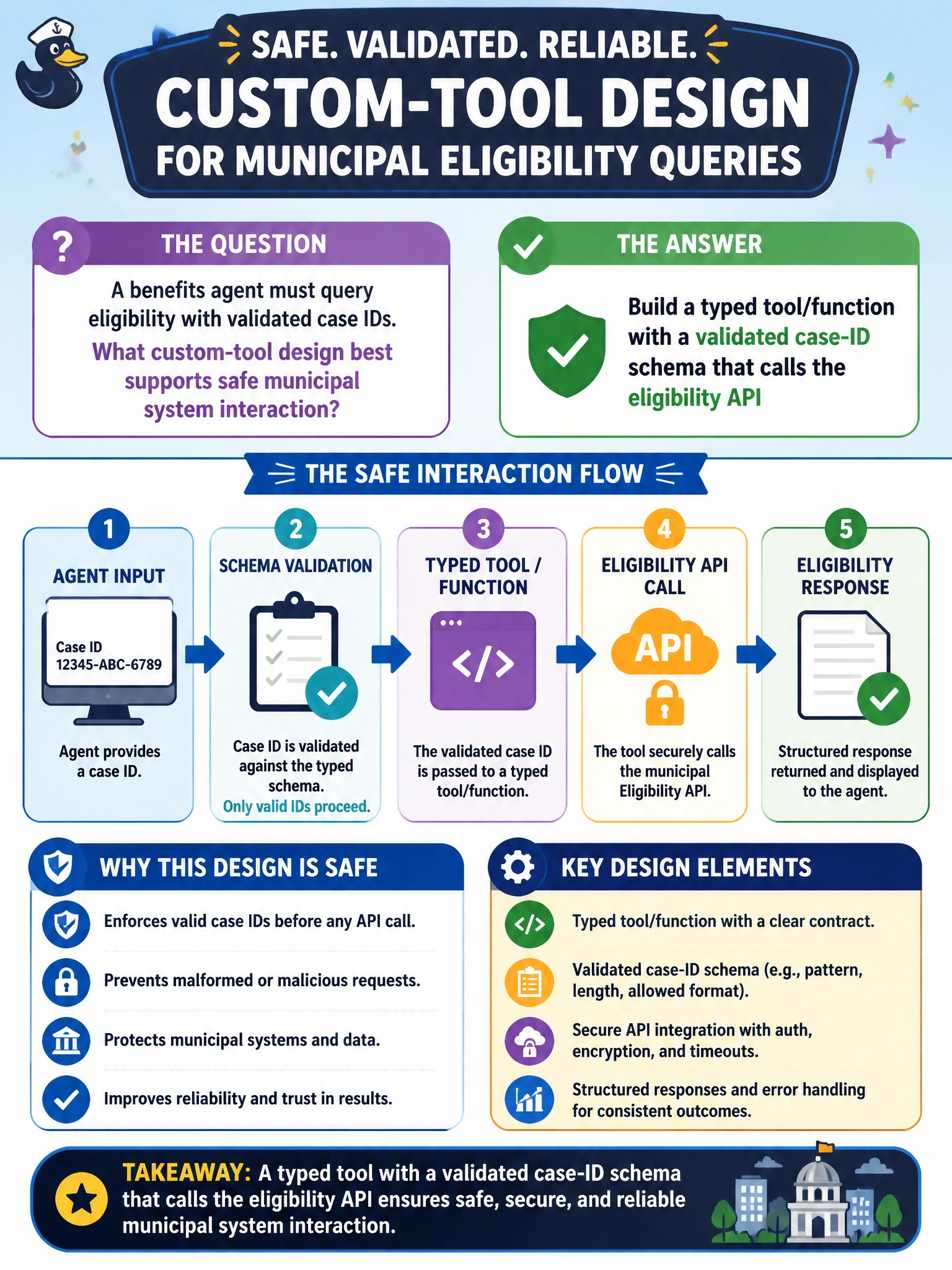
Eligibility lookups need a clean form, not a blank check to the database. Give the agent a typed tool that validates the case ID and calls the official API. Free-form SQL from chat is how benefits systems get hurt.
Full Explanation
Benefits agents that query eligibility must interact with municipal systems through constrained tools, not through free-form database access. A typed tool/function with a validated case-ID schema that calls the eligibility API enforces format checks, authorization, and auditable calls while returning policy-grounded results. Free-form SQL from chat, hard-coded single resident IDs, and publishing database admin credentials all violate safe system-interaction design for casework data.
Letting the LLM paste free-form SQL into the eligibility database from chat text fails by concept: it enables injection-style abuse, unpredictable queries, and direct exposure of sensitive tables. Hard-coding a single resident’s case ID into the prompt and never calling an API cannot serve other residents and embeds personal data into prompts. Publishing database admin credentials to the agent so it can browse any table destroys least privilege and creates a catastrophic civic data breach path.
Exam caveat: validation must cover checksum/format rules used by the city and reject guesses; tool responses should return only fields the agent is cleared to see. Log case-ID queries for program integrity audits without logging unnecessary PII in prompt traces.
Operational check: attempt valid and invalid case IDs against the typed tool in staging, confirm schema validation blocks bad IDs before any API call, and verify the agent cannot issue raw SQL or use elevated database credentials.