
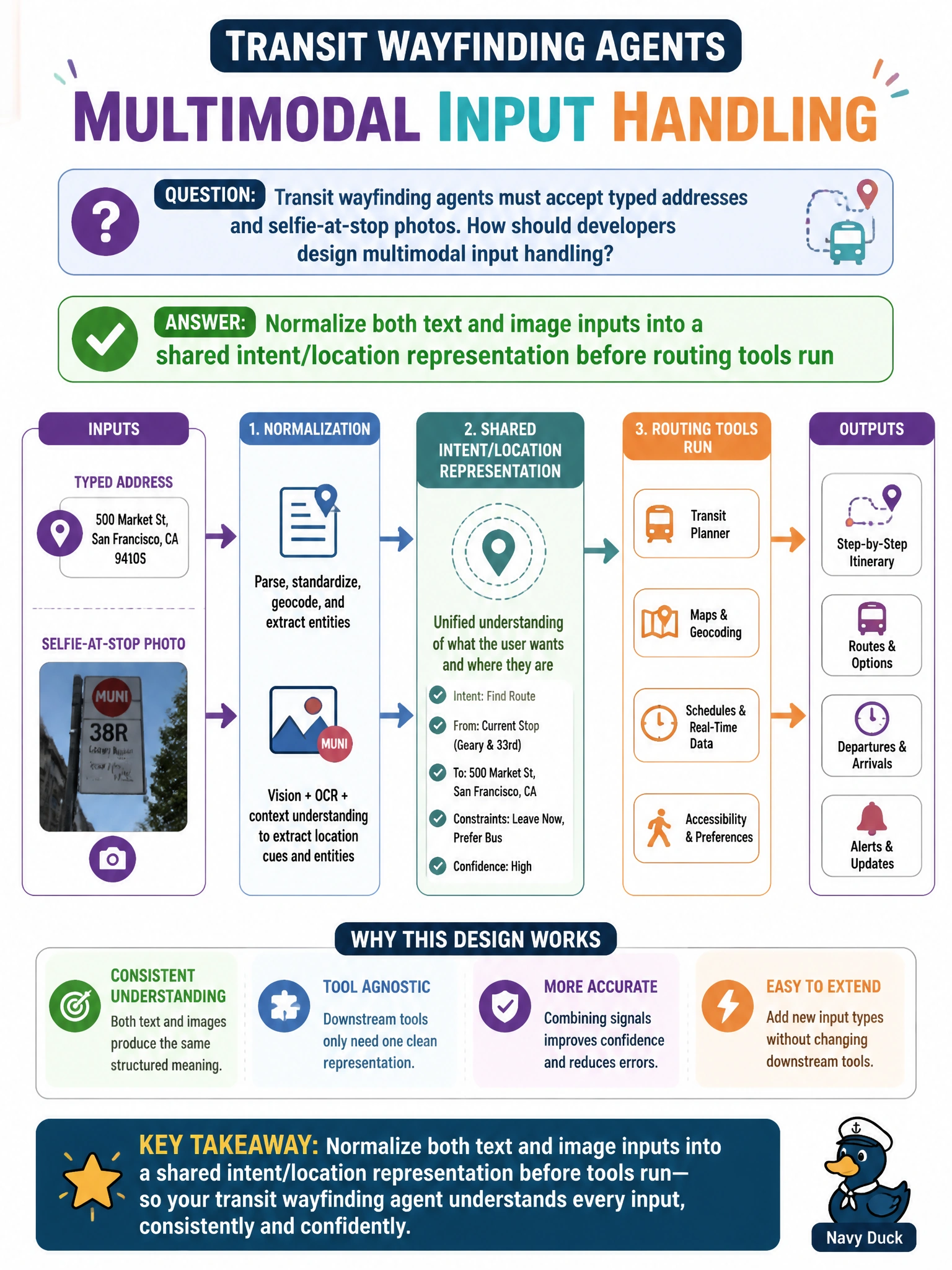
Transit wayfinding agents must accept typed addresses and selfie-at-stop photos. How should developers design multimodal input handling?
Select an answer to reveal the explanation.
Short Explanation
Riders show up with either an address or a phone photo of the stop—both should get them help. Normalize text and image inputs into one location/intent picture, then call the wayfinding tools. Don’t turn a selfie into a payment card.
Full Explanation
Transit wayfinding agents that accept typed addresses and selfie-at-stop photos need a unified understanding of rider intent and location before routing tools run. Developers should normalize both text and image inputs into a shared intent/location representation—address parse, stop ID from signage OCR, map match—then call the same downstream trip or map tools. Rejecting all photos, treating selfies as payment credentials, or running unrelated image-generation models on each selfie mishandles multimodal input relative to wayfinding goals.
Accepting only typed text and rejecting all photos even when riders cannot read stop codes fails by concept: it reduces accessibility and ignores a valid multimodal channel for location hints. Treating every selfie as a payment credential instead of a location hint confuses identity/payment with wayfinding and creates serious security misuse. Running unrelated image-generation models on each selfie before reading the stop wastes compute and does not extract location intent.
Exam caveat: selfie inputs may contain bystanders or other PII; minimize retention and prefer on-device or ephemeral processing where policy requires. OCR and vision matches need confidence thresholds and confirmation (“Is this Stop 412?”) before navigation guidance.
Operational check: submit matched pairs of typed addresses and stop selfies for the same location, verify both paths produce the same normalized location object for routing tools, and confirm payment or image-generation tools are not invoked on wayfinding selfies.