
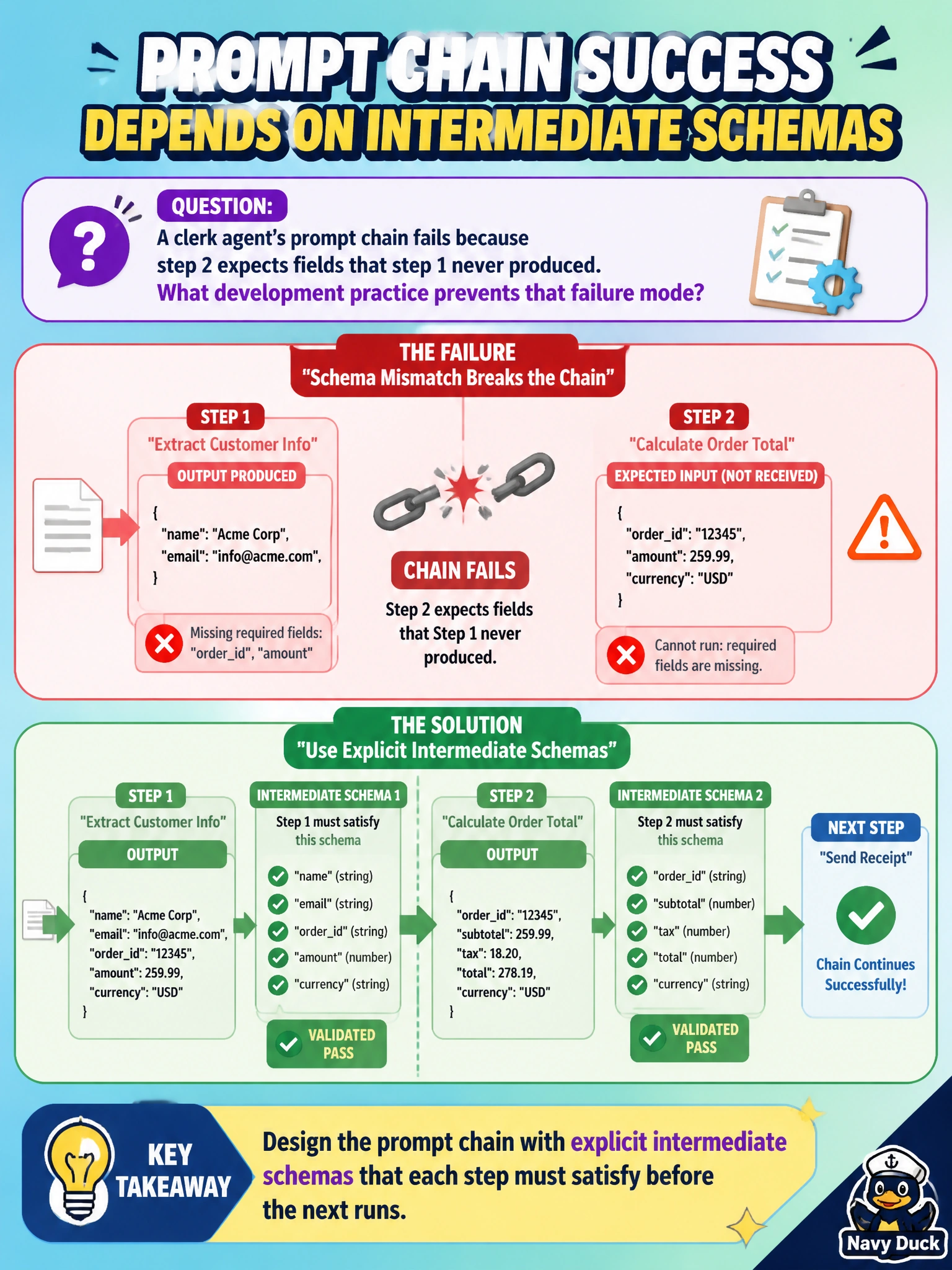
A clerk agent’s prompt chain fails because step 2 expects fields that step 1 never produced. What development practice prevents that failure mode?
Select an answer to reveal the explanation.
Short Explanation
Multi-step clerk work is like a relay—the next runner needs the baton in the right shape. Define intermediate schemas so step 1 actually emits what step 2 consumes. Guessing missing fields mid-chain is how renewals break.
Full Explanation
Clerk agent chains break when step 2 expects fields that step 1 never produced—missing case numbers, parcel IDs, or fee codes that later prompts assume exist. Designing the prompt chain with explicit intermediate schemas that each step must satisfy before the next runs prevents that failure mode: validation gates stop progression until required municipal fields are present or a recovery path runs. Hiding intermediates, inventing arbitrary JSON shapes, and skipping validation all trade short-term speed for brittle multi-step civic workflows.
Hiding intermediate outputs so later steps must guess missing fields fails by concept: it forces hallucination of structured clerk data instead of enforcing production of those fields. Letting each chain step invent any JSON shape without contracts destroys interoperability between steps and makes automated checks impossible. Skipping validation between steps to maximize generation speed deliberately removes the control that would catch schema gaps before residents see broken renewals or filings.
Exam caveat: schemas should be minimal but precise—overly rigid contracts without recovery paths can deadlock the chain when a legacy system returns partial data. Pair schema checks with clear repair prompts or tool re-queries for missing fields.
Operational check: in staging, force step 1 to omit a required field and confirm the chain halts or repairs rather than letting step 2 proceed; then satisfy the schema and verify step 2 receives typed fields exactly as contracted.