
A library FAQ agent over-answers legal and medical questions outside published services. Which prompt practice keeps it inside service boundaries?
Select an answer to reveal the explanation.
Short Explanation
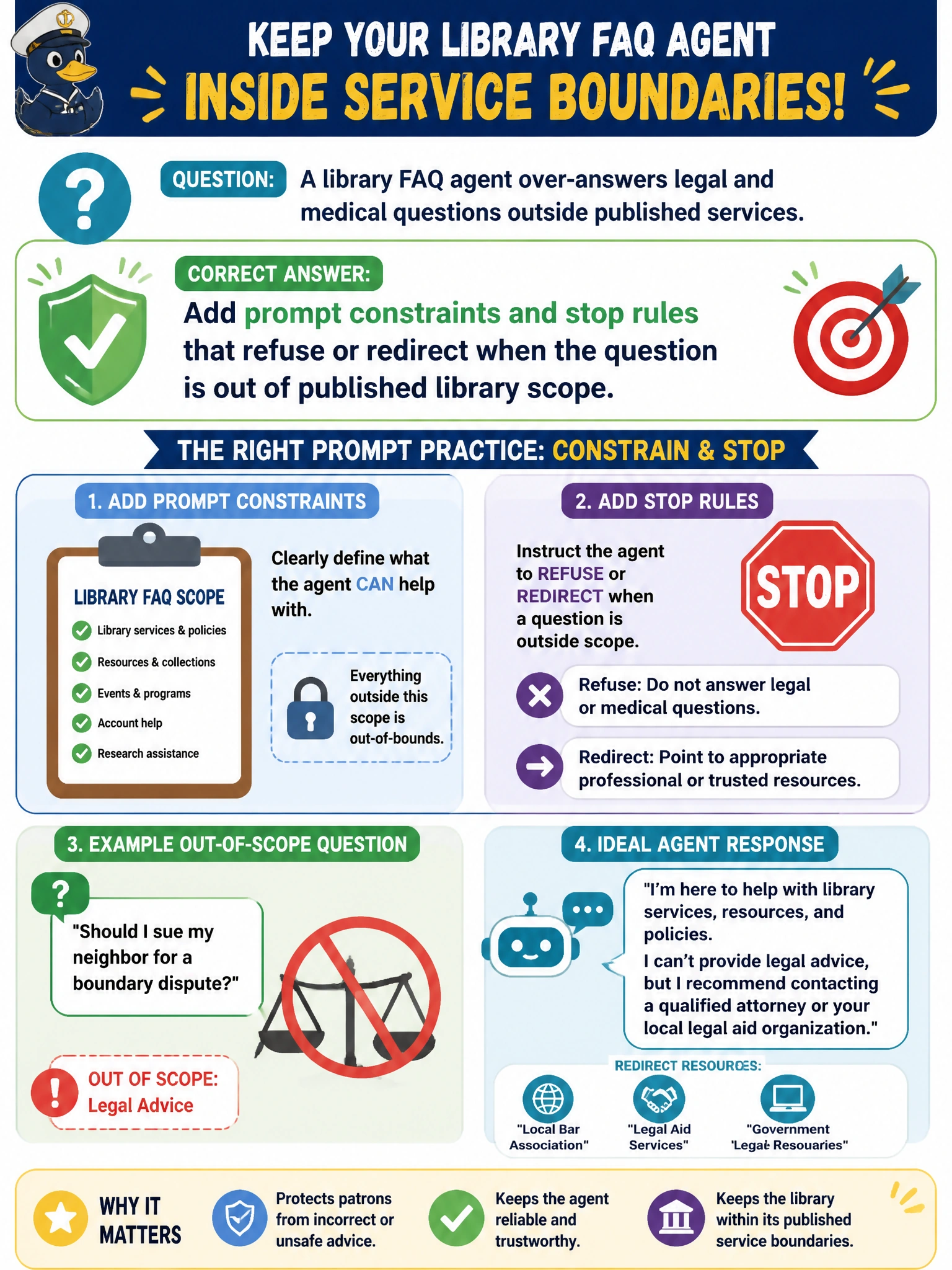
A library bot is a helpful librarian, not a lawyer or doctor. Put stop rules in the prompts: if it’s outside published services, refuse or redirect. Endless over-answering feels helpful until it gives bad legal advice.
Full Explanation
Library FAQ agents should help with published library services—hours, holds, card policies—not deliver legal or medical advice outside that scope. Prompt constraints and stop rules that refuse or redirect when a question leaves published library scope keep the agent inside service boundaries and point patrons to appropriate resources. Rewarding longer answers on every topic, removing scope limits, and relying on staff to clean up after out-of-scope answers all expand liability and confuse patrons about what the library chatbot is authorized to provide.
Rewarding longer answers on every topic to maximize engagement metrics fails by concept: engagement incentives conflict with scope control and push the model toward expansive, ungrounded advice. Removing scope limits so the agent always attempts a full answer institutionalizes out-of-domain responses. Training staff to ignore out-of-scope answers after they are shown to patrons is reactive harm reduction, not prompt design that prevents the disclosure.
Exam caveat: scope lists must be maintained as library services change, and refusals should still be helpful (referral language, phone/chat to human librarians) rather than abrupt dead ends. Borderline questions (e.g., copyright of library materials) need curated guidance, not open-ended legal counsel.
Operational check: probe the agent with legal and medical questions plus in-scope library FAQs; confirm out-of-scope items trigger stop/redirect behavior and in-scope items still answer from published policy content.