
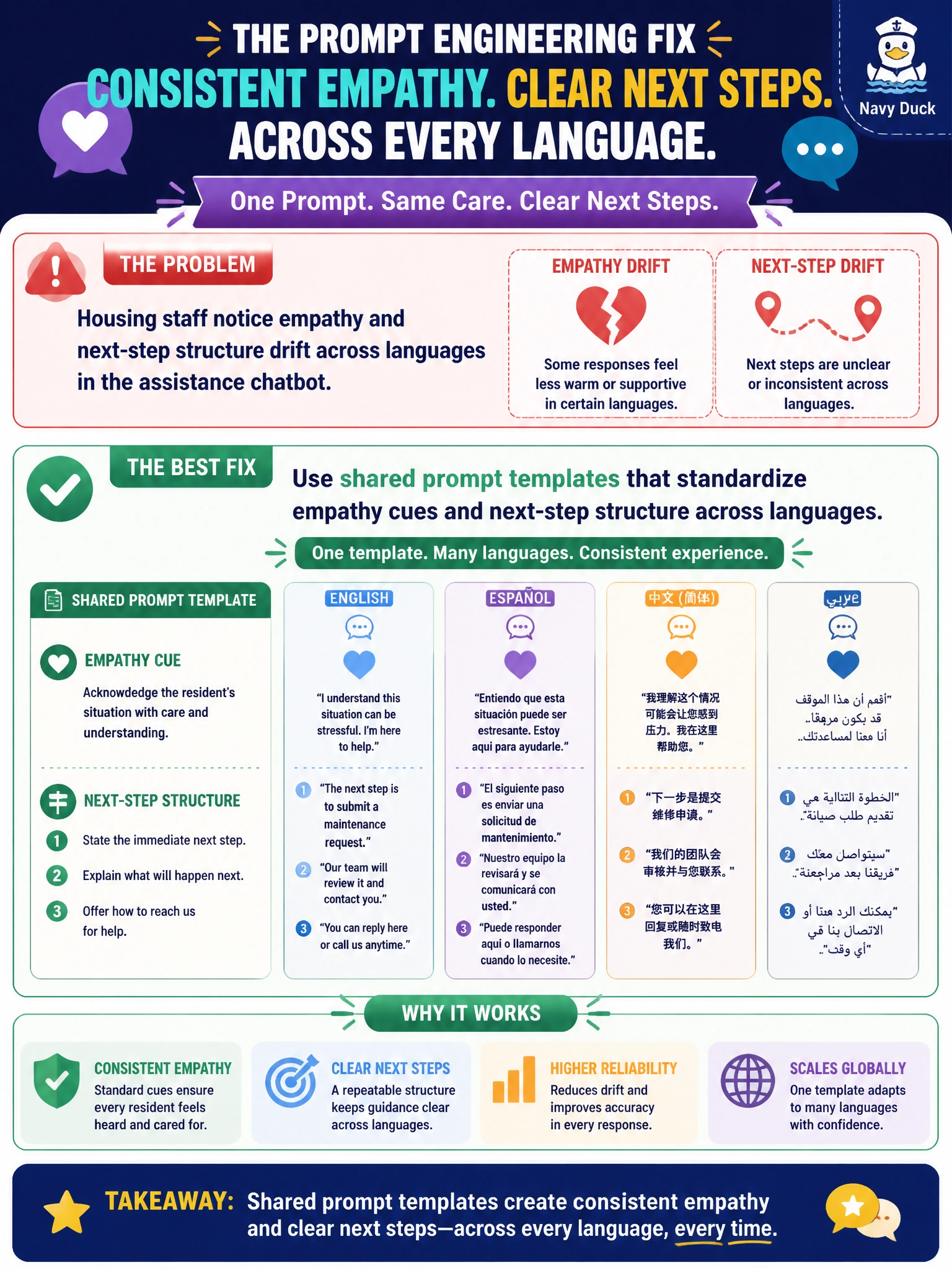
Housing staff notice empathy and next-step structure drift across languages in the assistance chatbot. What prompt-engineering fix best improves reliability?
Select an answer to reveal the explanation.
Short Explanation
Multilingual housing help should feel like the same caring clerk, just speaking another language. Shared prompt templates lock in empathy and clear next steps across locales. Free improvisation per language is how tone and guidance drift.
Full Explanation
Housing assistance chatbots serving multiple languages often drift in empathy cues and next-step structure when each locale improvises tone. Shared prompt templates that standardize those elements across languages improve reliability: residents still get localized wording, but the civic conversation pattern—acknowledge hardship, clarify eligibility needs, state concrete next steps—stays consistent. Partial translation (greeting only) and unconstrained improvisation recreate uneven service quality; shutting off non-English channels abandons equitable access rather than fixing prompt design.
Allowing each language path to improvise tone with no shared template fails by concept: it guarantees inconsistent empathy and action structure across communities the housing office serves. Translating only the greeting and leaving the rest of the chain unconstrained leaves the substantive guidance unstandardized where drift hurts most. Disabling non-English channels until staff rewrite every answer manually is an access regression, not a reliability engineering fix for multilingual prompt chains.
Exam caveat: templates must be reviewed by bilingual housing staff for cultural appropriateness; “shared structure” is not a substitute for accurate translation of program rules. Evaluation should score both policy correctness and presence of required next-step fields per language.
Operational check: run the same housing scenario through each supported language template, score empathy markers and next-step completeness against a shared rubric, and confirm drift drops versus unconstrained locale prompts before wider release.