
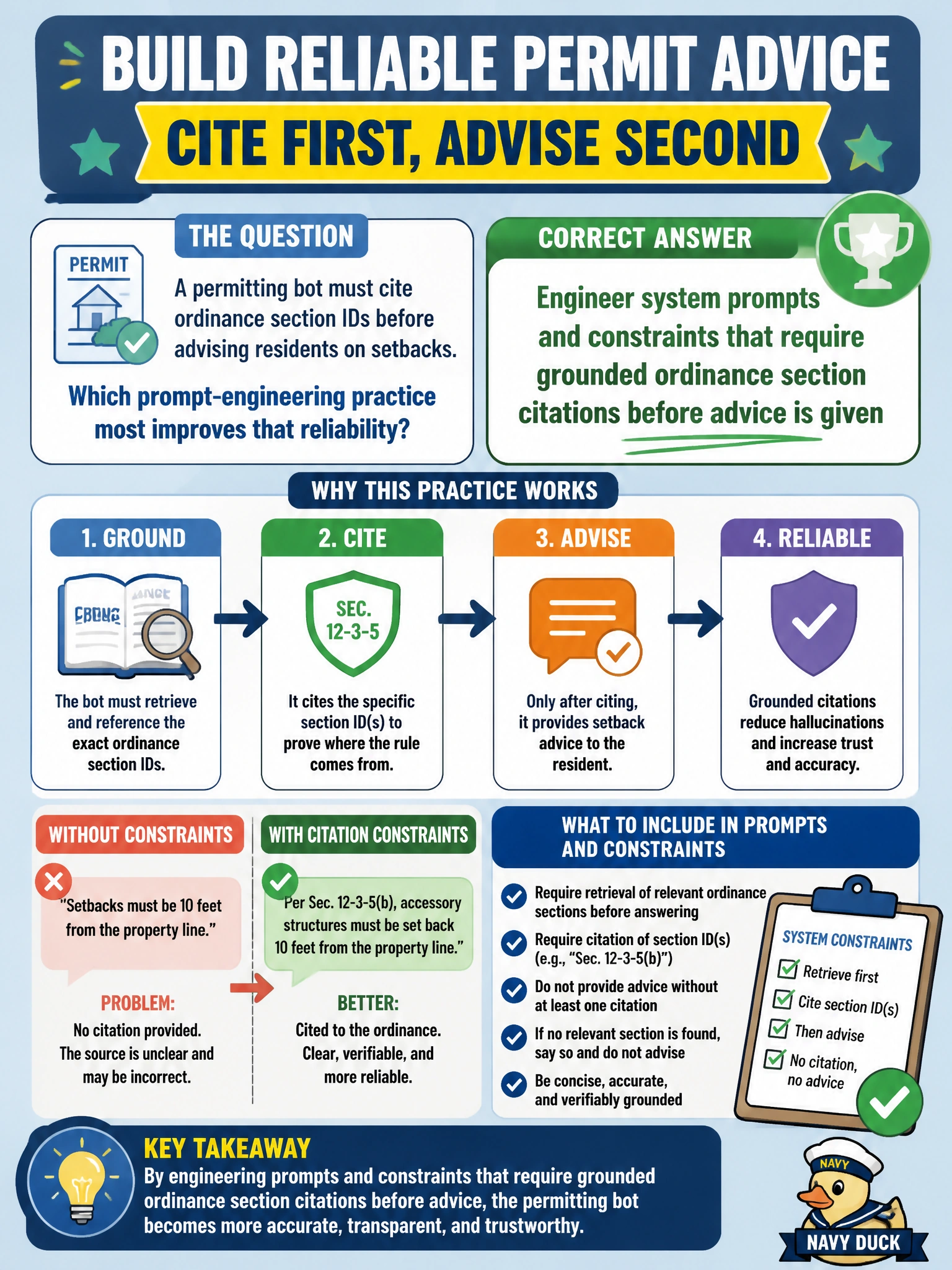
A permitting bot must cite ordinance section IDs before advising residents on setbacks. Which prompt-engineering practice most improves that reliability?
Select an answer to reveal the explanation.
Short Explanation
Residents deserve real code citations, not vibes. Bake a rule into the prompt chain: no setback advice until an ordinance section ID is grounded. Inventing section numbers is how trust evaporates at the permit counter.
Full Explanation
A permitting bot that advises residents on setbacks must cite real ordinance section IDs, not plausible-sounding numbers. Prompt engineering that places explicit system constraints—require grounded section citations from retrieval or tools before advice is emitted—improves reliability by blocking uncited guidance. Those constraints belong in the agent prompt chain and tool policy so every setback answer is tied to municipal code identifiers staff can verify. Speed without citations, invented section numbers, and marketing-only IDs all undermine trust in permitting guidance.
Removing all citation requirements so answers generate faster without lookups fails by concept: latency gains are bought by ungrounded legal-adjacent advice to residents. Instructing the model to invent plausible section numbers when retrieval is empty directly institutionalizes hallucination in a domain where false citations are harmful. Placing ordinance IDs only in marketing copy and never in the agent prompt chain means the runtime policy never enforces grounding where answers are produced.
Exam caveat: prompt constraints are necessary but not sufficient—retrieval/tooling must actually return current ordinance sections, and empty retrieval should trigger refusal or staff handoff rather than creative citation. Multi-jurisdiction cities must scope which code corpus the agent may cite.
Operational check: ask setback questions in staging with retrieval enabled and confirm every answer includes real section IDs present in the corpus; then force empty retrieval and confirm the agent refuses or escalates instead of inventing numbers.