
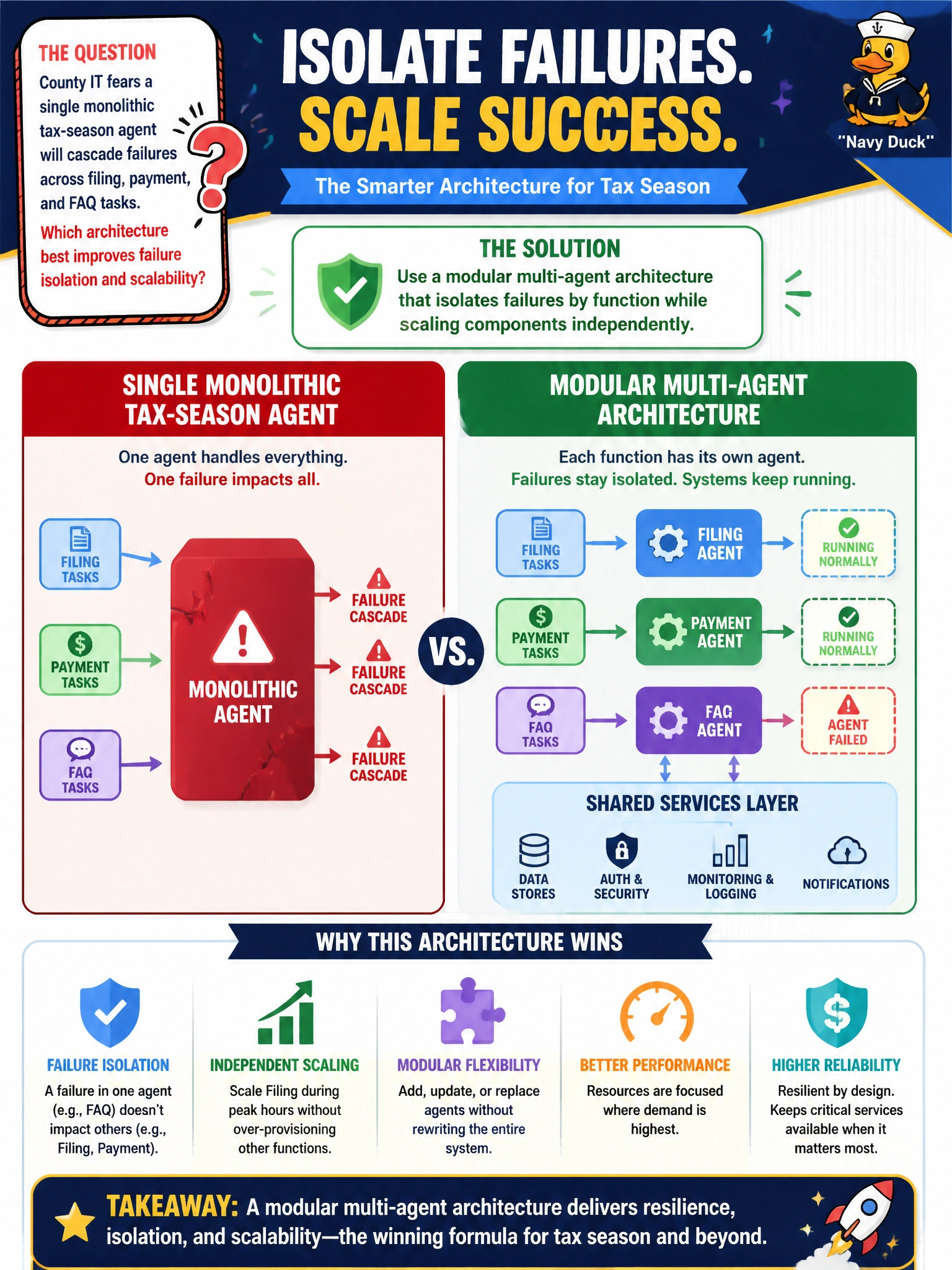
County IT fears a single monolithic tax-season agent will cascade failures across filing, payment, and FAQ tasks. Which architecture best improves failure isolation and scalability?
Select an answer to reveal the explanation.
Short Explanation
A monolith in tax season is like one overloaded help desk for filing, payments, and FAQs—when it tips over, everything tips. Modular agents keep those jobs in separate lanes. Failures stay contained and you can scale the hot path alone.
Full Explanation
County tax-season workloads mix filing help, payment flows, and FAQs—functions with different failure modes and scale profiles. A modular multi-agent architecture isolates those responsibilities so a payment-tool outage or bad filing prompt does not automatically poison FAQ handling, and so each component can scale independently under peak load. Shared monolithic memory and tool access concentrate blast radius: one hung tool call or corrupted context can cascade across every civic tax task sharing that process. Modularity plus independent scaling is therefore the architecture that improves both failure isolation and scalability.
Keeping one monolithic agent so every failure mode shares identical memory and tool access fails by concept: it maximizes cascade risk, which is exactly what county IT fears. Disabling monitoring during tax season to reduce overhead on the monolith removes visibility when fault isolation is most needed and does not improve architecture. Collapsing filing, payment, and FAQ into one prompt with no modular boundaries recreates the monolith inside the prompt layer and prevents targeted scale or recovery.
Exam caveat: modularity requires well-defined contracts and correlation IDs across agents; otherwise debugging becomes harder even if failures are isolated. Do not equate “more agents” with better design if they still share a single privileged tool identity.
Operational check: inject a controlled payment-tool failure in staging and verify filing and FAQ agents continue serving; then scale only the FAQ or filing component under load and confirm capacity increases without resizing the entire tax stack.