
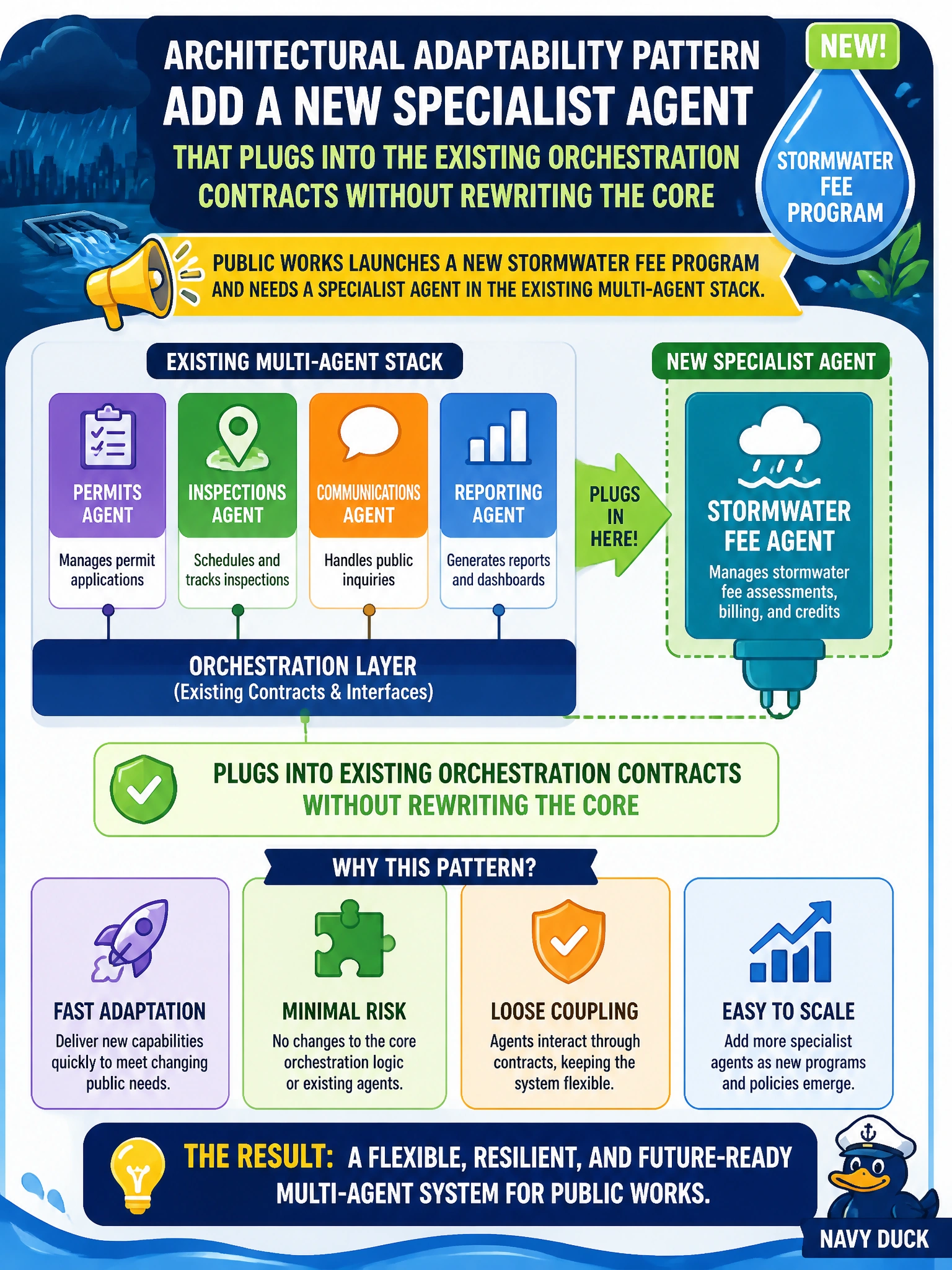
Public works launches a new stormwater fee program and needs a specialist agent in the existing multi-agent stack. What architectural adaptability pattern should the team use?
Select an answer to reveal the explanation.
Short Explanation
New city programs should plug in like a new specialist on a team that already has a playbook. Add a stormwater specialist that speaks the same orchestration contracts. Rewriting the whole core for every fee program is how pilots stall.
Full Explanation
When public works launches a stormwater fee program, the adaptable multi-agent pattern is to add a specialist that plugs into existing orchestration contracts rather than rewriting the core. Stable handoff, tool, and messaging interfaces let the new fee agent join the stack as another domain participant while coordinators, shared tools, and resident channels remain intact. That keeps municipal program rollout incremental: new policy logic lives in the specialist, not smeared across every unrelated agent prompt. Manual spreadsheets alone abandon agent participation that the city already invested in for consistent resident handling.
Merging stormwater logic into every existing agent’s prompt so no new agent is ever added fails by concept: it couples unrelated domains, bloats prompts, and makes fee-policy changes a cross-cutting edit risk. Replacing the entire orchestration core whenever any municipal program is introduced treats routine expansion as a platform rewrite and destroys adaptability. Running the stormwater fee process only as a manual spreadsheet with no agent participation may be a temporary fallback, but it is not the architectural pattern for extending a multi-agent civic stack.
Exam caveat: a new specialist still needs clear ownership, evaluation cases, and permissioned tools (fee schedules, parcel lookups); “plug in” does not mean unsupervised production access. Contracts must define inputs/outputs so the coordinator can route stormwater intents correctly.
Operational check: register the stormwater specialist against the existing orchestration contract in a lower environment, send representative fee questions through the same router used by other public-works agents, and confirm the core coordinator is unchanged while only the new specialist handles fee-domain tools.