
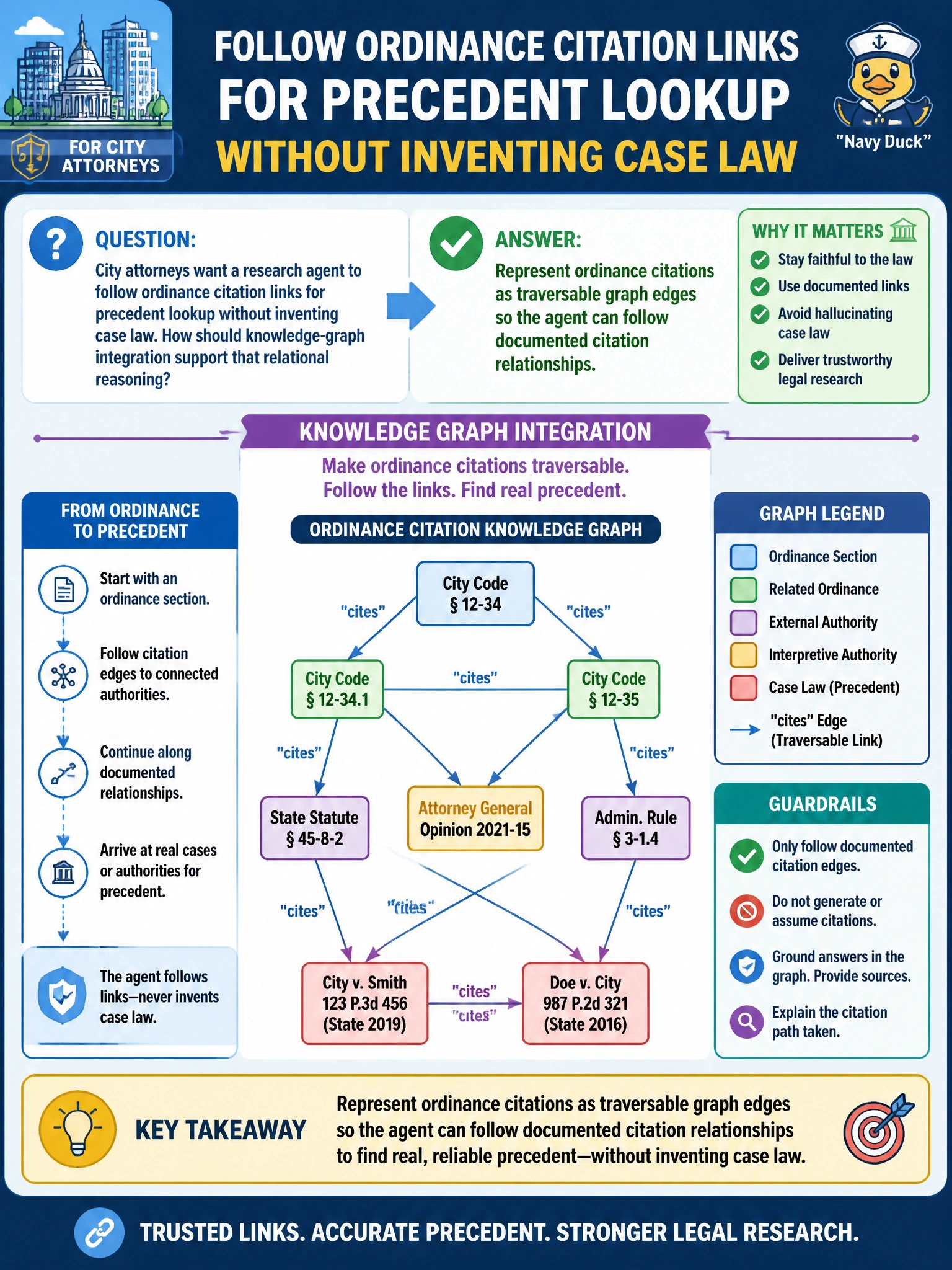
City attorneys want a research agent to follow ordinance citation links for precedent lookup without inventing case law. How should knowledge-graph integration support that relational reasoning?
Select an answer to reveal the explanation.
Short Explanation
Citation hopping is like following footnotes in a code binder—you only walk links that actually exist. Encoding those ordinance citations as graph edges lets the agent traverse real relationships. It should not hallucinate precedents that were never linked.
Full Explanation
City attorneys need ordinance research that follows real citation relationships without inventing case law. Representing citations as traversable knowledge-graph edges lets the research agent walk only documented links in the municipal corpus—from an ordinance to its cited sections and related precedents that actually exist in the graph. That pattern supports relational reasoning while keeping the agent grounded: if an edge is absent, the agent should not fabricate a citation path. Generative summaries, pretraining recall, and decorative UI labels do not provide auditable traversal of the code.
Replacing the ordinance corpus with a single generative summary that invents missing precedents fails by concept: it maximizes hallucination risk precisely where municipal legal research forbids invention. Disabling retrieval and relying on model pretraining for municipal code citations is unsafe because pretraining is neither jurisdiction-complete nor current, and it cannot prove a local citation edge exists. Storing citations only as decorative chat labels with no backend graph structure gives residents or attorneys the appearance of linkage without any traversable, reviewable relationship store.
Exam caveat: graph edges must be curated from authoritative municipal sources; a poorly populated citation graph can still under-serve research. Pair graph traversal with retrieval of the full ordinance text so the agent can quote grounded language after following an edge.
Operational check: select an ordinance with known citation links in staging, require the agent to follow those edges and refuse paths not present in the graph, and review outputs for invented section numbers or fabricated case references before any attorney-facing deployment.