
A social-services agent must spot when a household is enrolled in two programs that conflict under city policy. What knowledge-graph design choice best supports that relational conflict check?
Select an answer to reveal the explanation.
Short Explanation
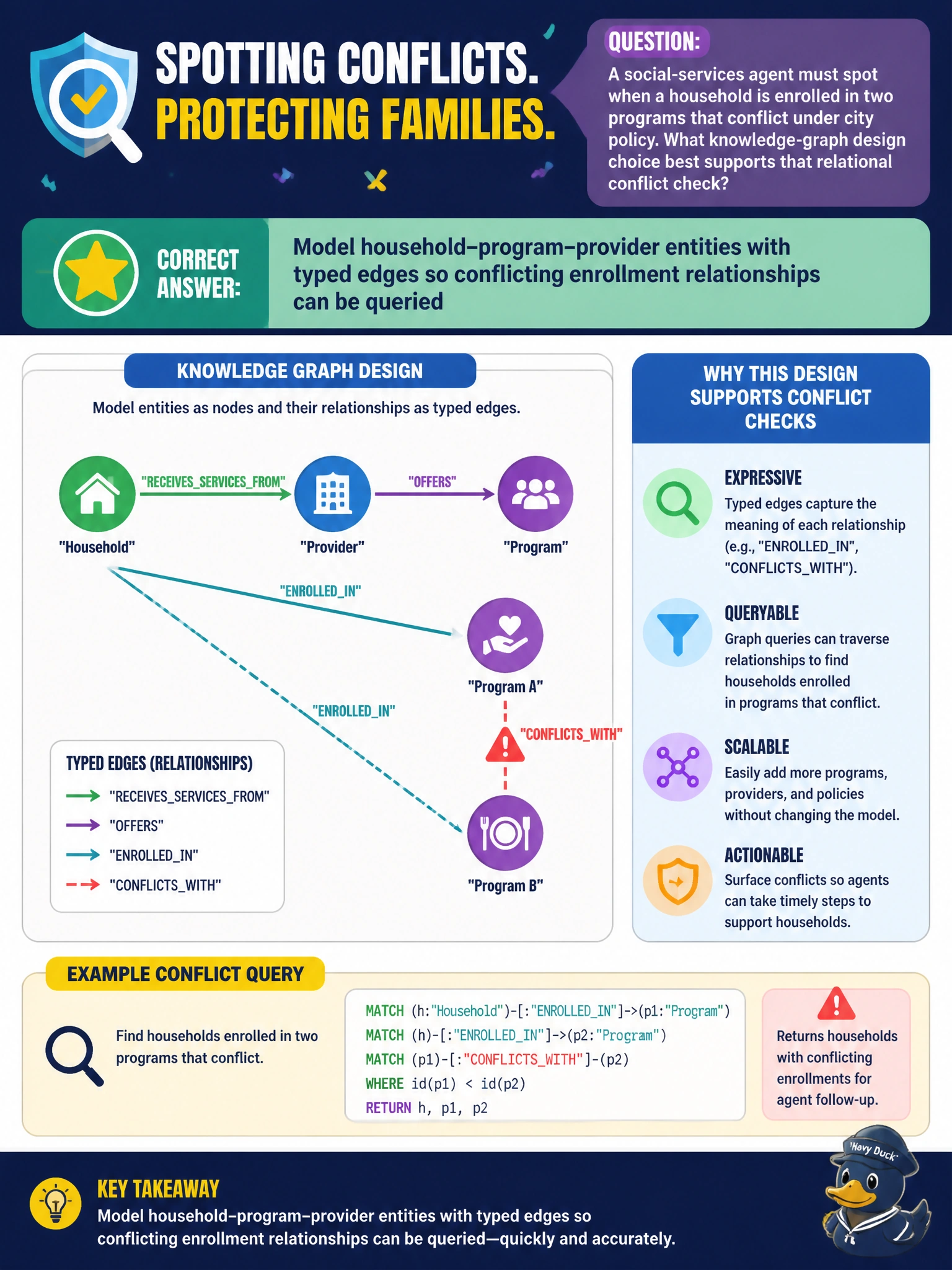
Think of enrollments like links on a corkboard: household, program, and provider pinned with strings between them. When two program strings shouldn’t both be there, the conflict jumps out. A graph with typed edges makes that conflict queryable—similarity search on brochure text won’t.
Full Explanation
Conflicting program enrollments under city policy are a relational integrity problem: the agent must see that the same household is linked to two mutually exclusive programs (and often to providers) and surface that conflict. Modeling household–program–provider entities with typed edges lets social-services agents query enrollment relationships directly—for example, detecting two active “enrolled_in” edges that policy marks as incompatible. Embeddings of brochures and free-text memory blobs may cluster topical language, but they do not encode enrollment facts as queryable relationships, so conflict checks become guesswork.
Storing each program brochure as an embedding and comparing cosine similarity to the household name fails by concept: similarity of marketing text to a name is not evidence of enrollment, let alone of a policy conflict. Collapsing households and programs into a single free-text memory blob without typed edges erases the structure needed for precise relationship queries and makes audits opaque. Deleting provider nodes so the graph holds only demographics strips entities that often carry eligibility, funding, or conflict rules and leaves an incomplete municipal case graph.
Exam caveat: a knowledge graph does not by itself enforce policy; city rules still must be expressed as constraints, queries, or downstream checks. The design win is that those rules can operate on explicit enrollment edges rather than on unstructured prose.
Operational check: load two conflicting enrollments for a test household in a non-production graph, run the conflict query the agent will use, and confirm both program edges and provider links appear. Then remove typed edges or collapse to a blob and show that the same check fails or becomes unreliable.