
A public-works outage agent must answer which hydrants lose pressure when a water main is isolated, using links among mains, hydrants, and open work orders. Why should the architecture integrate a knowledge graph rather than flat document retrieval alone?
Select an answer to reveal the explanation.
Short Explanation
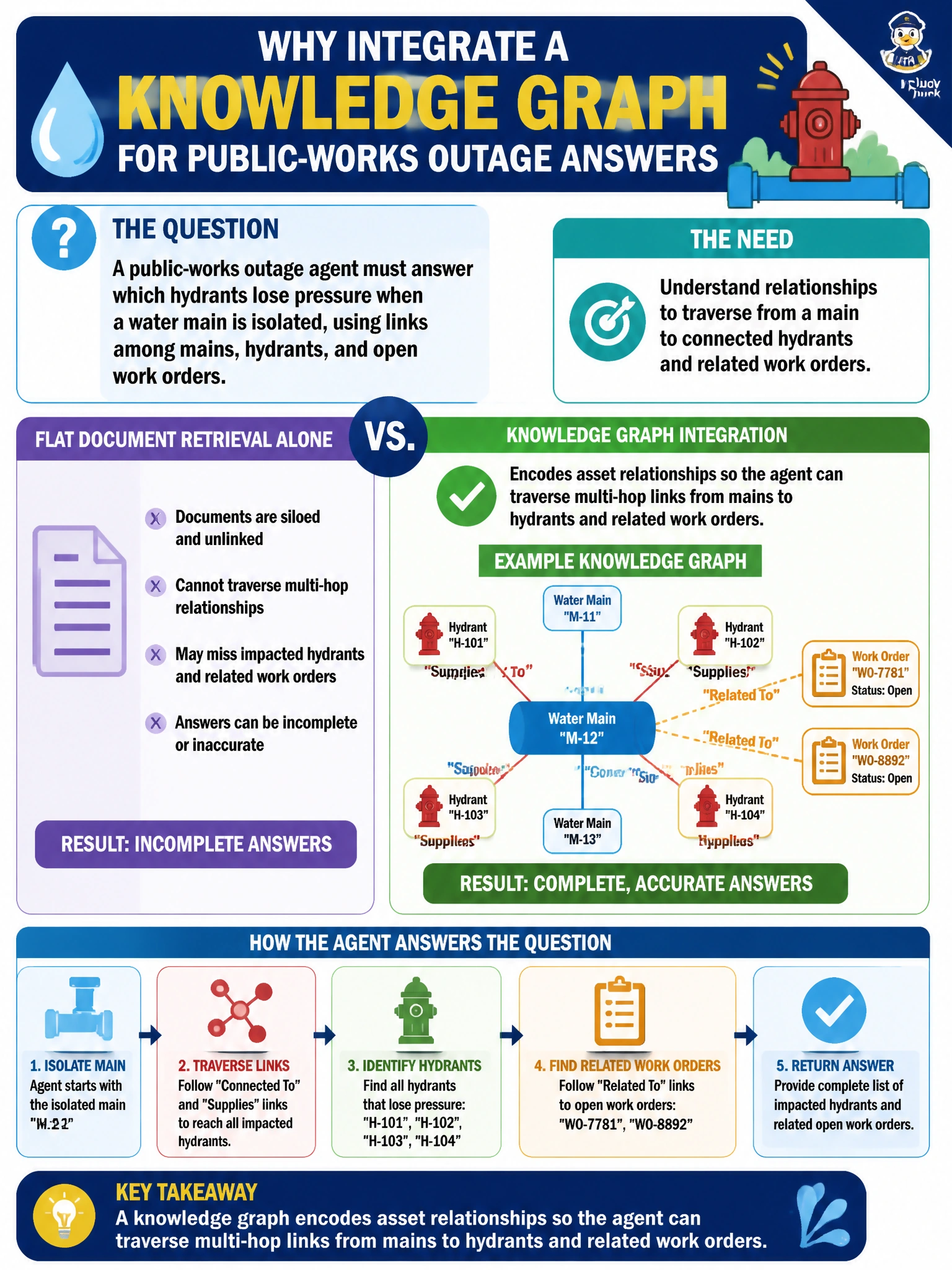
Picture the water system like a subway map: you need the connections, not just a pile of station pamphlets. A knowledge graph holds those hydrant–main–work-order links so the agent can hop across them. Flat document search alone struggles with that multi-hop “what else is affected?” question.
Full Explanation
Public-works outage impact questions are relational: isolating a water main only informs which hydrants lose pressure when the agent can follow connectivity and related open work. A knowledge graph encodes mains, hydrants, and work orders as entities with typed edges, so the outage agent can traverse multi-hop paths instead of hoping keyword-similar documents imply the same topology. Flat retrieval may surface manuals or tickets that mention a street name, but it does not guarantee a traversable asset path from the isolated main to affected hydrants and linked crews. Graph integration therefore complements—not casually replaces—municipal systems of record by making those links queryable for impact reasoning.
The option that knowledge graphs replace the work-order system of record fails by concept: graphs organize relationships for reasoning; they do not become the authoritative work-management database for municipal utilities. Claiming flat document retrieval always returns multi-hop asset paths faster confuses latency anecdotes with capability—document search is not structured traversal and routinely misses multi-hop connectivity. Restricting knowledge graphs to resident-facing chat UIs only misunderstands the use case: outage impact reasoning for public-works operations is exactly where relational hops matter, independent of the front-end channel.
Exam caveat: RAG over PDFs and ticket text remains useful for procedures and narrative context; the distinguishing requirement here is multi-hop asset linkage, not “graphs versus retrieval” as an absolute. Prefer hybrid designs where retrieval grounds procedures and the graph grounds topology.
Operational check: pick a known main-isolation scenario in a staging GIS/asset graph, ask which hydrants and open work orders are linked, and verify the agent returns the multi-hop path from graph edges rather than a loosely related document snippet. Confirm work-order IDs still resolve in the system of record.