
Zoning agents must reason over parcel–use–ordinance relationships. When is a knowledge graph a better architectural fit than flat document RAG alone?
Select an answer to reveal the explanation.
Short Explanation
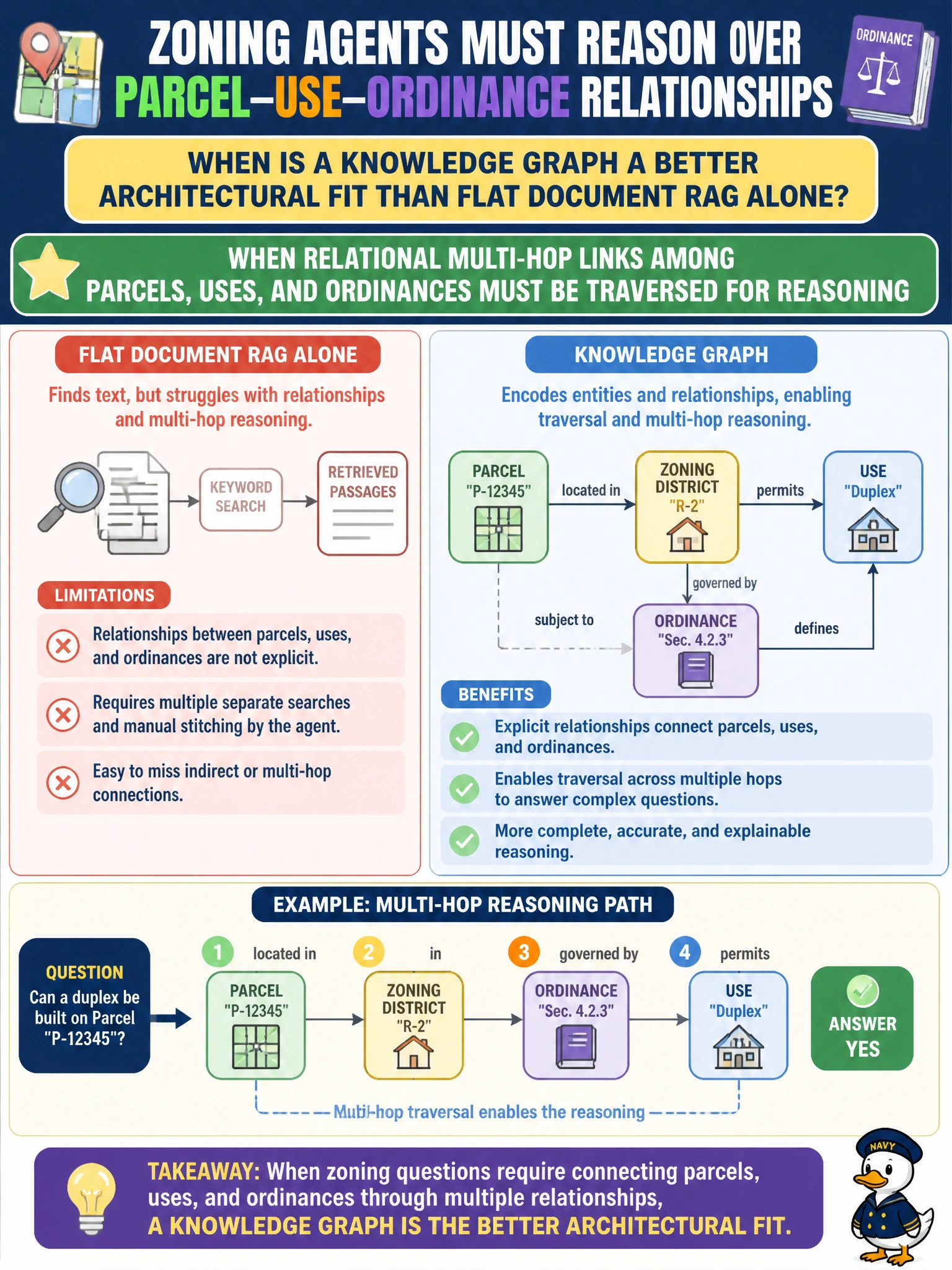
Flat RAG is a pile of zoning PDFs; a knowledge graph is the map of how parcels, uses, and ordinances connect. When the question is about those links, you want the map—not just another page dump.
Full Explanation
Knowledge graphs fit zoning agents better than flat document RAG alone when relational multi-hop links among parcels, uses, and ordinances must be traversed for reasoning. Encoding entities and edges lets the agent walk parcel → permitted use → governing ordinance paths that a single disconnected brochure chunk may not contain contiguously. That relational civic reasoning—not slogan retrieval—is the architectural justification for a graph layer.
When answers only need one disconnected brochure paragraph, flat RAG is usually enough, so that condition is not when graphs are better. Forbidding any structured representation of zoning entities fails by concept: it bans the graph approach rather than justifying it. Ignoring ordinance links to answer from marketing slogans fails correctness and legal grounding for zoning decisions.
Exam caveat: pick knowledge graphs for multi-hop entity–relationship reasoning; pick document RAG for passage-centric lookup. Production designs often combine both—graphs for relations, vectors for supporting text.
Operational check: pose a question requiring parcel→use→ordinance hops; confirm the graph query returns linked entities; compare to vector-only retrieval when the needed relation is missing from any single chunk; verify answers cite ordinance nodes rather than marketing slogans.