
Assessor appeal prep must branch if comparable sales are missing versus if comps exist. How should stateful orchestration handle that?
Select an answer to reveal the explanation.
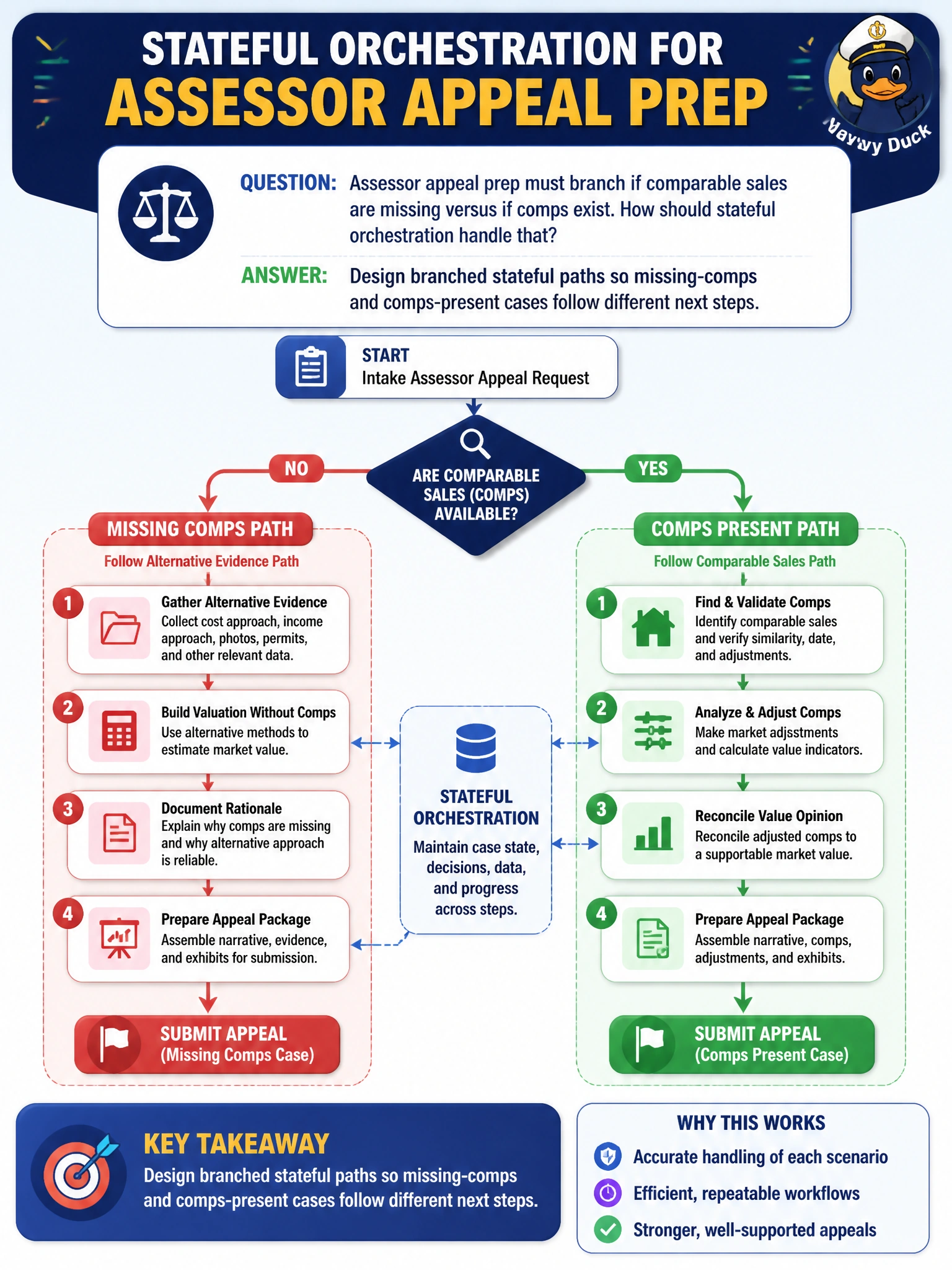
Short Explanation
No comps? Take the left hallway and gather more evidence. Comps on file? Take the right hallway and build the appeal packet. Branching keeps the workflow honest instead of faking numbers.
Full Explanation
Assessor appeal prep that differs when comparable sales are missing versus present needs branched stateful paths so each case follows different next steps. Missing-comps branches gather evidence or alternate valuation supports; comps-present branches assemble the appeal packet from available sales. Explicit branching keeps municipal reasoning honest about data preconditions instead of papering over gaps.
Always following the comps-present path and inventing sales figures fails as fabricating evidence—an integrity failure in assessment appeals. Collapsing both cases into one prompt that ignores whether comps exist fails by concept: it erases the decision predicate the workflow must respect. Terminating permanently whenever comps are absent fails operational continuity—absence should route to an evidence-gathering branch, not a forever dead end.
Exam caveat: branched stateful orchestration is the answer when control flow depends on a data condition. Inventing data or hard-stopping forever are typical distractors.
Operational check: run an appeal case with comps deleted; confirm missing-comps branch tasks appear (request sales, alternate evidence); run a comps-present case and confirm packet-assembly tasks; assert no synthetic sale prices are written into the appeal file.