
A grant-writing helper must keep workflow state across days so staff can resume mid-draft. Which orchestration capability is essential?
Select an answer to reveal the explanation.
Short Explanation
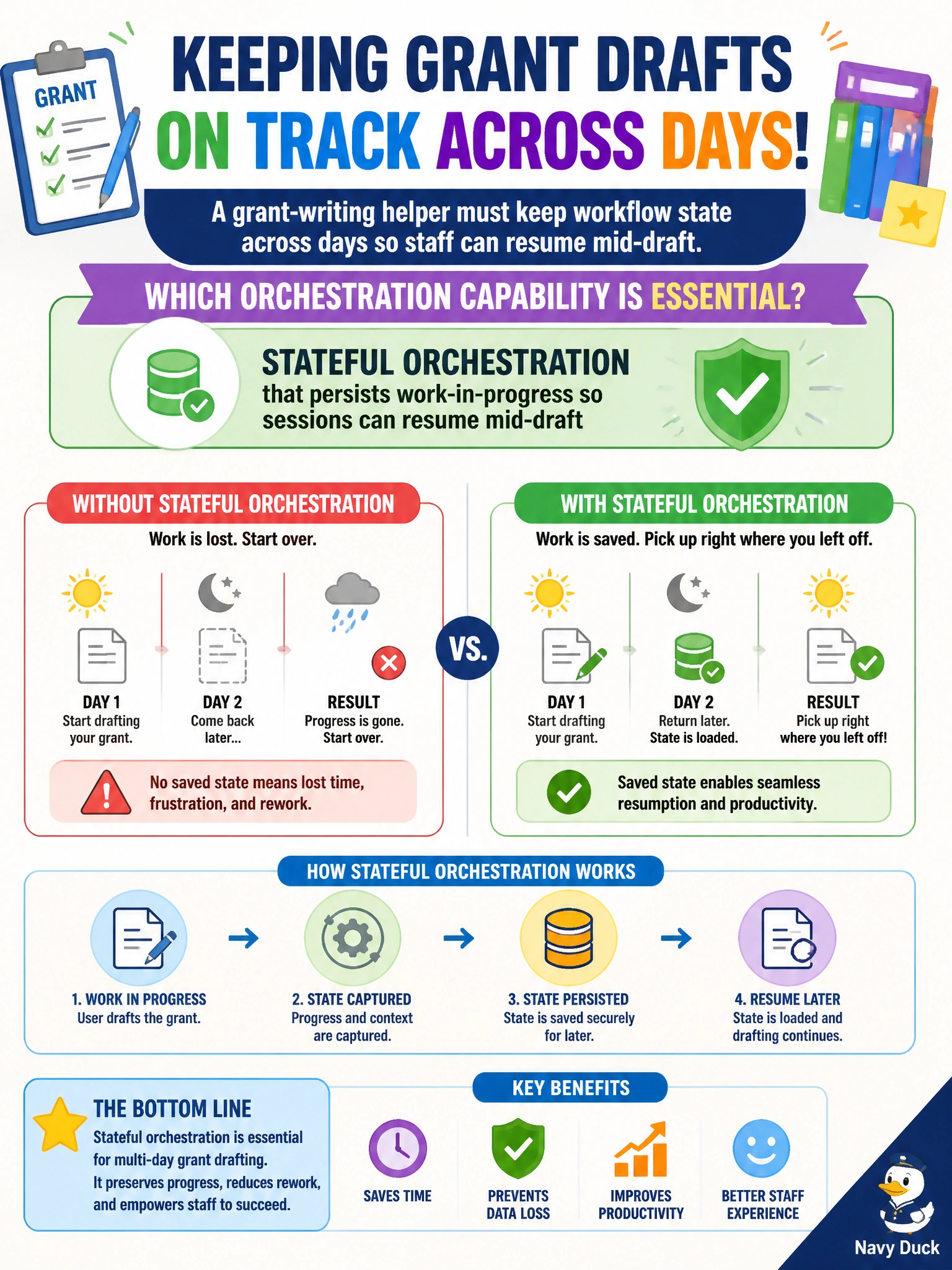
You may step away from a grant draft and return days later, so the helper needs stateful orchestration to preserve the work in progress. That lets you resume where staff left off instead of starting over.
Full Explanation
A grant-writing helper that must preserve work across days requires stateful orchestration that persists work in progress so sessions can resume mid-draft. Municipal grant cycles span meetings, reviews, and shift changes; without durable workflow state and identifiers, staff cannot reliably continue partial narratives, budgets, attachments, or checklist progress after leaving the browser. Stateless replies that forget the draft after every browser refresh fail the multi-day resume requirement. In-memory-only state that vanishes when the daily batch job restarts fails because process memory is not durable orchestration storage for civic drafting. Emailing drafts without workflow IDs or shared state provides no reliable way to resume work, collaborate, or maintain an auditable, governed workflow artifact. Exam caveat: “stateful orchestration” means persisted workflow state across sessions—not merely a longer prompt inside a single ephemeral chat tab. Practical check: save a mid-draft grant with a workflow ID, restart the app pool or cross a batch boundary, reopen the same ID, and confirm sections, checklist status, and last-editor metadata are restored; also confirm a second authorized staffer can resume under access controls.