
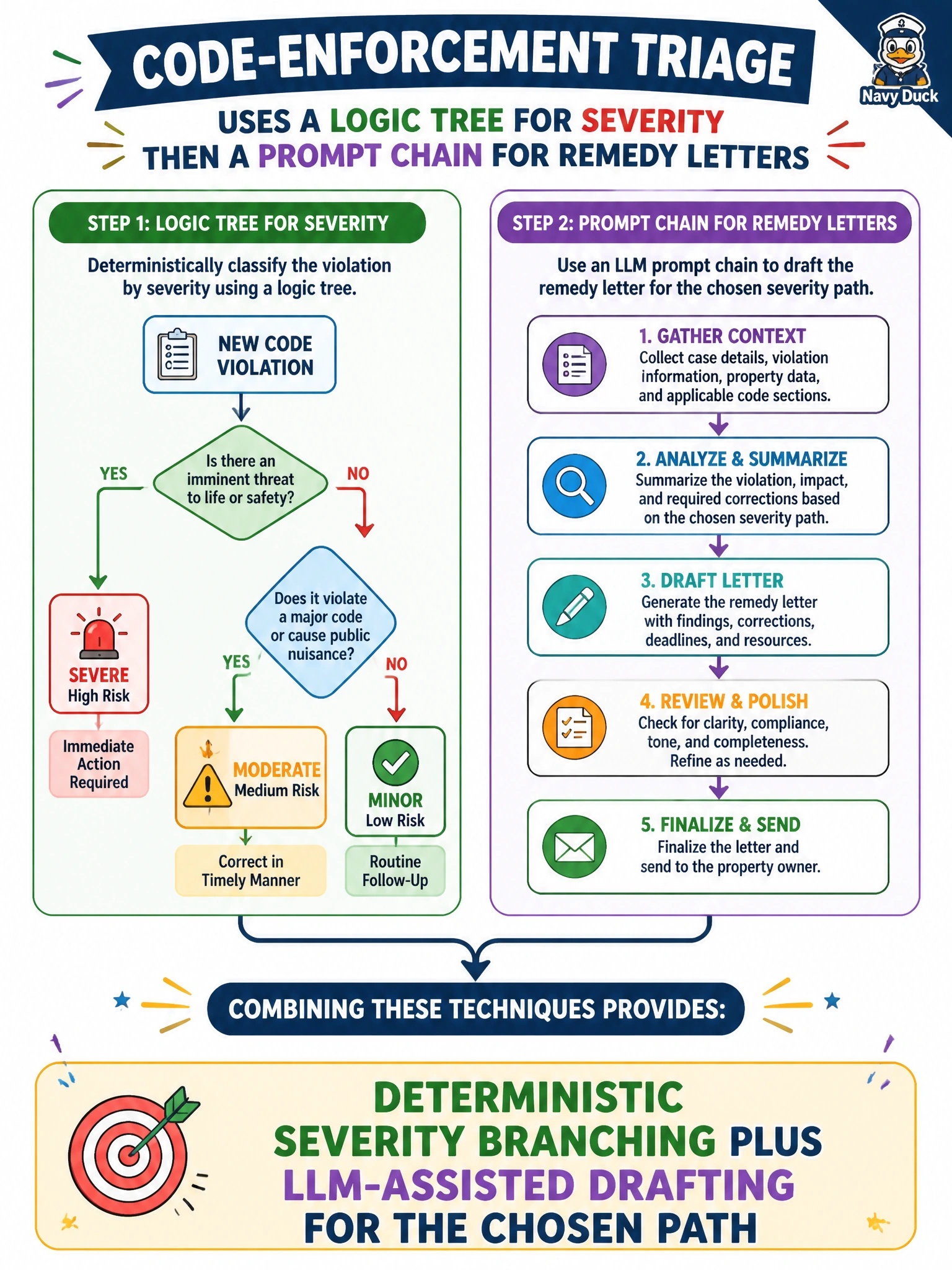
Code-enforcement triage uses a logic tree for severity then a prompt chain for remedy letters. What does combining those techniques provide?
Select an answer to reveal the explanation.
Short Explanation
First the flowchart decides how bad it is—that's the logic tree. Then the letter-writing chain drafts the remedy in plain language. Rules pick the path; the LLM writes along it.
Full Explanation
Combining a logic tree for severity with a prompt chain for remedy letters yields deterministic severity branching plus LLM-assisted drafting on the chosen path. Code-enforcement triage needs consistent severity rules first so similar violations classify alike; generative drafting then produces readable remedy language without letting the LLM invent or randomize the severity class that drives deadlines and penalties.
Only neural generation with no deterministic severity rules fails because severity becomes unstable across similar cases. Only a static PDF library with no agent involvement fails by concept: it drops the generative drafting half of the hybrid the stem describes. Random severity labels each run fail consistency and fairness in municipal enforcement.
Exam caveat: hybrid architectures pair deterministic control for high-stakes classification with LLMs for language generation. Do not pick “all neural” or “all static” when the stem combines both techniques.
Operational check: feed twin cases that should share a severity leaf; confirm identical severity codes from the logic tree; confirm letter drafts may differ in wording but cite the same severity path; mutate tree rules and verify severity changes without relying on the LLM to reclassify.