
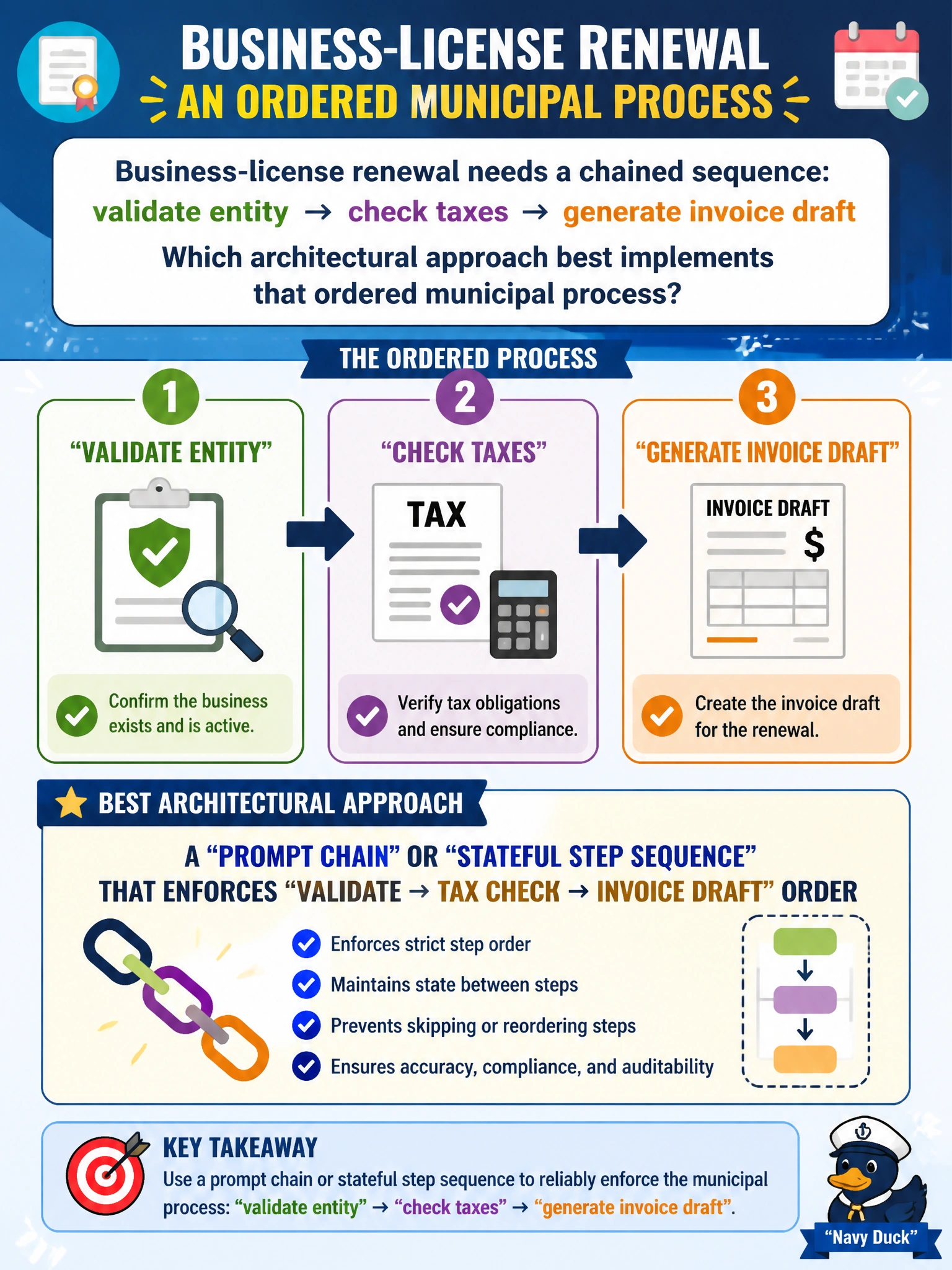
Business-license renewal needs a chained sequence: validate entity → check taxes → generate invoice draft. Which architectural approach best implements that ordered municipal process?
Select an answer to reveal the explanation.
Short Explanation
You can treat license renewal like a recipe, not a smoothie blender. A prompt chain keeps the steps in order: validate the entity, check taxes, then draft the invoice.
Full Explanation
Business-license renewal must validate the entity, check taxes, and then generate an invoice draft. A prompt chain or stateful step sequence is the right approach because it enforces that order and passes intermediate outputs forward. The steps have prerequisites: the tax check uses validation results, and the invoice draft uses tax outcomes. Chaining preserves this causality and prevents premature billing artifacts. A single general-purpose prompt that may produce any of the three results in any order fails because it leaves the required sequence and prerequisites undefined. Three independent agents that never share intermediate outputs fail because later steps cannot use earlier results. Skipping validation and tax checks to generate invoices faster sacrifices correctness and compliance with renewal finance controls. Exam caveat: when a process explicitly specifies an order, look for chaining or stateful sequencing rather than an unconstrained prompt or skipping required gates. Practical check: run a renewal where validation fails and confirm that neither the tax check nor invoice step runs; then run a successful renewal and verify that records show validation, tax check, and invoice draft in that order, with linked intermediate outputs retained for audit.