
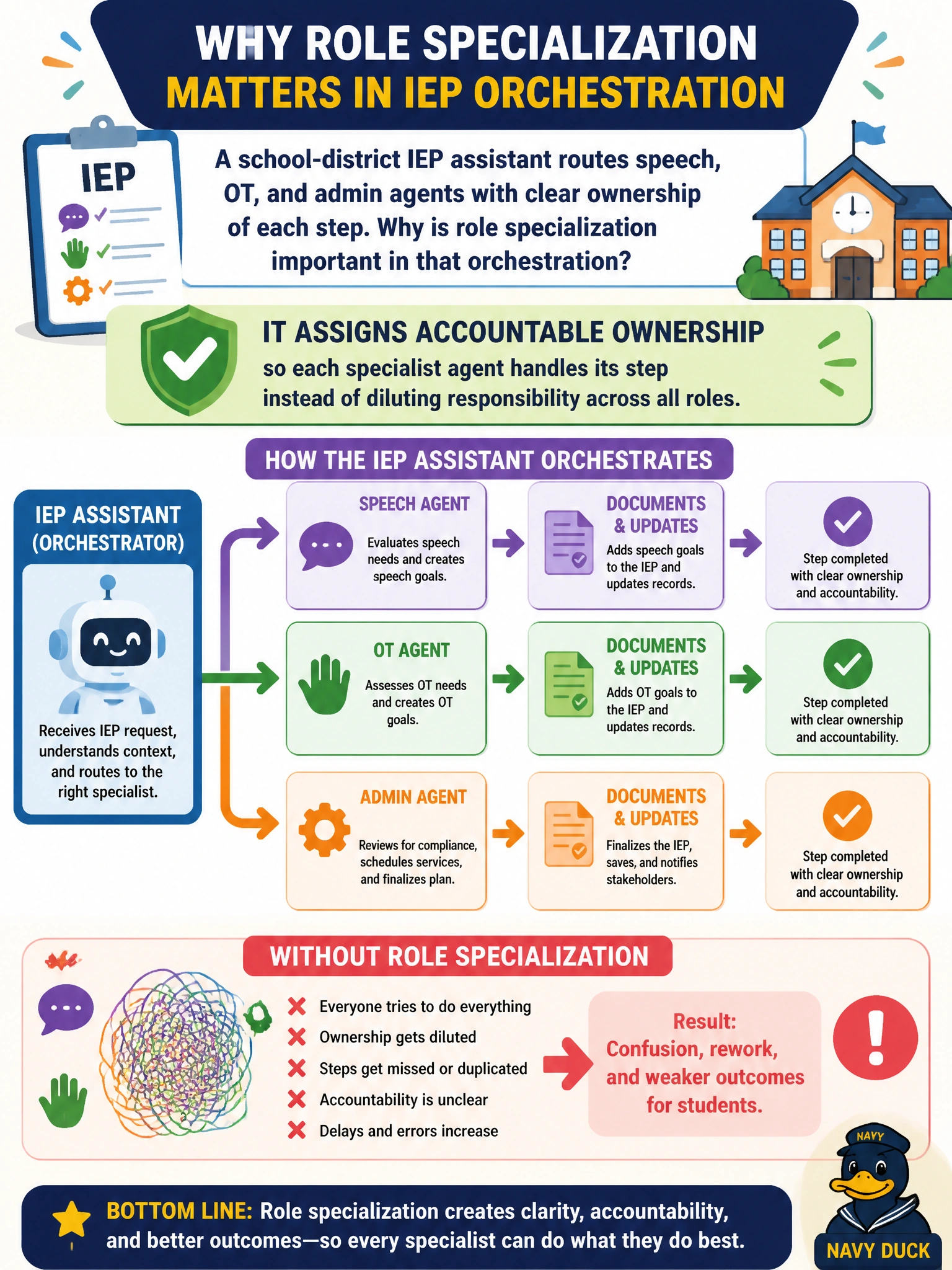
A school-district IEP assistant routes speech, OT, and admin agents with clear ownership of each step. Why is role specialization important in that orchestration?
Select an answer to reveal the explanation.
Short Explanation
Speech owns speech, OT owns OT, admin owns paperwork—like assigning stations in a clinic. Clear ownership beats three agents all "helping" and nobody finishing the step.
Full Explanation
Role specialization in a school-district IEP multi-agent assistant assigns accountable ownership so speech, OT, and admin agents each handle their step instead of diluting responsibility across all roles. Clear ownership improves clinical quality and administrative auditability: speech owns speech recommendations, OT owns OT steps, admin owns paperwork and scheduling coordination, with handoffs that record who finished what.
Forcing every agent to execute speech, OT, and admin tasks identically fails because it destroys specialization and accountability. Eliminating workflow state and handoff messages fails by concept: specialized routing still needs state and handoffs to progress the IEP packet across roles. Guaranteeing admin agents never interact with scheduling data fails as an arbitrary ban unrelated to why specialization matters; admin workflows often must coordinate scheduling fields.
Exam caveat: specialization is about ownership and fit-for-purpose skills, not about inventing absolute data taboos unless the stem states a privacy boundary.
Operational check: route a case with speech and OT needs; confirm each specialist agent is invoked for its step and writes ownership onto workflow state; attempt a mis-route of speech tasks to the admin agent and verify policy or guards reject or reassign.