
Permit review stalls when two specialist agents wait on each other indefinitely. What coordination design most directly prevents that deadlock?
Select an answer to reveal the explanation.
Short Explanation
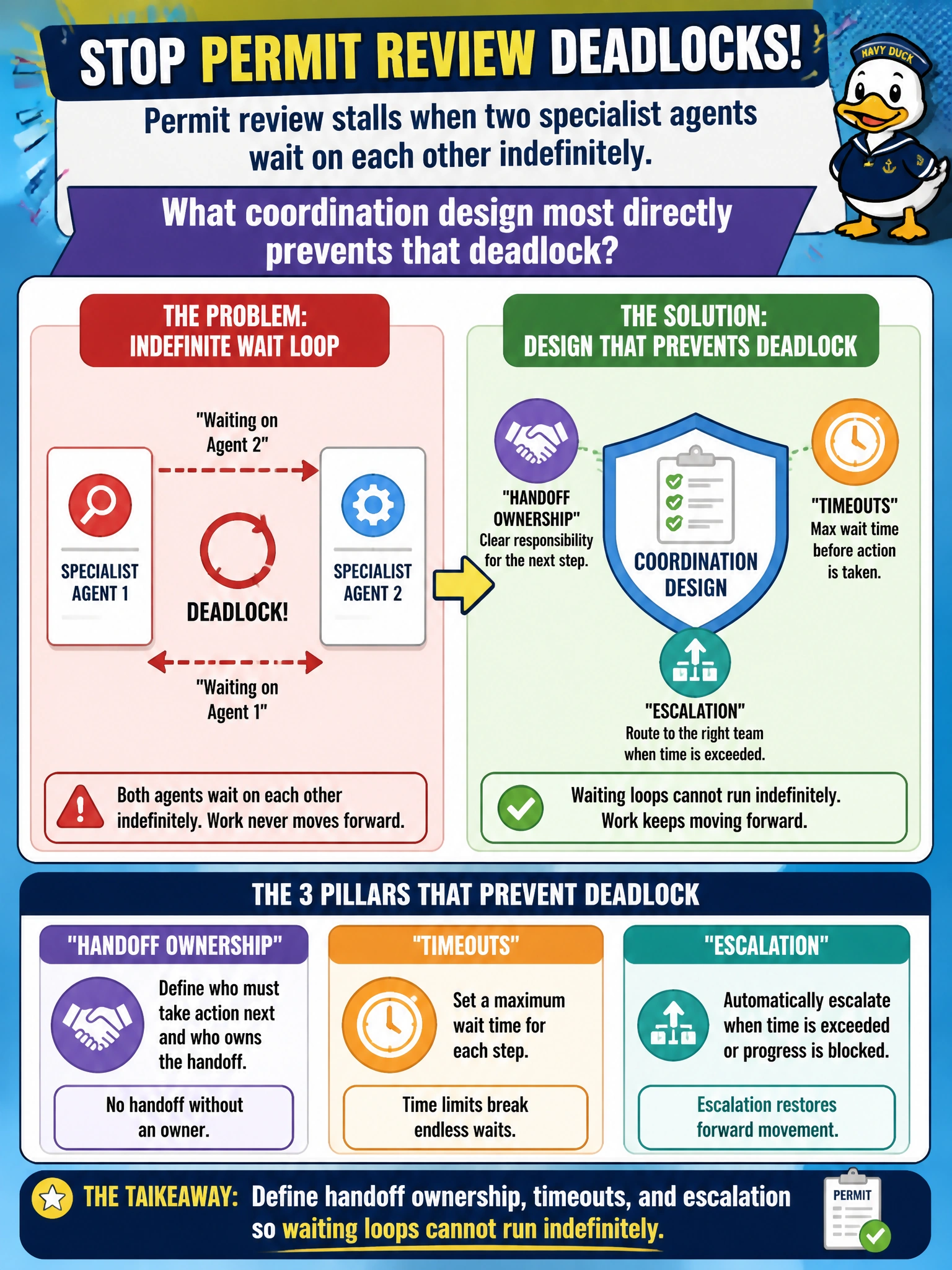
You can prevent the permit from getting stuck by giving the next step a clear owner, setting a wait limit, and escalating when time runs out. Those guardrails keep two agents from waiting on each other forever.
Full Explanation
Permit-review deadlock is prevented by defining handoff ownership, timeouts, and escalation so waiting loops cannot run indefinitely. Clear ownership answers who must act next; timeouts bound how long a peer may wait; escalation moves the case to a human queue or supervisor when specialists stall. Together, those controls keep municipal permit throughput from freezing on circular waits between reviewers. Removing all timeouts fails because unbounded waits enable deadlock. Requiring circular handoffs with no ownership of the next step fails because “after you” protocols create deadlock by design. Adding more specialist agents while leaving waiting limits and escalation paths undefined adds coordination complexity without fixing the waiting condition. Exam caveat: look for ownership, time bounds, and escalation together; adding agents without those controls does not resolve deadlock. Practical check: induce a mutual wait between two specialists, confirm the timeout fires, verify an escalation ticket and owner are assigned, and ensure the permit leaves the infinite-wait state within the configured SLA and progresses or is intentionally parked.