
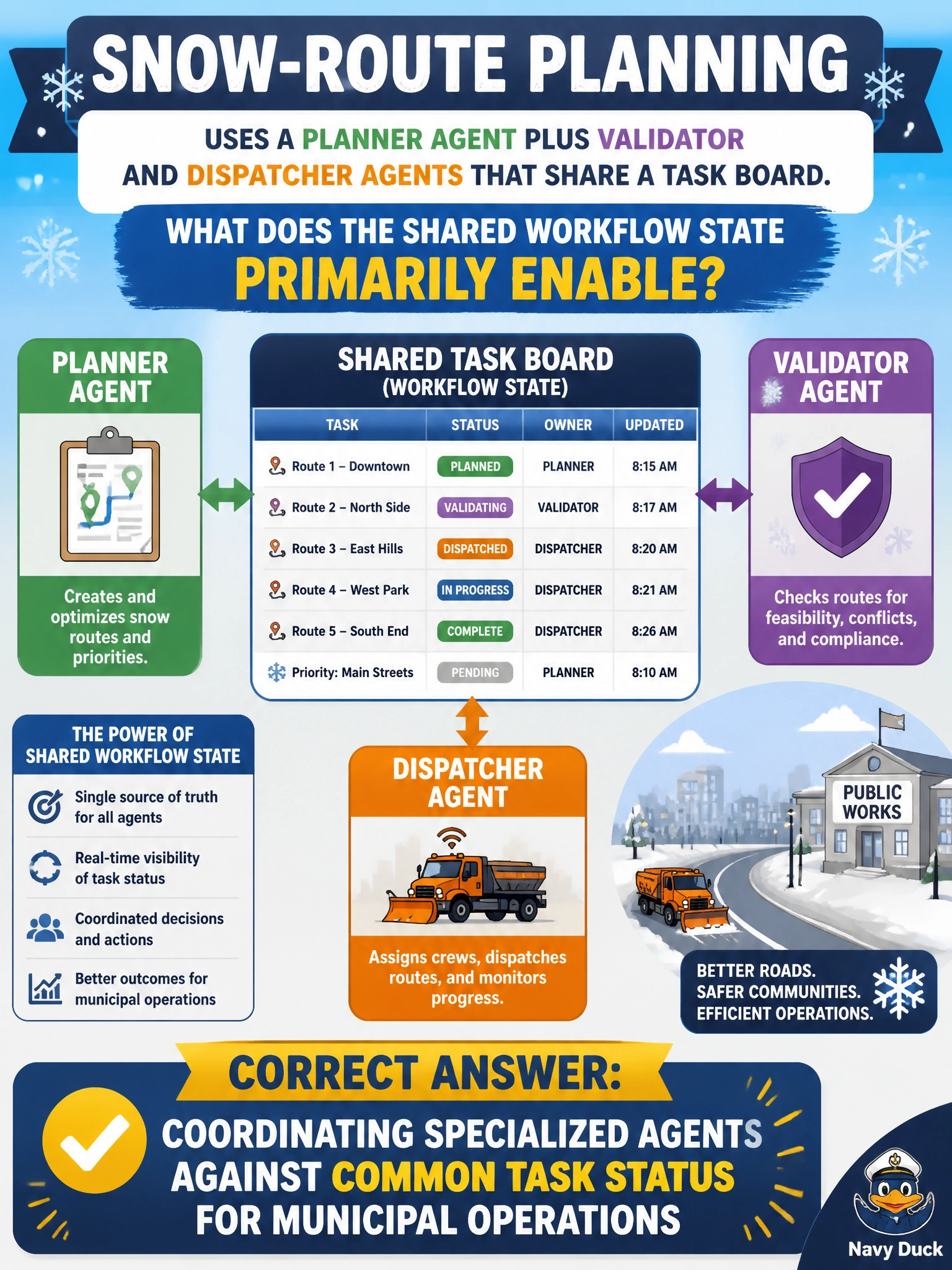
Snow-route planning uses a planner agent plus validator and dispatcher agents that share a task board. What does the shared workflow state primarily enable?
Select an answer to reveal the explanation.
Short Explanation
The shared task board is the plow barn whiteboard—planner posts a route, validator marks it checked, dispatcher rolls trucks. Everyone works from the same status, not three private notebooks.
Full Explanation
Shared workflow state on a snow-route task board lets planner, validator, and dispatcher agents coordinate specialized work against common municipal task status. Each role remains distinct—plan routes, validate constraints, dispatch trucks—while reading and updating the same statuses so operations do not fragment into three private notebooks. The board is the coordination medium that makes specialization safe at city scale.
Isolating each agent so none can see route updates fails because coordination requires shared visibility of status. Forcing all three roles into one undifferentiated prompt fails by concept: it erases the specialization the architecture was built to preserve. Deleting validator findings before the dispatcher reads them fails as sabotaging the quality gate the shared board exists to surface.
Exam caveat: shared state enables coordination among specialists; it is not an argument for collapsing roles into one monolith or for hiding validation outputs from downstream operators.
Operational check: post a planned route, have the validator mark findings on the board, confirm the dispatcher sees validated status before truck assignment; revoke board read for the dispatcher and confirm dispatch blocks or alerts rather than proceeding blind.