
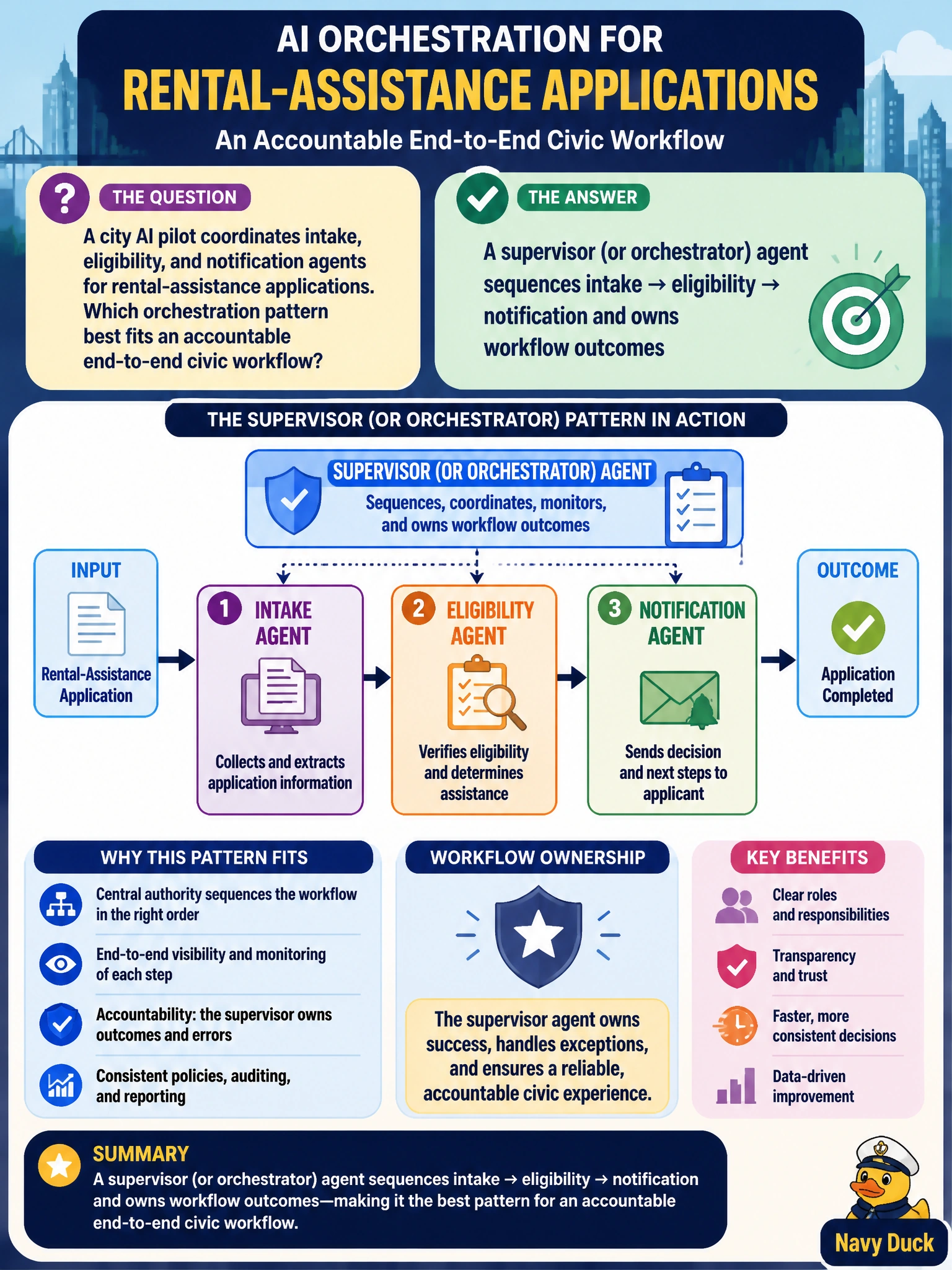
A city AI pilot coordinates intake, eligibility, and notification agents for rental-assistance applications. Which orchestration pattern best fits an accountable end-to-end civic workflow?
Select an answer to reveal the explanation.
Short Explanation
Somebody has to conduct the orchestra. A supervisor agent lines up intake, eligibility, then notify—and owns whether the rental-assistance workflow actually finished.
Full Explanation
Accountable end-to-end rental-assistance workflows fit a supervisor (orchestrator) pattern: one coordinating agent sequences intake → eligibility → notification and owns completion, failure, and escalation. Specialist agents still perform their steps, but outcome ownership stays centralized so the city pilot can answer whether an application finished, stalled, or erred—and who is responsible for unblocking it. That ownership boundary is what makes multi-agent civic intake operable under audit.
Three agents chatting freely with no owner fails because completion and failure become nobody’s responsibility. Silent state overwrites without coordination rules fail by concept as race-prone corruption of application state across intake and eligibility. Running notification before intake fails process order: outbound messages without a validated intake maximize noise rather than delivering assistance.
Exam caveat: orchestration questions emphasize ownership and sequencing. “More agents chatting” is not accountability; prefer a supervisor that owns the workflow outcome and step order.
Operational check: submit a test application; verify ordered transitions intake→eligibility→notification; kill the eligibility step and confirm the supervisor records failure/escalation rather than sending premature notifications; inspect audit logs for a single workflow owner identifier.