
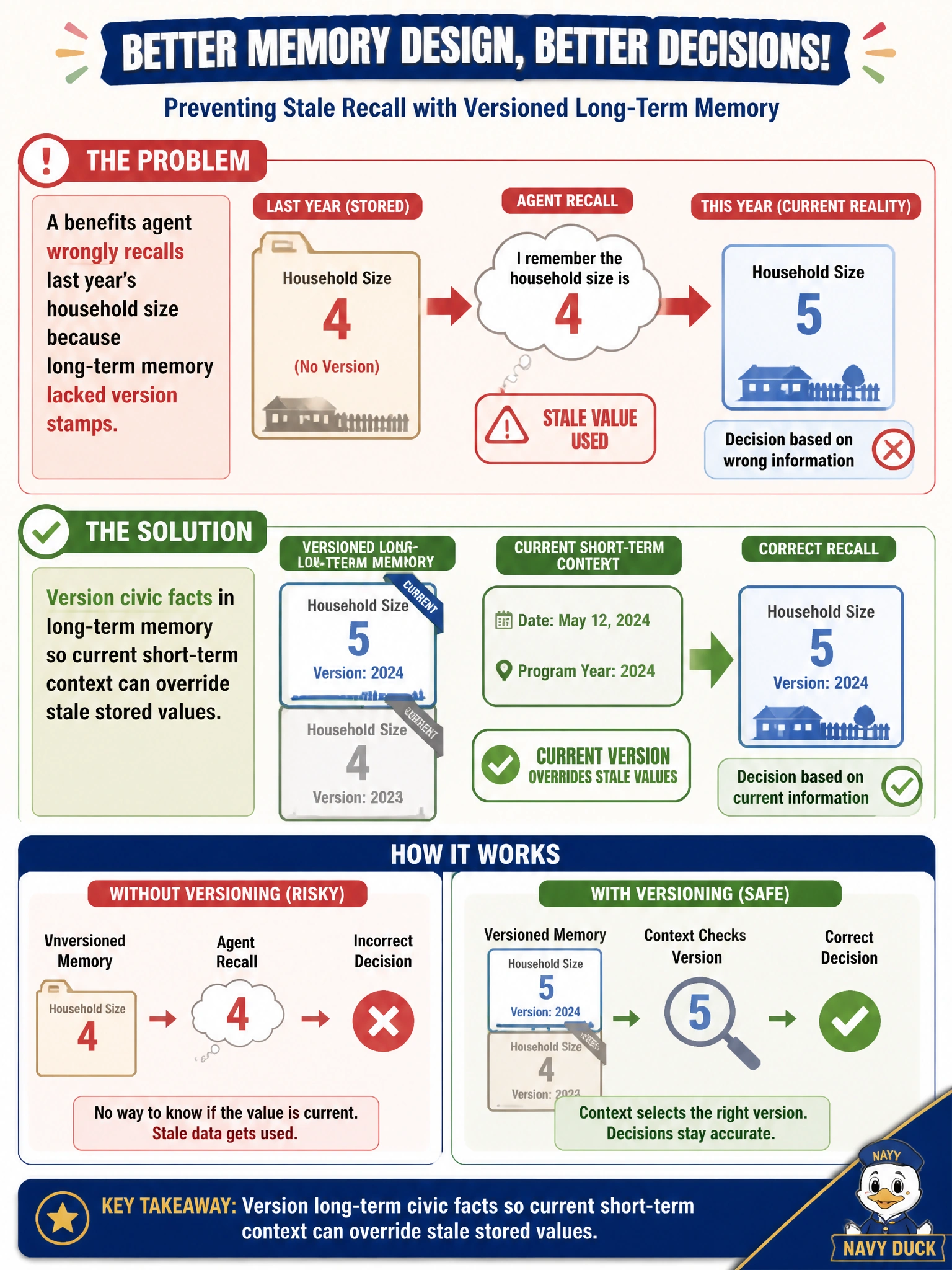
A benefits agent wrongly recalls last year's household size because long-term memory lacked version stamps. What memory design change best prevents that class of error?
Select an answer to reveal the explanation.
Short Explanation
Think of last year’s household size as a stale sticky note. Version stamps let today’s intake override outdated long-term memory, so you don’t confidently recall the wrong family.
Full Explanation
The right design is to version civic facts in long-term memory and let newer short-term context override stale stored values. Treat household composition as a dated, versioned attribute: when the active interview or eligibility system provides a newer household size, it should supersede an undated long-term recall such as “family of four.” Version stamps, timestamps, or explicit precedence rules prevent silent regression to outdated municipal facts. Always preferring the oldest remembered household size fails because preserving historical continuity is precisely the error being addressed. Disabling short-term context and consulting only unversioned long-term memory removes the override channel that keeps determinations current. Randomly shuffling memory entries adds nondeterministic noise and encodes neither currency nor provenance. Exam caveat: stale-memory questions test provenance and override rules; look for versioning or explicit precedence of current context over undated long-term facts, not simply more memory. Practical check: seed long-term memory with household size=3 (v1) and size=5 (v2), then place household size=4 with a newer timestamp in short-term context. Confirm the agent uses size=4 for the determination; remove the short-term override and confirm it selects the highest version, not the oldest entry.