
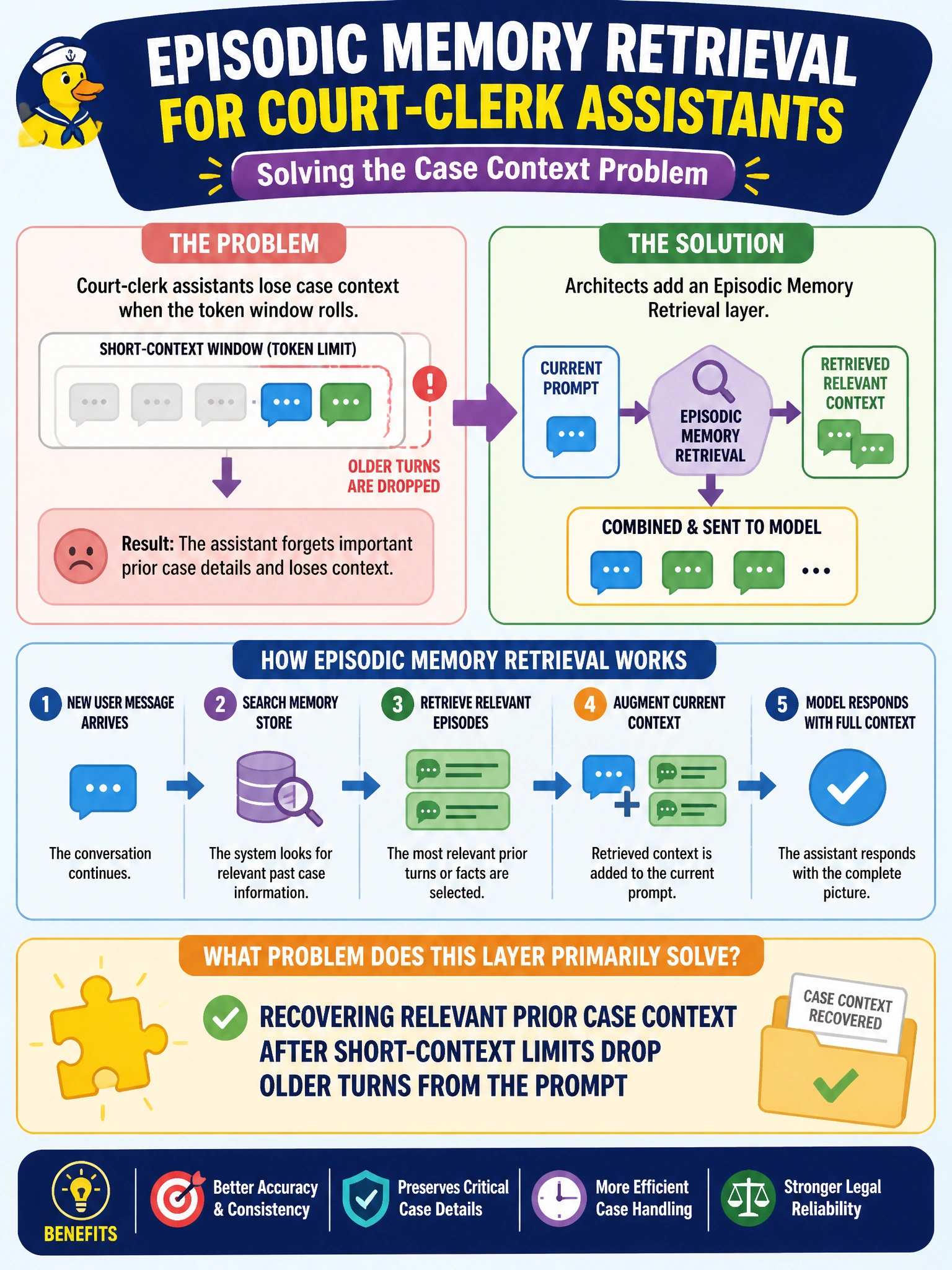
Court-clerk assistants lose case context when the token window rolls, so architects add episodic memory retrieval. What problem does that architectural layer primarily solve?
Select an answer to reveal the explanation.
Short Explanation
The chat window is a tiny desk—papers fall off the back. Episodic memory is the filing drawer the assistant can pull from when the desk fills up, so the case doesn't vanish mid-conversation.
Full Explanation
When court-clerk assistants lose case context as the token window rolls, episodic memory retrieval restores relevant prior case turns after short-context limits drop older messages from the prompt. That architectural layer solves continuity under finite context by fetching compact episode records keyed to the matter—parties, prior rulings discussed, outstanding clerk tasks—then injecting only what the current turn needs. It does not pretend the prompt is infinite; it compensates for a hard window with selective recall suited to multi-hearing municipal court work.
Eliminating case identifiers fails because retrieval still needs stable keys into clerk workflows and docket systems. Guaranteeing infinite prompt windows without retrieval fails by concept: production assistants retain finite context budgets regardless of model marketing claims. Replacing court records systems with unconstrained model parameters fails because authoritative case history lives in records systems and curated memory stores, not in weights that cannot be audited as a docket.
Exam caveat: episodic retrieval complements—not replaces—systems of record. The tested failure mode is prompt-window loss of dialogue/case-episode context, not wholesale CRM replacement.
Operational check: run a long clerk dialogue until early turns fall out of the window; ask a follow-up that depends on an early fact; confirm episodic retrieval injects that fact and the assistant answers correctly; disable retrieval and confirm the failure mode returns.